Green Tinkerbird

Green Tinkerbird

Pogoniulus simplex

Silhouette: PhyloPic

LCLeast ConcernNTVUENCR
Daily sighting probability <5% · Rare
at Bwindi Impenetrable National Park

In 3 days <5%

7 Verified sightings at Bwindi Impenetrable National Park From 2019 to 2026
18 In all 2 parks
April Best month
☀️ Diurnal When it's spotted

About the Green Tinkerbird

The green tinkerbird (Pogoniulus simplex) is a species of bird in the African barbet family Lybiidae. It is found in East Africa (Kenya, Malawi, Mozambique, and Tanzania). The genus name Pogoniulus is a diminutive of the name Pogonias that had been introduced in 1811 by Johann Karl Wilhelm Illiger. Pogonias is from the Ancient Greek πωγωνιας/pōgōnias meaning "bearded". The specific simplex is from latin, meaning "simple", "plain".

Alternative English names for this species include "Eastern Green Tinkerbird," "Green Tinker Barbet," and "African Green Tinkerbird." In historical literature, it has been previously referred to as the "Little Green Barbet."

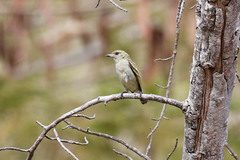
This species is monotypic. The Green Tinkerbird is a diminutive (approximately 11.5 cm, 8.8 g) and active olive-green barbet characterized by a lack of obvious facial markings, a short, two-toned bill with a black tip and yellow base, a conspicuous bright yellow rump, and two distinct yellow wing bars. In the field, this species exhibits a predominantly olive-green appearance with a paler gray-olive underside. The short, dagger-shaped bill is a key feature, along with the striking yellow rump... Wikipedia →

Sounds

Song0:35

Tanzania · 2019

© Peter Boesman · XC510362 · CC BY-NC-ND 4.0

Duet1:19

Kenya · 2025

© Louis A. Hansen · XC1062823 · CC BY-NC-SA 4.0

Call0:49

Mozambique · 2013

© Niall Perrins · XC185984 · CC BY-NC-SA 4.0

Global Distribution

Parks Where Found

# Park Country Daily sighting probability
1 Mikumi National Park 🇹🇿 Tanzania
<5%
2 Bwindi Impenetrable National Park 🇺🇬 Uganda
<5%

Before you go

What are the chances of seeing a Green Tinkerbird in Bwindi Impenetrable National Park?

Rare

Under 5% of wildlife watchers report a Green Tinkerbird sighting in Bwindi Impenetrable National Park on a given day, based on 7 verified sightings from GBIF citizen-science data from 2019 to 2026. It is the 354th most-seen of the 400 birds we can rate there. Over three days the chance rises to under 5%, if each day is a fresh chance.

When is the best time to see a Green Tinkerbird in Bwindi Impenetrable National Park?

Any time of year

In every month with enough records, under 5% of wildlife watchers report a Green Tinkerbird in Bwindi Impenetrable National Park on a given day, so our monthly data shows no clear season.

What time of day is best to see a Green Tinkerbird?

Between 10 am and 1 pm

Across all the parks we cover, that three-hour window holds the most Green Tinkerbird sightings with a recorded time, and about 8 in 10 of them come between 6 am and 6 pm: it is a daytime animal.

Is Bwindi Impenetrable National Park the best place to see a Green Tinkerbird?

Among the best

Of the 2 parks where we can rate Green Tinkerbird sightings, Bwindi Impenetrable National Park ranks 2nd at under 5%, level with the leaders once rounded. The best odds are in Mikumi National Park (Tanzania, under 5%).

Which relatives of the Green Tinkerbird live in Bwindi Impenetrable National Park?

Same genus: Pogoniulus

The closest relatives of the Green Tinkerbird that you can see in Bwindi Impenetrable National Park (genus Pogoniulus, Tinkerbirds) are Yellow-rumped Tinkerbird (about 50%), Speckled Tinkerbird (about 30%) and Western Tinkerbird (about 10%), with each one's daily chance of a sighting.

Where does the Green Tinkerbird sighting chance come from?

GBIF citizen-science records

It is estimated from how often the Green Tinkerbird is recorded against all the birds logged in Bwindi Impenetrable National Park (7 verified sightings from 2019 to 2026), calibrated against known sighting rates. Figures are rounded to the nearest 10% because citizen-science data supports honest approximations, not decimals, and months with records from fewer than five people show "—". How it works.

← Back to Bwindi Impenetrable National Park