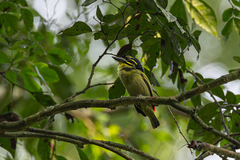
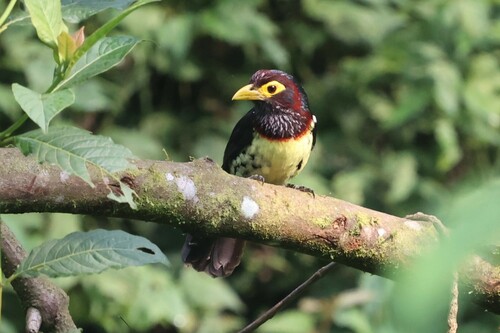
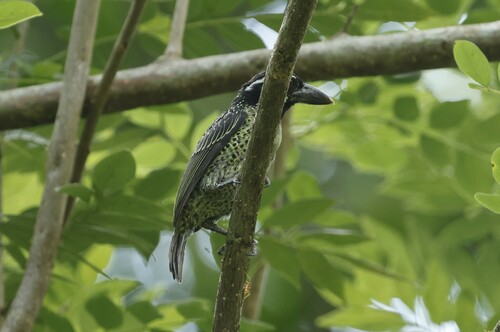
Red-rumped Tinkerbird

Red-rumped Tinkerbird

Pogoniulus atroflavus

Silhouette: PhyloPic

LCLeast ConcernNTVUENCR
Daily sighting probability <5% · Rare
at Bwindi Impenetrable National Park

In 3 days <5%

13 Verified sightings at Bwindi Impenetrable National Park From 2019 to 2026
148 In all 5 parks
October Best month
☀️ Diurnal When it's spotted

About the Red-rumped Tinkerbird

The red-rumped tinkerbird (Pogoniulus atroflavus) is a small bird species in the Lybiidae family. It is widely distributed across the tropical rainforests of mid-western Africa. This species is monotypic, with no recognized subspecies. Measuring approximately 12–13 cm in length and weighing 14–21.5 g, the Red-rumped Tinkerbird is noted for its distinct coloration—a yellow chest, black head and back, and red lower back or rump that gives the species its name. The wings are black with yellow-tipped feathers, and younger birds tend to display duller plumage with a yellowish bill.

The species is closely related to other members of the genus Pogoniulus, including P. bilineatus, P. pusillus, and P. chrysoconus. The Red-rumped Tinkerbird lives in mangrove forests, forest clearings, plantations, and grasslands. Red Rumped birds are typically found at elevations below 800 m, however in certain parts of West Africa, they can be found at up to 1,550 m of elevation. The species is distributed throughout mid-west Africa, where it occupies tropical and subtropical forested regions, and is lower rank on the food chain. Wikipedia →

Sounds

Call0:40

Ghana · 2022

© Peter Boesman · XC719418 · CC BY-NC-ND 4.0

Song0:14

Ghana · 2001

© Nature sounds by Simply Birding · XC648711 · CC BY-NC-ND 4.0

Uncertain0:18

Gabon · 2021

© BurBenj · XC671686 · CC BY-NC-SA 4.0

Global Distribution

Parks Where Found

# Park Country Daily sighting probability
1 Odzala-Kokoua National Park 🇨🇬 Republic of the Congo
~30%
2 Semuliki National Park 🇺🇬 Uganda
~30%
3 Taï National Park 🇨🇮 Ivory Coast
~10%
4 Bwindi Impenetrable National Park 🇺🇬 Uganda
<5%
5 Queen Elizabeth National Park 🇺🇬 Uganda
<5%

Before you go

What are the chances of seeing a Red-rumped Tinkerbird in Bwindi Impenetrable National Park?

Rare

Under 5% of wildlife watchers report a Red-rumped Tinkerbird sighting in Bwindi Impenetrable National Park on a given day, based on 13 verified sightings from GBIF citizen-science data from 2019 to 2026. It is the 313th most-seen of the 400 birds we can rate there. Over three days the chance rises to under 5%, if each day is a fresh chance.

When is the best time to see a Red-rumped Tinkerbird in Bwindi Impenetrable National Park?

Any time of year

In every month with enough records, under 5% of wildlife watchers report a Red-rumped Tinkerbird in Bwindi Impenetrable National Park on a given day, so our monthly data shows no clear season.

What time of day is best to see a Red-rumped Tinkerbird?

Between 7 and 10 am

Across all the parks we cover, that three-hour window holds the most Red-rumped Tinkerbird sightings with a recorded time, and about 9 in 10 of them come between 6 am and 6 pm: it is a daytime animal.

Is Bwindi Impenetrable National Park the best place to see a Red-rumped Tinkerbird?

4th of 5

Of the 5 parks where we can rate Red-rumped Tinkerbird sightings, Bwindi Impenetrable National Park ranks 4th at under 5%. The best odds are in Odzala-Kokoua National Park (Republic of the Congo, about 30%), Semuliki National Park (Uganda, about 30%) and Taï National Park (Ivory Coast, about 10%).

Which relatives of the Red-rumped Tinkerbird live in Bwindi Impenetrable National Park?

Same genus: Pogoniulus

The closest relatives of the Red-rumped Tinkerbird that you can see in Bwindi Impenetrable National Park (genus Pogoniulus, Tinkerbirds) are Yellow-rumped Tinkerbird (about 50%), Speckled Tinkerbird (about 30%) and Western Tinkerbird (about 10%), with each one's daily chance of a sighting.

Where does the Red-rumped Tinkerbird sighting chance come from?

GBIF citizen-science records

It is estimated from how often the Red-rumped Tinkerbird is recorded against all the birds logged in Bwindi Impenetrable National Park (13 verified sightings from 2019 to 2026), calibrated against known sighting rates. Figures are rounded to the nearest 10% because citizen-science data supports honest approximations, not decimals, and months with records from fewer than five people show "—". How it works.

← Back to Bwindi Impenetrable National Park