Diamond Stingray

Diamond Stingray

Hypanus dipterurus

Silhouette: Eloisa Pinheiro Giareta · PhyloPic

Daily sighting probability ~50% · Likely
at Cabo Pulmo National Park

In 3 days ~90% in a week >90%

19 Verified sightings at Cabo Pulmo National Park From 2019 to 2026
316 In all 2 parks
February Best month
☀️ Diurnal When it's spotted

About the Diamond Stingray

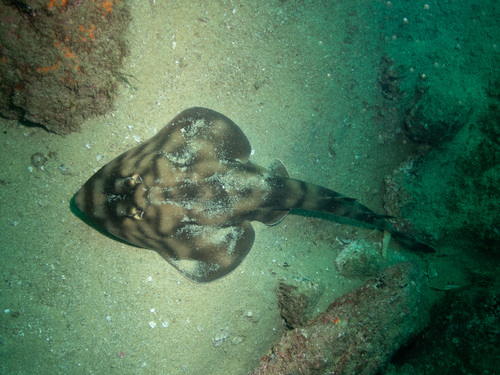
The diamond stingray (Hypanus dipterurus) is a species of stingray in the family Dasyatidae. It is found in the coastal waters of the eastern Pacific Ocean from southern California to northern Chile, and around the Galápagos and Hawaiian Islands. This bottom-dweller generally inhabits sandy or muddy flats near rocky reefs and kelp forests, to a depth of 30 m (98 ft), though off Hawaii it may range considerably deeper. As its common name suggests, this species has an angular, diamond-shaped pectoral fin disc that is plain brown or gray above, with rows of tubercles along the midline and on the "shoulders". The long, whip-like tail has both dorsal and ventral fin folds, which distinguish this ray from the closely similar longtail stingray (H. longa). It typically grows to 1 m (3.3 ft) across.

When searching for food, diamond stingrays may form groups of up to hundreds of individuals. It is most active at night and preys mainly on burrowing invertebrates and small bony fishes, which are extracted from the bottom via suction or digging. This species is aplacental viviparous: once the embryos exhaust their yolk supply, they are nourished by histotroph ("uterine milk") produced by the mother. Females bear 1–4 pups every summer in estuaries; mating is followed by a ten-month period of either sperm storage or arrested embryonic development, after which the embryos rapidly mature over 2–3 months. The slowest-growing stingray known, this species is not resilient against fishing pressure. It is caught for food by artisanal fishers in Latin America, particularly in Mexico where it is one of the most economically important rays. This is assessed as Vulnerable by the International Union for Conservation of Nature (IUCN). Though innocuous towards humans, the diamond stingray's long, venomous tail spine is potentially dangerous. Wikipedia →

Global Distribution

Parks Where Found

# Park Country Daily sighting probability
1 Galápagos Islands 🇪🇨 Ecuador
~60%
2 Cabo Pulmo National Park 🇲🇽 Mexico
~50%

Zoos & Centres Where Found

# Zoo / Centre Country
1 SeaWorld San Diego 🇺🇸 United States In captivity
2 Six Flags Discovery Kingdom 🇺🇸 United States In captivity
3 Birch Aquarium 🇺🇸 United States In captivity
4 Sea Life Aquarium 🇺🇸 United States In captivity

Before you go

What are the chances of seeing a Diamond Stingray in Cabo Pulmo National Park?

Likely

About 50% of wildlife watchers report a Diamond Stingray sighting in Cabo Pulmo National Park on a given day, based on 19 verified sightings from GBIF citizen-science data from 2019 to 2026. It is the 2nd most-seen of the 5 sharks and rays we can rate there. Over three days the chance rises to about 90%, and over a week to over 90%, if each day is a fresh chance.

When is the best time to see a Diamond Stingray in Cabo Pulmo National Park?

February and June

In those months about 80% of wildlife watchers report a Diamond Stingray in Cabo Pulmo National Park on a given day, against about 20% in April, the lowest month. Those are among Cabo Pulmo National Park's driest months, with about 10 mm of rain a month against 120 mm in September. July has too few records to rate.

What time of day is best to see a Diamond Stingray?

Between 9 am and noon

Across all the parks we cover, that three-hour window holds the most Diamond Stingray sightings with a recorded time, and about 8 in 10 of them come between 6 am and 6 pm: it is a daytime animal.

Is Cabo Pulmo National Park the best place to see a Diamond Stingray?

2nd of 2

Of the 2 parks where we can rate Diamond Stingray sightings, Cabo Pulmo National Park ranks 2nd at about 50%. The best odds are in Galápagos Islands (Ecuador, about 60%).

Where does the Diamond Stingray sighting chance come from?

GBIF citizen-science records

It is estimated from how often the Diamond Stingray is recorded against all the sharks and rays logged in Cabo Pulmo National Park (19 verified sightings from 2019 to 2026), calibrated against known sighting rates. Figures are rounded to the nearest 10% because citizen-science data supports honest approximations, not decimals, and months with records from fewer than five people show "—". How it works.

← Back to Cabo Pulmo National Park