Serrated Casquehead Iguana

Serrated Casquehead Iguana

Laemanctus serratus

Silhouette: Jose Carlos Arenas-Monroy · PhyloPic

LCLeast ConcernNTVUENCR
Daily sighting probability ~10% · With luck
at Calakmul Biosphere Reserve

In 3 days ~30% in a week ~60%

8 Verified sightings at Calakmul Biosphere Reserve From 2019 to 2026
13 In all 2 parks
August Best month
☀️🌙 Day & Night When it's spotted

About the Serrated Casquehead Iguana

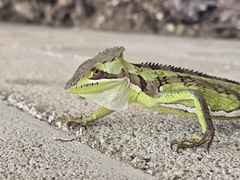
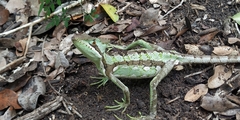
Laemanctus serratus, also known commonly as the serrated casquehead iguana, is a species of lizard in the family Corytophanidae. The species is native to southeastern Mexico and Central America. There are two recognized subspecies.

Laemanctus serratus is found in the Mexican states of Campeche, Chiapas, Hidalgo, Oaxaca, Puebla, Querétaro, Quintana Roo, San Luis Potosí, Tamaulipas, Veracruz, and Yucatán, and also in the countries of Belize, Guatemala, and Honduras.

The preferred natural habitat of Laemanctus serratus is forest Laemanctus serratus has enlarged triangular scales along the posterior margin of the head casque, and a serrated middorsal crest. Laemanctus serratus is diurnal and arboreal.

Laemanctus serratus is oviparous. Two subspecies are recognized as being valid, including the nominotypical subspecies. Laemanctus serratus alticoronatus Cope, 1866 Laemanctus serratus serratus Cope, 1864 Cope ED (1864). "Contributions to the Herpetology of Tropical America". Proceedings of the Academy of Natural Sciences of Philadelphia [16]: 166... Wikipedia →

Global Distribution

Parks Where Found

# Park Country Daily sighting probability
1 Calakmul Biosphere Reserve 🇲🇽 Mexico
~10%
2 Ría Lagartos Biosphere Reserve 🇲🇽 Mexico
~10%

Zoos & Centres Where Found

# Zoo / Centre Country
1 San Diego Zoo 🇺🇸 United States In captivity
2 Chester Zoo 🇬🇧 United Kingdom In captivity
3 Faunia 🇪🇸 Spain In captivity

Before you go

What are the chances of seeing a Serrated Casquehead Iguana in Calakmul Biosphere Reserve?

With luck

About 10% of wildlife watchers report a Serrated Casquehead Iguana sighting in Calakmul Biosphere Reserve on a given day, based on 8 verified sightings from GBIF citizen-science data from 2019 to 2026. It is the 26th most-seen of the 46 reptiles we can rate there. Over three days the chance rises to about 30%, and over a week to about 60%, if each day is a fresh chance.

When is the best time to see a Serrated Casquehead Iguana in Calakmul Biosphere Reserve?

August

In that month about 30% of wildlife watchers report a Serrated Casquehead Iguana in Calakmul Biosphere Reserve on a given day, against under 5% in September to April, the lowest months.

What time of day is best to see a Serrated Casquehead Iguana?

Between 9 am and noon

Across all the parks we cover, that three-hour window holds the most Serrated Casquehead Iguana sightings with a recorded time, and about 6 in 10 of them come between 6 am and 6 pm: it is seen both by day and at night.

Is Calakmul Biosphere Reserve the best place to see a Serrated Casquehead Iguana?

Yes

Of the 2 parks where we can rate Serrated Casquehead Iguana sightings, Calakmul Biosphere Reserve has the highest daily chance: about 10%. Next come Ría Lagartos Biosphere Reserve (Mexico, about 10%).

Which relatives of the Serrated Casquehead Iguana live in Calakmul Biosphere Reserve?

Same family: Corytophanidae

The closest relatives of the Serrated Casquehead Iguana that you can see in Calakmul Biosphere Reserve (family Corytophanidae, Helmeted Lizards) are Brown Basilisk (about 40%), Helmeted Iguana (about 20%) and Hernandez’s Helmeted Basilisk (about 10%), with each one's daily chance of a sighting.

Where does the Serrated Casquehead Iguana sighting chance come from?

GBIF citizen-science records

It is estimated from how often the Serrated Casquehead Iguana is recorded against all the reptiles logged in Calakmul Biosphere Reserve (8 verified sightings from 2019 to 2026), calibrated against known sighting rates. Figures are rounded to the nearest 10% because citizen-science data supports honest approximations, not decimals, and months with records from fewer than five people show "—". How it works.

← Back to Calakmul Biosphere Reserve