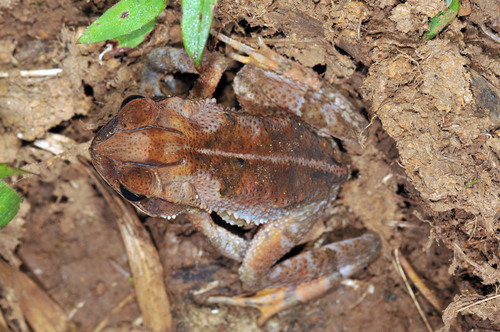
Dry Forest Toad

Dry Forest Toad

Incilius coccifer

Silhouette: Jose Carlos Arenas-Monroy · PhyloPic

LCLeast ConcernNTVUENCR
Daily sighting probability ~10% · With luck
at Carara National Park

In 3 days ~30% in a week ~50%

9 Verified sightings at Carara National Park From 2019 to 2026
33 In all 3 parks
September Best month
🌅 Crepuscular When it's spotted

About the Dry Forest Toad

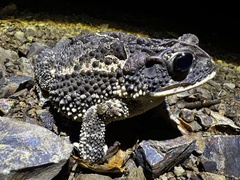
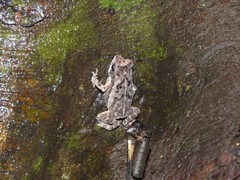
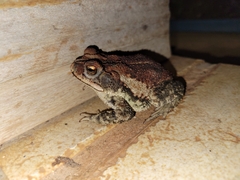
Incilius coccifer (common name: southern round-gland toad or southern roundgland toad) is a species of toad in the family Bufonidae. It is found in southern Mexico and southeastward in the Central America through Guatemala, El Salvador, Honduras, and Nicaragua to northwestern Costa Rica. Several species that were formerly included in this species have been named as distinct species: Incilius porteri, Incilius ibarrai, Incilius pisinnus, and Incilius signifer. Its natural habitats are lowland dry and moist forests, and it occurs also in disturbed areas such as pastures, roadside ditches, gardens, and vacant lots in urban areas. It is an abundant and widespread species that is not facing significant threats. Wikipedia →

Sounds

Recording0:20

El Salvador · 2015

© Carlos Peña · iNaturalist · CC BY-NC 4.0

Recording0:15

Costa Rica · 2024

© María Rebeca Álvarez Ramirez. · iNaturalist · CC BY-NC 4.0

Recording0:19

Costa Rica · 2026

© Kattya Castro Del Valle · iNaturalist · CC BY-NC 4.0

Global Distribution

Parks Where Found

# Park Country Daily sighting probability
1 Santa Rosa National Park 🇨🇷 Costa Rica
~30%
2 Ostional Wildlife Refuge 🇨🇷 Costa Rica
~20%
3 Carara National Park 🇨🇷 Costa Rica
~10%

Cities Where Found

# City Country Daily sighting probability
1 San José 🇨🇷 Costa Rica
~10%

Before you go

What are the chances of seeing a Dry Forest Toad in Carara National Park?

With luck

About 10% of wildlife watchers report a Dry Forest Toad sighting in Carara National Park on a given day, based on 9 verified sightings from GBIF citizen-science data from 2019 to 2026. It is the 17th most-seen of the 22 amphibians we can rate there. Over three days the chance rises to about 30%, and over a week to about 50%, if each day is a fresh chance.

When is the best time to see a Dry Forest Toad in Carara National Park?

September

In that month about 40% of wildlife watchers report a Dry Forest Toad in Carara National Park on a given day, against under 5% in July, October and December–May, the lowest months. That is one of Carara National Park's wettest months, with about 590 mm of rain against 35 mm in February.

What time of day is best to see a Dry Forest Toad?

Between 6 and 9 pm

Across all the parks we cover, that three-hour window holds the most Dry Forest Toad sightings with a recorded time, and about 7 in 10 of them come between 6 pm and 6 am: it is most active around dawn and dusk.

Is Carara National Park the best place to see a Dry Forest Toad?

3rd of 3

Of the 3 parks where we can rate Dry Forest Toad sightings, Carara National Park ranks 3rd at about 10%. The best odds are in Santa Rosa National Park (Costa Rica, about 30%) and Ostional Wildlife Refuge (Costa Rica, about 20%).

Which relatives of the Dry Forest Toad live in Carara National Park?

Same genus: Incilius

The closest relatives of the Dry Forest Toad that you can see in Carara National Park (genus Incilius, Central American Toads) are Rainforest Toad (about 20%) and Yellow Toad (about 10%), with each one's daily chance of a sighting.

Where does the Dry Forest Toad sighting chance come from?

GBIF citizen-science records

It is estimated from how often the Dry Forest Toad is recorded against all the amphibians logged in Carara National Park (9 verified sightings from 2019 to 2026), calibrated against known sighting rates. Figures are rounded to the nearest 10% because citizen-science data supports honest approximations, not decimals, and months with records from fewer than five people show "—". How it works.

← Back to Carara National Park