
Harlequin Treefrog

Harlequin Treefrog

Dendropsophus ebraccatus

Silhouette: Dmitry Bogdanov (vectorized by T. Michael Keesey) · PhyloPic

LCLeast ConcernNTVUENCR
Daily sighting probability ~30% · Possible
at Carara National Park

In 3 days ~70% in a week ~90%

97 Verified sightings at Carara National Park From 2019 to 2026
807 In all 14 parks
June Best month
🌙 Nocturnal When it's spotted

About the Harlequin Treefrog

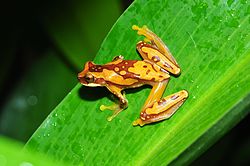
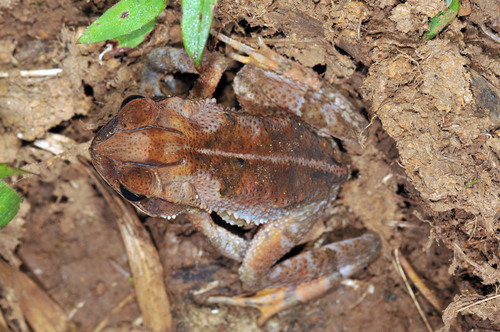
Dendropsophus ebraccatus, also known as the hourglass treefrog, referring to the golden-brown hourglass shape seen surrounded by skin yellow on its back. Their underbellies are yellow. Their arms and lower legs usually display bold patterns while their upper legs or thighs are light yellow giving them the appearance of wearing no pants. The species name "ebraccata" translates to "without trousers" in Latin.

The hourglass treefrog is throughout Mexico from southern Veracruz and northern Oaxaca, slightly more southern in Chiapas, Tabasco, and the Yucatán Peninsula. The hourglass treefrog also presides south of Mexico in the northern Guatemala and Belize areas. The range of the hourglass treefrog becomes more scarce in Honduras and a few more known locations in Nicaragua, but then has been commonly reported again in Central America spanning from Costa Rica to Panama even venturing into Colombia and northwestern Ecuador.

Dendropsophus ebraccatus is a member of the wide-ranging tree frog family Hylidae and the genus Dendropsophus. Dendropsophus is a group of small, primarily yellow tree frogs found throughout Central and South America. A unique feature of the genus is that... Wikipedia →

Sounds

Recording1:23

Colombia · 2025

© Fabrice Schmitt · XC1005829 · CC BY-NC-SA 4.0

Advertisement call0:24

Costa Rica · 2023

© Chris Harrison · XC893967 · CC BY-NC-SA 4.0

Recording0:13

Panama · 2021

© Emily Hjalmarson · iNaturalist · CC BY-NC 4.0

Global Distribution

Parks Where Found

# Park Country Daily sighting probability
1 Arenal Volcano National Park 🇨🇷 Costa Rica
~40%
2 Tenorio Volcano National Park 🇨🇷 Costa Rica
~40%
3 Carara National Park 🇨🇷 Costa Rica
~30%
4 Gandoca-Manzanillo Wildlife Refuge 🇨🇷 Costa Rica
~30%
5 Piedras Blancas National Park 🇨🇷 Costa Rica
~30%
6 Braulio Carrillo National Park 🇨🇷 Costa Rica
~30%
7 Soberanía National Park 🇵🇦 Panama
~30%
8 Bastimentos Island National Marine Park 🇵🇦 Panama
~20%
9 Manuel Antonio National Park 🇨🇷 Costa Rica
~20%
10 Cahuita National Park 🇨🇷 Costa Rica
~20%
11 La Amistad International Park (Panama) 🇵🇦 Panama
~10%
12 Corcovado National Park 🇨🇷 Costa Rica
~10%
13 Tortuguero National Park 🇨🇷 Costa Rica
~10%
14 Calakmul Biosphere Reserve 🇲🇽 Mexico
~10%

Zoos & Centres Where Found

# Zoo / Centre Country
1 Monteverde Theme Park 🇨🇷 Costa Rica In captivity

Before you go

What are the chances of seeing a Harlequin Treefrog in Carara National Park?

Possible

About 30% of wildlife watchers report a Harlequin Treefrog sighting in Carara National Park on a given day, based on 97 verified sightings from GBIF citizen-science data from 2019 to 2026. It is the 3rd most-seen of the 22 amphibians we can rate there. Over three days the chance rises to about 70%, and over a week to about 90%, if each day is a fresh chance.

When is the best time to see a Harlequin Treefrog in Carara National Park?

June and November

In those months about 50% of wildlife watchers report a Harlequin Treefrog in Carara National Park on a given day, against under 5% in September, the lowest month. Those are among Carara National Park's wettest months, with about 540 mm of rain a month against 35 mm in February.

What time of day is best to see a Harlequin Treefrog?

Between 7 and 10 pm

Across all the parks we cover, that three-hour window holds the most Harlequin Treefrog sightings with a recorded time, and about 9 in 10 of them come between 6 pm and 6 am: it is mostly seen at night.

Is Carara National Park the best place to see a Harlequin Treefrog?

3rd of 14

Of the 14 parks where we can rate Harlequin Treefrog sightings, Carara National Park ranks 3rd at about 30%. The best odds are in Arenal Volcano National Park (Costa Rica, about 40%) and Tenorio Volcano National Park (Costa Rica, about 40%).

Where does the Harlequin Treefrog sighting chance come from?

GBIF citizen-science records

It is estimated from how often the Harlequin Treefrog is recorded against all the amphibians logged in Carara National Park (97 verified sightings from 2019 to 2026), calibrated against known sighting rates. Figures are rounded to the nearest 10% because citizen-science data supports honest approximations, not decimals, and months with records from fewer than five people show "—". How it works.

← Back to Carara National Park