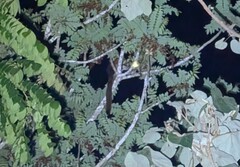
Indian Giant Flying Squirrel

Indian Giant Flying Squirrel

Petaurista philippensis

Silhouette: CBG Photography Group, Centre for Biodiversity Genomics (photograph) · PhyloPic

LCLeast ConcernNTVUENCR
Daily sighting probability ~30% · Possible
at Cat Tien National Park

In 3 days ~60% in a week ~90%

25 Verified sightings at Cat Tien National Park From 2019 to 2026
32 In all 2 parks
August Best month
☀️ Diurnal When it's spotted

About the Indian Giant Flying Squirrel

The Indian giant flying squirrel (Petaurista philippensis), also called the large brown flying squirrel or the common giant flying squirrel, is a species of rodent in the family Sciuridae. It is capable of gliding flight using a skin membrane, the patagium, stretched between front and hind legs. It is found in mainland Southeast and South Asia, and southern and central China.

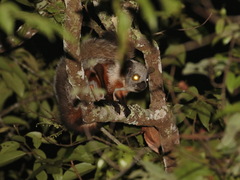
This is a large species, with a head and body length of about 43 cm and a tail of 50–52 cm. It has black to gray-brown fur, long and soft on the upper parts and somewhat shorter underneath the body, with a grizzled appearance. A wing membrane between the forelimb and hindlimb, paler coloured underneath, allows gliding between trees. The tail is hairy and blackish to gray-brown, the feet are black, and the nose is pale pink with black vibrissae.

Its taxonomy is very complex and not fully resolved. Up until the 1980s, some authorities even listed the Indian giant flying squirrel itself as a subspecies of the red giant flying squirrel (P. petaurista). In 2005, Mammal Species of the World included grandis, yunanensis, hainana, nigra, rubicundus and rufipes (last four as synonyms of... Wikipedia →

Sounds

Recording0:19

India · 2021

© Aravind_PS · iNaturalist · CC BY-NC 4.0

Recording0:03

Thailand · 2026

© Zac Peterson · iNaturalist · CC BY 4.0

Global Distribution

Parks Where Found

# Park Country Daily sighting probability
1 Cat Tien National Park 🇻🇳 Vietnam
~30%
2 Kanha National Park 🇮🇳 India
~20%

Before you go

What are the chances of seeing an Indian Giant Flying Squirrel in Cat Tien National Park?

Possible

About 30% of wildlife watchers report an Indian Giant Flying Squirrel sighting in Cat Tien National Park on a given day, based on 25 verified sightings from GBIF citizen-science data from 2019 to 2026. It is the 15th most-seen of the 28 mammals we can rate there. Over three days the chance rises to about 60%, and over a week to about 90%, if each day is a fresh chance.

When is the best time to see an Indian Giant Flying Squirrel in Cat Tien National Park?

August

In that month about 50% of wildlife watchers report an Indian Giant Flying Squirrel in Cat Tien National Park on a given day, against under 5% in January and October, the lowest months. That is one of Cat Tien National Park's wettest months, with about 470 mm of rain against 15 mm in February.

What time of day is best to see an Indian Giant Flying Squirrel?

Between 1 and 4 pm

Across all the parks we cover, that three-hour window holds the most Indian Giant Flying Squirrel sightings with a recorded time, and about 9 in 10 of them come between 6 am and 6 pm: it is a daytime animal.

Is Cat Tien National Park the best place to see an Indian Giant Flying Squirrel?

Yes

Of the 2 parks where we can rate Indian Giant Flying Squirrel sightings, Cat Tien National Park has the highest daily chance: about 30%. Next come Kanha National Park (India, about 20%).

Which relatives of the Indian Giant Flying Squirrel live in Cat Tien National Park?

Same family: Sciuridae

The closest relatives of the Indian Giant Flying Squirrel that you can see in Cat Tien National Park (family Sciuridae, Squirrels) are Pallas's Squirrel (about 60%), Cambodian Striped Squirrel (about 40%) and Indochinese Ground Squirrel (about 40%), with each one's daily chance of a sighting.

Where does the Indian Giant Flying Squirrel sighting chance come from?

GBIF citizen-science records

It is estimated from how often the Indian Giant Flying Squirrel is recorded against all the mammals logged in Cat Tien National Park (25 verified sightings from 2019 to 2026), calibrated against known sighting rates. Figures are rounded to the nearest 10% because citizen-science data supports honest approximations, not decimals, and months with records from fewer than five people show "—". How it works.

← Back to Cat Tien National Park