Orange-necked Hill Partridge

Orange-necked Hill Partridge

Arborophila davidi

Silhouette: PhyloPic

LCNTNear ThreatenedVUENCR
Daily sighting probability ~10% · With luck
at Cat Tien National Park

In 3 days ~20% in a week ~40%

107 Verified sightings at Cat Tien National Park From 2019 to 2026
107 In 1 park
May Best month
☀️ Diurnal When it's spotted

About the Orange-necked Hill Partridge

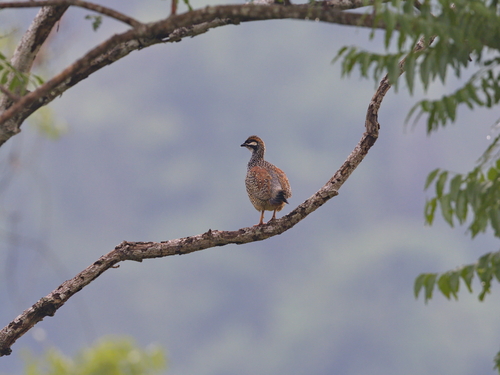
The orange-necked partridge (Arborophila davidi) is a species of bird in the family Phasianidae. It is found in eastern Cambodia and southern Vietnam. Its habitats are lowland forests, shrubland, and plantations. It was described in 1927 and rediscovered in 1991. It is threatened by habitat loss, and the International Union for Conservation of Nature (IUCN) has assessed it as a near-threatened species.

This species was described by Jean Théodore Delacour in 1927. The specific name is derived from André David-Beaulieu, a French colonial administrator who collected the type specimen earlier in 1927. There are no subspecies.

The orange-necked partridge is about 27 cm (11 in) long and weighs about 241 g (8.5 oz). The forehead and crown are dusky, and the nape is mottled brown. A black band extends from the beak to the sides of the neck, and a whitish band extends from the eye to the neck-sides, becoming orange. There is also a black breast-band. The chin is pale buff, and the throat is rusty-orange. The breast is olive-brown, and the belly is greyish and whitish. The flanks have black and white scallops. The back and rump are olive-brown, with dark brown... Wikipedia →

Sounds

Song0:16

Vietnam · 2026

© Ding Li Yong · XC1107435 · CC BY-NC-ND 4.0

Duet0:26

Vietnam · 2023

© Brian Cox · XC799467 · CC BY-NC-SA 4.0

Call0:08

Vietnam · 2020

© Toby Trung · XC531873 · CC BY-NC-SA 4.0

Global Distribution

Parks Where Found

# Park Country Daily sighting probability
1 Cat Tien National Park 🇻🇳 Vietnam
~10%

More parks will be added in future updates.

Before you go

What are the chances of seeing an Orange-necked Hill Partridge in Cat Tien National Park?

With luck

About 10% of wildlife watchers report an Orange-necked Hill Partridge sighting in Cat Tien National Park on a given day, based on 107 verified sightings from GBIF citizen-science data from 2019 to 2026. It is the 140th most-seen of the 244 birds we can rate there. Over three days the chance rises to about 20%, and over a week to about 40%, if each day is a fresh chance.

When is the best time to see an Orange-necked Hill Partridge in Cat Tien National Park?

April and May

In those months about 20% of wildlife watchers report an Orange-necked Hill Partridge in Cat Tien National Park on a given day, against under 5% in June to December, the lowest months.

What time of day is best to see an Orange-necked Hill Partridge?

Between 7 and 10 am

Across all the parks we cover, that three-hour window holds the most Orange-necked Hill Partridge sightings with a recorded time, and about 8 in 10 of them come between 6 am and 6 pm: it is a daytime animal.

Where else can you see an Orange-necked Hill Partridge?

Only Cat Tien National Park, in our data

Cat Tien National Park is the only park on Wallace's Line with enough records to rate Orange-necked Hill Partridge sightings: about 10% of wildlife watchers there report one on a given day.

Which relatives of the Orange-necked Hill Partridge live in Cat Tien National Park?

Same family: Phasianidae

The closest relatives of the Orange-necked Hill Partridge that you can see in Cat Tien National Park (family Phasianidae, Pheasants, Grouse, and Allies) are Red Junglefowl (about 50%), green-legged partridge (about 50%) and Germain's Peacock-Pheasant (about 40%), with each one's daily chance of a sighting.

Where does the Orange-necked Hill Partridge sighting chance come from?

GBIF citizen-science records

It is estimated from how often the Orange-necked Hill Partridge is recorded against all the birds logged in Cat Tien National Park (107 verified sightings from 2019 to 2026), calibrated against known sighting rates. Figures are rounded to the nearest 10% because citizen-science data supports honest approximations, not decimals, and months with records from fewer than five people show "—". How it works.

← Back to Cat Tien National Park