Siamese Rhinoceros Beetle

Siamese Rhinoceros Beetle

Xylotrupes socrates

Daily sighting probability ~10% · With luck
at Cat Tien National Park

In 3 days ~30% in a week ~60%

7 Verified sightings at Cat Tien National Park From 2019 to 2026
36 In all 4 parks
October Best month
☀️🌙 Day & Night When it's spotted

About the Siamese Rhinoceros Beetle

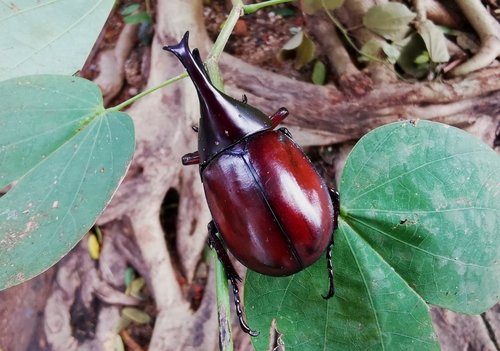
Xylotrupes socrates, commonly known as the Siamese rhinoceros beetle or fighting beetle (Thai: กว่างชน), is a species of large scarab beetle belonging to the subfamily Dynastinae. It is particularly known for its role in insect fighting in Thailand.

Like most dynastid beetles, the adult male of X. socrates possesses two horns: one on the head and another on the pronotum, both bifurcate and curling inward. Adult females lack these horns. Both sexes have dark chestnut-brown (in younger beetles) or black (in older beetles) exoskeletons and elytra.

The species is widespread in south-east Asian countries such as Bangladesh, Cambodia, China, India, Laos, Myanmar, Nepal, Thailand, and Vietnam. These beetles are used for staging beetle fights, a traditional form of entertainment popular in the northern region of Thailand. They are captured and trained to become stronger and more aggressive. In the fight the beetle that lifts its opponent up by its horns wins. A beetle may also win if his opponent crawls away, falls, or is overturned. Insect fighting is mostly practiced in the Chiang Mai and Nan provinces of Thailand. It is also popular... Wikipedia →
Global Distribution

Parks Where Found

# Park Country Daily sighting probability
1 Khao Yai National Park 🇹🇭 Thailand
~10%
2 Cat Tien National Park 🇻🇳 Vietnam
~10%
3 Khao Sok National Park 🇹🇭 Thailand
~10%
4 Kaeng Krachan National Park 🇹🇭 Thailand
~10%

Cities Where Found

# City Country Daily sighting probability
1 Xiamen City 🇨🇳 China
~10%
2 Tuen Mun 🇨🇳 China
~10%
3 Guangzhou 🇨🇳 China
~10%
4 Hong Kong 🇨🇳 China
~10%
5 Bangkok 🇹🇭 Thailand
<5%

Before you go

What are the chances of seeing a Siamese Rhinoceros Beetle in Cat Tien National Park?

With luck

About 10% of wildlife watchers report a Siamese Rhinoceros Beetle sighting in Cat Tien National Park on a given day, based on 7 verified sightings from GBIF citizen-science data from 2019 to 2026. It is the 87th most-seen of the 125 insects we can rate there. Over three days the chance rises to about 30%, and over a week to about 60%, if each day is a fresh chance.

When is the best time to see a Siamese Rhinoceros Beetle in Cat Tien National Park?

September and October

In those months about 30% of wildlife watchers report a Siamese Rhinoceros Beetle in Cat Tien National Park on a given day, against under 5% in May, July–August and November–March, the lowest months. Those are among Cat Tien National Park's wettest months, with about 380 mm of rain a month against 15 mm in February.

What time of day is best to see a Siamese Rhinoceros Beetle?

Between 7 and 10 am

Across all the parks we cover, that three-hour window holds the most Siamese Rhinoceros Beetle sightings with a recorded time, and about 6 in 10 of them come between 6 am and 6 pm: it is seen both by day and at night.

Is Cat Tien National Park the best place to see a Siamese Rhinoceros Beetle?

Among the best

Of the 4 parks where we can rate Siamese Rhinoceros Beetle sightings, Cat Tien National Park ranks 2nd at about 10%, level with the leaders once rounded. The best odds are in Khao Yai National Park (Thailand, about 10%).

Which relatives of the Siamese Rhinoceros Beetle live in Cat Tien National Park?

Same order: Coleoptera

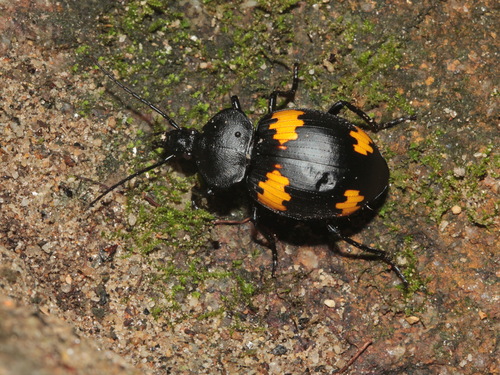
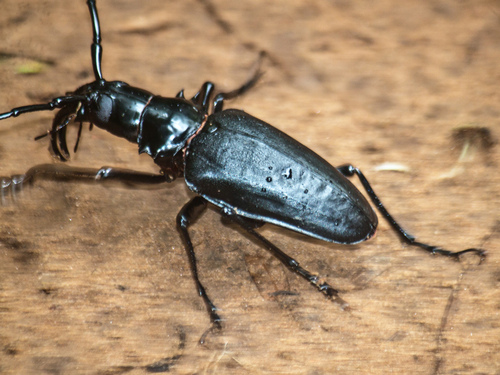
The closest relatives of the Siamese Rhinoceros Beetle that you can see in Cat Tien National Park (order Coleoptera, Beetles) are Craspedophorus sublaevis (about 20%), Sipalinus gigas (about 20%) and Dorysthenes walkeri (about 10%), with each one's daily chance of a sighting.

Where does the Siamese Rhinoceros Beetle sighting chance come from?

GBIF citizen-science records

It is estimated from how often the Siamese Rhinoceros Beetle is recorded against all the insects logged in Cat Tien National Park (7 verified sightings from 2019 to 2026), calibrated against known sighting rates. Figures are rounded to the nearest 10% because citizen-science data supports honest approximations, not decimals, and months with records from fewer than five people show "—". How it works.

← Back to Cat Tien National Park