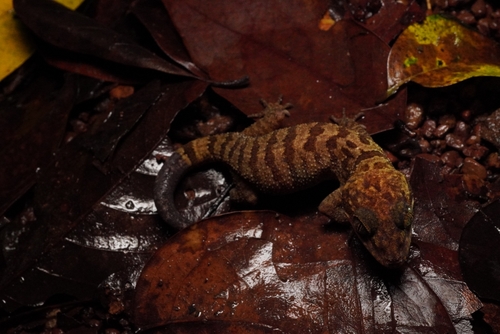
Spotted Forest Skink

Spotted Forest Skink

Sphenomorphus maculatus

Silhouette: Gopal Murali · PhyloPic

LCLeast ConcernNTVUENCR
Daily sighting probability ~50% · Likely
at Cat Tien National Park

In 3 days ~90% in a week >90%

96 Verified sightings at Cat Tien National Park From 2019 to 2026
433 In all 5 parks
October Best month
🌅 Crepuscular When it's spotted

About the Spotted Forest Skink

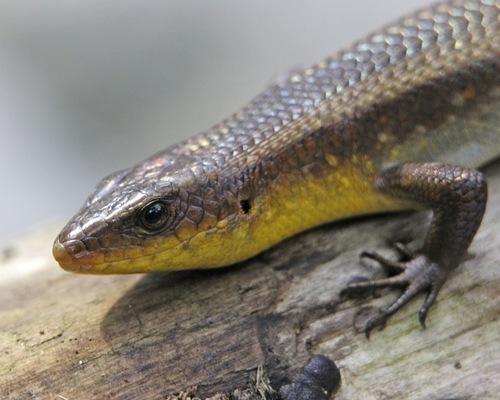
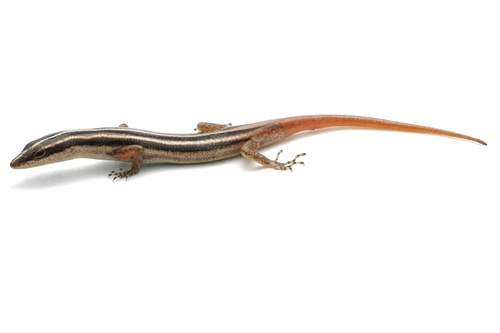
Sphenomorphus maculatus, the spotted forest skink, maculated forest skink or stream-side skink is a species of skink found in China, South Asia and Southeast Asia. Physical Structure: Head tapered and flat. Tail tapered and as long as two times of snout–vent length. Trunk and eyelid covered with scales. Scales on the back towards the tail larger. [1].

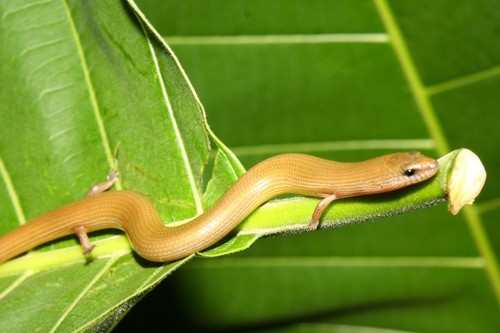
Color: Upper side of the head, body and tail is brown, with smooth scales, and faint darker markings. The throat and belly are pale and immaculate. On the flanks, beneath the dark stripe, a mottled zone comprising yellowish and brown spots.

Length: Maximum: 19 cm, Common: 17 cm(SVL. 6 cm) It is non-venomous and harmless to humans. Bangladesh, Bhutan, Cambodia, China (S Yunnan, SE Xizang = Tibet), India (Andaman and Nicobar Islands, Darjeeling), Malaysia, Myanmar, Nepal, Singapore, Sunda region (Brunei, Indonesia, Papua New Guinea, Timor-Leste), Thailand (Northern) and Vietnam.

Terrestrial; nocturnal; inhabits the vicinity of streams and small rivers in lowland and hilly areas. Found foraging among rocks and vegetation right at the waters edge. Feeds on small insects and invertebrates... Wikipedia →

Global Distribution

Parks Where Found

# Park Country Daily sighting probability
1 Khao Sok National Park 🇹🇭 Thailand
~70%
2 Cat Tien National Park 🇻🇳 Vietnam
~50%
3 Khao Yai National Park 🇹🇭 Thailand
~40%
4 Kaeng Krachan National Park 🇹🇭 Thailand
~30%
5 Doi Inthanon National Park 🇹🇭 Thailand
~20%

Before you go

What are the chances of seeing a Spotted Forest Skink in Cat Tien National Park?

Likely

About 50% of wildlife watchers report a Spotted Forest Skink sighting in Cat Tien National Park on a given day, based on 96 verified sightings from GBIF citizen-science data from 2019 to 2026. It is the 6th most-seen of the 45 reptiles we can rate there. Over three days the chance rises to about 90%, and over a week to over 90%, if each day is a fresh chance.

When is the best time to see a Spotted Forest Skink in Cat Tien National Park?

August and October

In those months about 60% of wildlife watchers report a Spotted Forest Skink in Cat Tien National Park on a given day, against about 40% in November, the lowest month. Those are among Cat Tien National Park's wettest months, with about 400 mm of rain a month against 15 mm in February.

What time of day is best to see a Spotted Forest Skink?

Between 4 and 7 am

Across all the parks we cover, that three-hour window holds the most Spotted Forest Skink sightings with a recorded time, and about half of them come between 6 pm and 6 am: it is most active around dawn and dusk.

Is Cat Tien National Park the best place to see a Spotted Forest Skink?

2nd of 5

Of the 5 parks where we can rate Spotted Forest Skink sightings, Cat Tien National Park ranks 2nd at about 50%. The best odds are in Khao Sok National Park (Thailand, about 70%). All parks ranked.

Which relatives of the Spotted Forest Skink live in Cat Tien National Park?

Same family: Scincidae

The closest relatives of the Spotted Forest Skink that you can see in Cat Tien National Park (family Scincidae, Skinks) are Many-lined Sun-skink (about 40%), Bronze Grass Skink (about 40%) and Common Striped Skink (about 20%), with each one's daily chance of a sighting.

Where does the Spotted Forest Skink sighting chance come from?

GBIF citizen-science records

It is estimated from how often the Spotted Forest Skink is recorded against all the reptiles logged in Cat Tien National Park (96 verified sightings from 2019 to 2026), calibrated against known sighting rates. Figures are rounded to the nearest 10% because citizen-science data supports honest approximations, not decimals, and months with records from fewer than five people show "—". How it works.

← Back to Cat Tien National Park