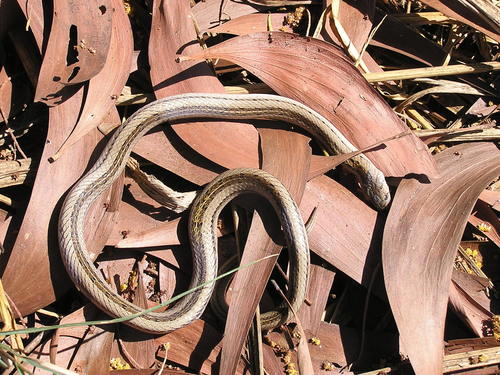
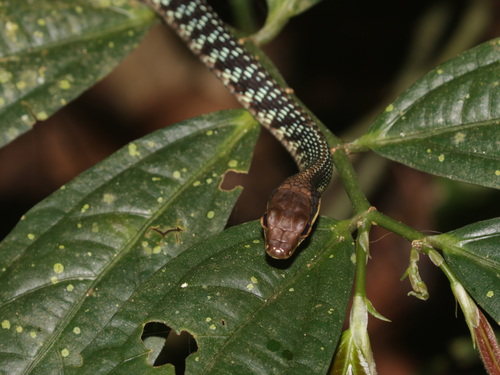
Yellow-Spotted Keelback

Yellow-Spotted Keelback

Fowlea flavipunctatus

Silhouette: Alex Slavenko · PhyloPic

Daily sighting probability ~20% · Possible
at Cat Tien National Park

In 3 days ~40% in a week ~70%

9 Verified sightings at Cat Tien National Park From 2019 to 2026
22 In all 2 parks
June Best month
☀️ Diurnal When it's spotted

About the Yellow-Spotted Keelback

The yellow-spotted keelback (Fowlea flavipunctata) is a species of colubrid snake found in Thailand, Myanmar, China, West Malaysia, Laos, Cambodia, Vietnam, and Bangladesh. Its type locality is: Island of Hong Kong (Hong Kong) and Canton River?, China.

IUCN includes Taiwan in the range of F. flavipunctata, but excludes Malaysia and Bangladesh. F. f. schnurrenbergeri of Nepal is now considered an independent species, Fowlea schnurrenbergeri. F. flavipunctata is a semiaquatic snake that occurs in slow rivers and streams, marshes, swamps, ponds, and lakes. It thrives also in wet human-modified habitats, including rice fields and ditches. It feeds on fish and frogs. It is diurnal.

F. flavipunctata is exploited in parts of its range to support snake farms and pigs and for use in snake wine. Hallowell, E.; 1861 "Report upon the Reptilia of the North Pacific Exploring Expedition, under command of Capt. John Rogers, U.S.N." Proc. Acad. Nat. Sci. Philadelphia 12 [1860]: 480 - 510 Wikipedia →

Global Distribution

Parks Where Found

# Park Country Daily sighting probability
1 Cat Tien National Park 🇻🇳 Vietnam
~20%
2 Khao Yai National Park 🇹🇭 Thailand
~20%

Cities Where Found

# City Country Daily sighting probability
1 Hanoi 🇻🇳 Vietnam
~40%
2 Xiuying District 🇨🇳 China
~30%
3 Guangzhou 🇨🇳 China
~20%
4 Ho Chi Minh City 🇻🇳 Vietnam
~20%
5 Taichung 🇹🇼 Taiwan
~10%
6 Tuen Mun 🇨🇳 China
~10%
7 Taipei 🇹🇼 Taiwan
~10%
8 Bangkok 🇹🇭 Thailand
~10%

Zoos & Centres Where Found

# Zoo / Centre Country
1 Dong Tam Snake Farm 🇻🇳 Vietnam In captivity
2 Siam Serpentarium 🇹🇭 Thailand In captivity
3 Snake Farm of Queen Saovabha Memorial Institute 🇹🇭 Thailand In captivity

Before you go

What are the chances of seeing a Yellow-Spotted Keelback in Cat Tien National Park?

Possible

About 20% of wildlife watchers report a Yellow-Spotted Keelback sighting in Cat Tien National Park on a given day, based on 9 verified sightings from GBIF citizen-science data from 2019 to 2026. It is the 34th most-seen of the 45 reptiles we can rate there. Over three days the chance rises to about 40%, and over a week to about 70%, if each day is a fresh chance.

When is the best time to see a Yellow-Spotted Keelback in Cat Tien National Park?

June

In that month about 40% of wildlife watchers report a Yellow-Spotted Keelback in Cat Tien National Park on a given day, against under 5% in July to May, the lowest months. That is one of Cat Tien National Park's wettest months, with about 340 mm of rain against 15 mm in February.

What time of day is best to see a Yellow-Spotted Keelback?

Between 1 and 4 pm

Across all the parks we cover, that three-hour window holds the most Yellow-Spotted Keelback sightings with a recorded time, and about 8 in 10 of them come between 6 am and 6 pm: it is a daytime animal.

Is Cat Tien National Park the best place to see a Yellow-Spotted Keelback?

Yes

Of the 2 parks where we can rate Yellow-Spotted Keelback sightings, Cat Tien National Park has the highest daily chance: about 20%. Next come Khao Yai National Park (Thailand, about 20%).

Which relatives of the Yellow-Spotted Keelback live in Cat Tien National Park?

Same family: Colubridae

The closest relatives of the Yellow-Spotted Keelback that you can see in Cat Tien National Park (family Colubridae, Colubrid Snakes) are Oriental Whipsnake (about 30%), Laotian Wolf Snake (about 30%) and Golden Tree Snake (about 20%), with each one's daily chance of a sighting.

Where does the Yellow-Spotted Keelback sighting chance come from?

GBIF citizen-science records

It is estimated from how often the Yellow-Spotted Keelback is recorded against all the reptiles logged in Cat Tien National Park (9 verified sightings from 2019 to 2026), calibrated against known sighting rates. Figures are rounded to the nearest 10% because citizen-science data supports honest approximations, not decimals, and months with records from fewer than five people show "—". How it works.

← Back to Cat Tien National Park