Black-vented Oriole

Black-vented Oriole

Icterus wagleri

Silhouette: Matt Wilkins · PhyloPic

LCLeast ConcernNTVUENCR
Daily sighting probability ~10% · With luck
at Celaque National Park

In 3 days ~30% in a week ~60%

40 Verified sightings at Celaque National Park From 2019 to 2026
123 In all 4 parks
October Best month
☀️ Diurnal When it's spotted

About the Black-vented Oriole

The black-vented oriole (Icterus wagleri) is a species of bird in the family Icteridae, the oropendolas, New World orioles, and New World blackbirds.. It is found in El Salvador, Guatemala, Honduras, Mexico, and Nicaragua and has reached the United States as a vagrant.

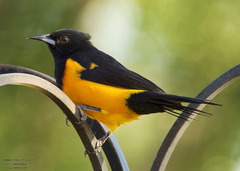
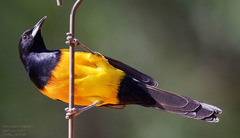
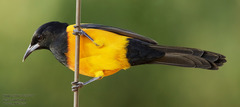
The black-vented oriole was formally described in 1857 with the binomial Icterus wagleri, which it has retained ever since. The black-vented oriole is 20.5 to 23 cm (8.1 to 9.1 in) long. Males weigh an average of about 41 g (1.4 oz) and females an average of 39 g (1.4 oz). Adult males of the nominate subspecies have a black head, throat, upper breast, mantle, back, rump, uppertail coverts, and tail. Their lowermost belly and undertail coverts are also black. Their wing is mostly black with orange-yellow lesser and median coverts that show as an epaulet on the closed wing. Their underparts have a tinge of chestnut just below the black breast and are otherwise orange-yellow. Adult females are duller overall than males and generally more yellow... Wikipedia →

Sounds

Call0:20

Guatemala · 2024

© Peter Boesman · XC880140 · CC BY-NC-ND 4.0

Song0:47

Mexico · 2022

© Manuel Grosselet · XC695988 · CC BY-NC-SA 4.0

Alarm call0:56

Mexico · 2015

© Jorge Daniel Ruiz Contreras · XC281896 · CC BY-NC-SA 4.0

Global Distribution

Parks Where Found

# Park Country Daily sighting probability
1 Celaque National Park 🇭🇳 Honduras
~10%
2 La Tigra National Park 🇭🇳 Honduras
~10%
3 Cañón del Sumidero National Park 🇲🇽 Mexico
<5%
4 Cumbres de Monterrey National Park 🇲🇽 Mexico
<5%

Cities Where Found

# City Country Daily sighting probability
1 Puebla 🇲🇽 México
~10%
2 Guatemala City 🇬🇹 Guatemala
~10%
3 Guadalajara 🇲🇽 México
<5%
4 Mexico City 🇲🇽 México
<5%
5 Tegucigalpa 🇭🇳 Honduras
<5%

Zoos & Centres Where Found

# Zoo / Centre Country
1 Berlin Zoological Garden 🇩🇪 Germany In captivity
2 Aquarium Berlin 🇩🇪 Germany In captivity

Before you go

What are the chances of seeing a Black-vented Oriole in Celaque National Park?

With luck

About 10% of wildlife watchers report a Black-vented Oriole sighting in Celaque National Park on a given day, based on 40 verified sightings from GBIF citizen-science data from 2019 to 2026. It is the 64th most-seen of the 193 birds we can rate there. Over three days the chance rises to about 30%, and over a week to about 60%, if each day is a fresh chance.

When is the best time to see a Black-vented Oriole in Celaque National Park?

October

In that month about 30% of wildlife watchers report a Black-vented Oriole in Celaque National Park on a given day, against under 5% in February, the lowest month. That is one of Celaque National Park's wettest months, with about 310 mm of rain against 60 mm in February.

What time of day is best to see a Black-vented Oriole?

Between 7 and 10 am

Across all the parks we cover, that three-hour window holds the most Black-vented Oriole sightings with a recorded time, and about 9 in 10 of them come between 6 am and 6 pm: it is a daytime animal.

Is Celaque National Park the best place to see a Black-vented Oriole?

Yes

Of the 4 parks where we can rate Black-vented Oriole sightings, Celaque National Park has the highest daily chance: about 10%. Next come La Tigra National Park (Honduras, about 10%) and Cañón del Sumidero National Park (Mexico, under 5%).

Which relatives of the Black-vented Oriole live in Celaque National Park?

Same genus: Icterus

The closest relatives of the Black-vented Oriole that you can see in Celaque National Park (genus Icterus, New World Orioles) are Yellow-backed Oriole (about 30%), Altamira Oriole (about 30%) and Streak-backed Oriole (about 30%), with each one's daily chance of a sighting.

Where does the Black-vented Oriole sighting chance come from?

GBIF citizen-science records

It is estimated from how often the Black-vented Oriole is recorded against all the birds logged in Celaque National Park (40 verified sightings from 2019 to 2026), calibrated against known sighting rates. Figures are rounded to the nearest 10% because citizen-science data supports honest approximations, not decimals, and months with records from fewer than five people show "—". How it works.

← Back to Celaque National Park