Faithful Beauty

Faithful Beauty

Composia fidelissima

Daily sighting probability ~20% · Possible
at Celestún Biosphere Reserve

In 3 days ~50% in a week ~80%

11 Verified sightings at Celestún Biosphere Reserve From 2019 to 2026
222 In all 3 parks
February Best month
☀️ Diurnal When it's spotted

About the Faithful Beauty

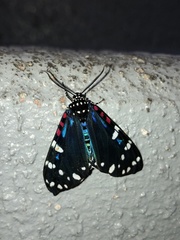
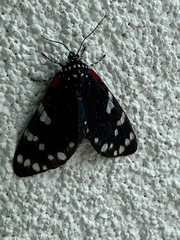
Composia fidelissima the faithful beauty or Uncle Sam moth is a moth in the family Erebidae. It is found in southern Florida and the West Indies, including Cuba. The species was first described by Gottlieb August Wilhelm Herrich-Schäffer in 1866.

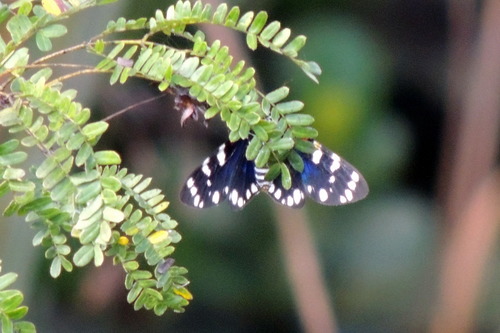
The moth's forewings are black with rows of white dots and red around the costal margin. Their hindwings fade from blue into black, with white dots around the edge. Their thorax continues the trend of white-speckled black, while their abdomen takes on the same blue color of their hindwings.

They have a wingspan of 48–64 mm. Adults are on wing year round. They are day flying. The larvae feed on Cynanchum scoparium, Canavalia (including Canavalia rosea), Nerium (including Nerium oleander) and Echites species (including Echites umbellatus).

Composia fidelissima fidelissima Composia fidelissima vagrans Bates, 1933 Wikipedia →
Global Distribution

Parks Where Found

# Park Country Daily sighting probability
1 Ría Lagartos Biosphere Reserve 🇲🇽 Mexico
~40%
2 Everglades National Park 🇺🇸 United States
~20%
3 Celestún Biosphere Reserve 🇲🇽 Mexico
~20%

Cities Where Found

# City Country Daily sighting probability
1 Miami 🇺🇸 United States
<5%

Before you go

What are the chances of seeing a Faithful Beauty in Celestún Biosphere Reserve?

Possible

About 20% of wildlife watchers report a Faithful Beauty sighting in Celestún Biosphere Reserve on a given day, based on 11 verified sightings from GBIF citizen-science data from 2019 to 2026. Over three days the chance rises to about 50%, and over a week to about 80%, if each day is a fresh chance.

When is the best time to see a Faithful Beauty in Celestún Biosphere Reserve?

February

In that month about 40% of wildlife watchers report a Faithful Beauty in Celestún Biosphere Reserve on a given day, against under 5% in March to October, the lowest months. That is one of Celestún Biosphere Reserve's driest months, with about 10 mm of rain against 160 mm in June.

What time of day is best to see a Faithful Beauty?

Between 2 and 5 pm

Across all the parks we cover, that three-hour window holds the most Faithful Beauty sightings with a recorded time, and about 9 in 10 of them come between 6 am and 6 pm: it is a daytime animal.

Is Celestún Biosphere Reserve the best place to see a Faithful Beauty?

3rd of 3

Of the 3 parks where we can rate Faithful Beauty sightings, Celestún Biosphere Reserve ranks 3rd at about 20%. The best odds are in Ría Lagartos Biosphere Reserve (Mexico, about 40%) and Everglades National Park (United States, about 20%).

Which relatives of the Faithful Beauty live in Celestún Biosphere Reserve?

Same order: Lepidoptera

The closest relatives of the Faithful Beauty that you can see in Celestún Biosphere Reserve (order Lepidoptera, Butterflies and Moths) are West Indian Mangrove Buckeye (about 20%) and Gulf Fritillary (about 20%), with each one's daily chance of a sighting.

Where does the Faithful Beauty sighting chance come from?

GBIF citizen-science records

It is estimated from how often the Faithful Beauty is recorded against all the insects logged in Celestún Biosphere Reserve (11 verified sightings from 2019 to 2026), calibrated against known sighting rates. Figures are rounded to the nearest 10% because citizen-science data supports honest approximations, not decimals, and months with records from fewer than five people show "—". How it works.

← Back to Celestún Biosphere Reserve