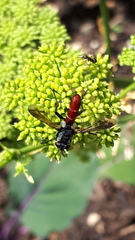
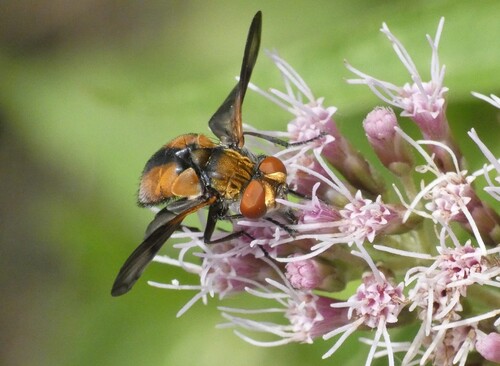
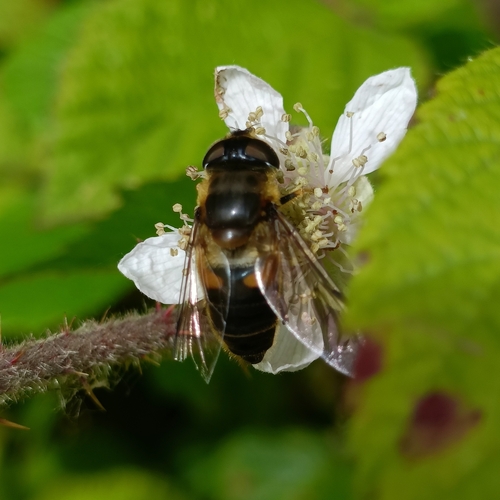
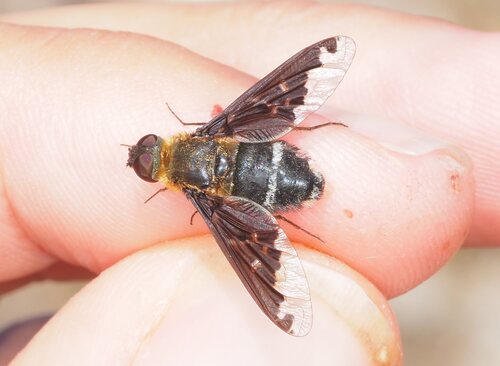
Cylindromyia bicolor

Cylindromyia bicolor

Cylindromyia bicolor

Daily sighting probability ~10% · With luck
at Cévennes National Park

In 3 days ~20% in a week ~30%

11 Verified sightings at Cévennes National Park From 2019 to 2026
16 In all 2 parks
June Best month
☀️ Diurnal When it's spotted

About the Cylindromyia bicolor

Cylindromyia bicolor is a European species of fly in the family Tachinidae. Czech Republic, Hungary, Moldova, Romania, Slovakia, Ukraine, Bosnia and Herzegovina, Bulgaria, Corsica, Croatia, Greece, Italy, Macedonia, Portugal, Serbia, Slovenia, Spain, Turkey, Austria, Belgium, France, Germany, Netherlands, Switzerland, Kazakhstan, Iran, Russia, Transcaucasia.

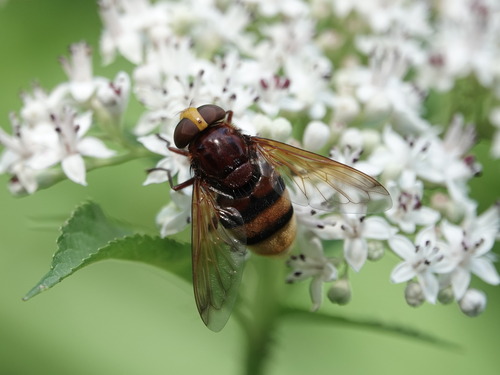
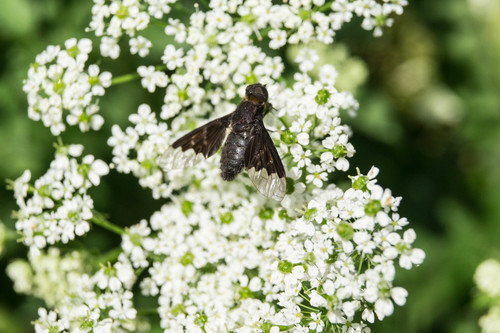
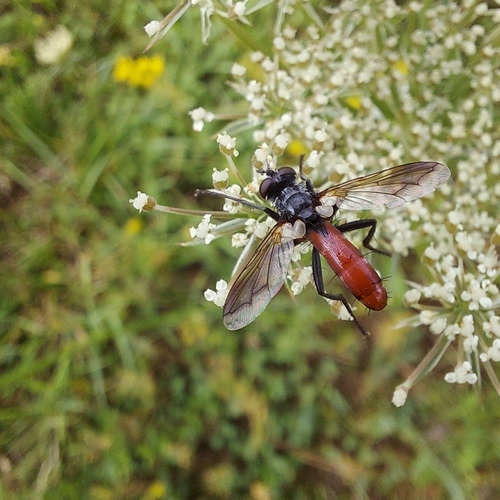
These insects mainly inhabit dry meadows, bushes, edges of wood, marshes, parks and gardens. Cylindromyia bicolor can reach a length of 11–14 millimetres (0.43–0.55 in). These small flies have a grayish thorax and very elongated, cylindrical red abdomen, with a black longitudinal band at the base and discal bristles at the tergites 2–4. The large compound eyes are dark brown. Wings are partly smoked. Calyptra are large and white. Legs are black.

Adults can be found from mid July to October, with a peak in August. They feed on nectar and pollen of flowers of various local plants, but especially on Apiaceae. Larvae of this species are endoparasites of Rhaphigaster nebulosa (Pentatomidae). The females lay their eggs on their hosts, usually one egg per bug. Then the... Wikipedia →
Global Distribution

Parks Where Found

# Park Country Daily sighting probability
1 Cévennes National Park 🇫🇷 France
~10%
2 Bavarian Forest National Park 🇩🇪 Germany
<5%

Cities Where Found

# City Country Daily sighting probability
1 Warsaw 🇵🇱 Poland
~10%
2 Budapest 🇭🇺 Hungary
~10%
3 Lyon 🇫🇷 France
~10%
4 Berlin 🇩🇪 Germany
~10%
5 Cologne 🇩🇪 Germany
<5%
6 Prague 🇨🇿 Czechia
<5%
7 Paris 🇫🇷 France
<5%
8 Munich 🇩🇪 Germany
<5%
9 Vienna 🇦🇹 Austria
<5%
10 Porto 🇵🇹 Portugal
<5%

Before you go

What are the chances of seeing a Cylindromyia bicolor in Cévennes National Park?

With luck

About 10% of wildlife watchers report a Cylindromyia bicolor sighting in Cévennes National Park on a given day, based on 11 verified sightings from GBIF citizen-science data from 2019 to 2026. It is the 590th most-seen of the 996 insects we can rate there. Over three days the chance rises to about 20%, and over a week to about 30%, if each day is a fresh chance.

When is the best time to see a Cylindromyia bicolor in Cévennes National Park?

April and June–August

In those months about 10% of wildlife watchers report a Cylindromyia bicolor in Cévennes National Park on a given day, against under 5% in May and September–March, the lowest months.

What time of day is best to see a Cylindromyia bicolor?

Between 3 and 6 pm

Across all the parks we cover, that three-hour window holds the most Cylindromyia bicolor sightings with a recorded time, and about 8 in 10 of them come between 6 am and 6 pm: it is a daytime animal.

Is Cévennes National Park the best place to see a Cylindromyia bicolor?

Yes

Of the 2 parks where we can rate Cylindromyia bicolor sightings, Cévennes National Park has the highest daily chance: about 10%. Next come Bavarian Forest National Park (Germany, under 5%).

Which relatives of the Cylindromyia bicolor live in Cévennes National Park?

Same family: Tachinidae

The closest relatives of the Cylindromyia bicolor that you can see in Cévennes National Park (family Tachinidae, Tachinid Flies) are Ectophasia crassipennis (about 10%) and Yellow-Faced Fly (about 10%), with each one's daily chance of a sighting.

Where does the Cylindromyia bicolor sighting chance come from?

GBIF citizen-science records

It is estimated from how often the Cylindromyia bicolor is recorded against all the insects logged in Cévennes National Park (11 verified sightings from 2019 to 2026), calibrated against known sighting rates. Figures are rounded to the nearest 10% because citizen-science data supports honest approximations, not decimals, and months with records from fewer than five people show "—". How it works.

← Back to Cévennes National Park