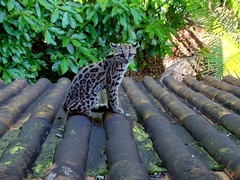
Margay

Margay

Leopardus wiedii

Silhouette: Margot Michaud · PhyloPic

LCNTNear ThreatenedVUENCR
Daily sighting probability <5% · Rare
at Chagres National Park

In 3 days ~10% in a week ~30%

7 Verified sightings at Chagres National Park From 2019 to 2026
15 In all 2 parks
February Best month
☀️🌙 Day & Night When it's spotted

About the Margay

The margay (Leopardus wiedii) is a small wild cat native to Mexico, Central and South America. A solitary and nocturnal felid, it lives mainly in primary evergreen and deciduous forest. Until the 1990s, margays were hunted for the wildlife trade, at which point the killing of the species was outlawed in most countries; however, years of hunting resulted in a notable population decrease. Since 2008, the margay has been listed as Near Threatened on the IUCN Red List, as the population is thought to be declining due to loss of habitat and deforestation.

The scientific name Felis wiedii was used by Heinrich Rudolf Schinz in 1821 in his first scientific description of the margay, named in honour of Prince Maximilian of Wied-Neuwied, who collected specimens in Brazil. The margay is very similar to the larger ocelot (Leopardus pardalis) in appearance, although the head is a little shorter, the eyes larger, and the tail and legs longer. It weighs from 2.6 to 4 kg (5.7 to 8.8 lb), with a body length of 48 to 79 cm (19 to 31 in) and a tail length of 33 to 51 cm (13 to 20 in). Unlike most other cats, the female possesses only two teats.

Its fur is brown and marked with numerous... Wikipedia →

Sounds

Recording0:10

Brazil · 2025

© Charles Boufleur · iNaturalist · CC BY-NC 4.0

Global Distribution

Parks Where Found

# Park Country Daily sighting probability
1 Manu National Park 🇵🇪 Peru
~10%
2 Chagres National Park 🇵🇦 Panama
<5%

Zoos & Centres Where Found

# Zoo / Centre Country
1 Belize Zoo 🇧🇿 Belize In captivity
2 Parc des Félins 🇫🇷 France In captivity
3 Parque Municipal Summit 🇵🇦 Panama In captivity
4 Joya Grande 🇭🇳 Honduras In captivity
5 Zoológico de San Juan de Aragón 🇲🇽 Mexico In captivity
6 Senda Verde (Wildlife Sanctuary) 🇧🇴 Bolivia In captivity
7 Amaru 🇪🇨 Ecuador In captivity
8 La Paz Waterfall Gardens 🇨🇷 Costa Rica In captivity
9 Bioparque Wakatá 🇨🇴 Colombia In captivity
10 Parque de la Conservación 🇨🇴 Colombia In captivity
11 Zoológico Thomas Belt 🇳🇮 Nicaragua In captivity
12 Parque Zoológico Nacional Simón Bolívar 🇨🇷 Costa Rica In captivity
13 Buenaventura Zoo 🇵🇦 Panama In captivity
14 Croco Cun Zoo 🇲🇽 Mexico In captivity
15 El Nispero Zoo 🇵🇦 Panama In captivity
16 ARCAS Petén Education Centre 🇬🇹 Guatemala In captivity
17 Randers Tropical Zoo 🇩🇰 Denmark In captivity
18 Tiergarten Teltow 🇩🇪 Germany In captivity
19 Erlebniswelt Tier und Natur 🇩🇪 Germany In captivity
20 Arenal Eco Zoo 🇨🇷 Costa Rica In captivity
21 Centro de Rescate Las Pumas 🇨🇷 Costa Rica In captivity
22 National Zoo of Nicaragua 🇳🇮 Nicaragua In captivity
23 Parque del Centenario 🇲🇽 Mexico In captivity
24 Rescate Wildlife Rescue Center 🇨🇷 Costa Rica In captivity
25 Réserve Zoologique de Calviac 🇫🇷 France In captivity
26 Zoológico Miguél Álvarez del Toro 🇲🇽 Mexico In captivity

Before you go

What are the chances of seeing a Margay in Chagres National Park?

Rare

Under 5% of wildlife watchers report a Margay sighting in Chagres National Park on a given day, based on 7 verified sightings from GBIF citizen-science data from 2019 to 2026. It is the 9th most-seen of the 12 mammals we can rate there. Over three days the chance rises to about 10%, and over a week to about 30%, if each day is a fresh chance.

When is the best time to see a Margay in Chagres National Park?

February, July, September and December

In those months about 10% of wildlife watchers report a Margay in Chagres National Park on a given day, against under 5% in January, March–June, August and October–November, the lowest months.

What time of day is best to see a Margay?

Between 10 am and 1 pm

Across all the parks we cover, that three-hour window holds the most Margay sightings with a recorded time, and about half of them come between 6 am and 6 pm: it is seen both by day and at night.

Is Chagres National Park the best place to see a Margay?

2nd of 2

Of the 2 parks where we can rate Margay sightings, Chagres National Park ranks 2nd at under 5%. The best odds are in Manu National Park (Peru, about 10%).

Where does the Margay sighting chance come from?

GBIF citizen-science records

It is estimated from how often the Margay is recorded against all the mammals logged in Chagres National Park (7 verified sightings from 2019 to 2026), calibrated against known sighting rates. Figures are rounded to the nearest 10% because citizen-science data supports honest approximations, not decimals, and months with records from fewer than five people show "—". How it works.

← Back to Chagres National Park