

Collared Crescentchest

Collared Crescentchest

Melanopareia torquata

Silhouette: Sheatherius · PhyloPic

LCLeast ConcernNTVUENCR
Daily sighting probability ~30% · Possible
at Chapada Diamantina National Park

In 3 days ~70% in a week ~90%

216 Verified sightings at Chapada Diamantina National Park From 2019 to 2026
490 In all 4 parks
December Best month
☀️ Diurnal When it's spotted

About the Collared Crescentchest

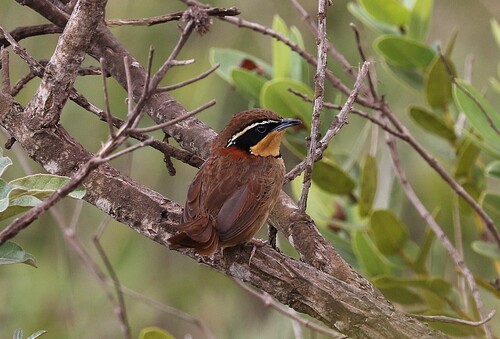
The collared crescentchest (Melanopareia torquata) is a species of suboscine passerine bird in the family Melanopareiidae. It is found in Bolivia, Brazil, and Paraguay. The collared crescentchest was formally described in 1831 by the German naturalist Prince Maximilian of Wied-Neuwied under the binomial name Synallaxis torquatus. The specific epithet is Latin meaning "collared". Wied-Neuwied specified the locality as the "Campo Geral" of inner Brasil. This is the grassland on the border between the Brazilian states of Bahia and Minas Gerais. The collared crescentchest is now one of four crescentchests placed in the genus Melanopareia that was introduced in 1853 by the German naturalist Ludwig Reichenbach.

Three subspecies are recognised: The subspecies M. t. bitorquata has sometimes been treated as a separate species, the double-collared crescentchest. The crescentchests (genus Melanopareia) were at one time included in family Rhinocryptidae, the tapaculos. A 2010 publication confirmed... Wikipedia →

Sounds

Song1:21

Brazil · 2026

© Robson Silva e Silva · XC1151144 · CC BY-NC-SA 4.0

Call0:26

Paraguay · 2024

© Carlos Bocos · XC941660 · CC BY-NC-SA 4.0

Canto0:34

Brazil · 2016

© Caio Brito · XC427576 · CC BY-NC-SA 4.0

Global Distribution

Parks Where Found

# Park Country Daily sighting probability
1 Emas National Park 🇧🇷 Brazil
~40%
2 Chapada Diamantina National Park 🇧🇷 Brazil
~30%
3 Serra da Canastra National Park 🇧🇷 Brazil
~20%
4 Chapada dos Guimarães National Park 🇧🇷 Brazil
~10%

Before you go

What are the chances of seeing a Collared Crescentchest in Chapada Diamantina National Park?

Possible

About 30% of wildlife watchers report a Collared Crescentchest sighting in Chapada Diamantina National Park on a given day, based on 216 verified sightings from GBIF citizen-science data from 2019 to 2026. It is the 33rd most-seen of the 271 birds we can rate there. Over three days the chance rises to about 70%, and over a week to about 90%, if each day is a fresh chance.

When is the best time to see a Collared Crescentchest in Chapada Diamantina National Park?

October to December

In those months about 40% of wildlife watchers report a Collared Crescentchest in Chapada Diamantina National Park on a given day, against about 10% in April and June, the lowest months. Those are among Chapada Diamantina National Park's wettest months, with about 140 mm of rain a month against 50 mm in June.

What time of day is best to see a Collared Crescentchest?

Between 7 and 10 am

Across all the parks we cover, that three-hour window holds the most Collared Crescentchest sightings with a recorded time, and about 8 in 10 of them come between 6 am and 6 pm: it is a daytime animal.

Is Chapada Diamantina National Park the best place to see a Collared Crescentchest?

2nd of 4

Of the 4 parks where we can rate Collared Crescentchest sightings, Chapada Diamantina National Park ranks 2nd at about 30%. The best odds are in Emas National Park (Brazil, about 40%).

Which relatives of the Collared Crescentchest live in Chapada Diamantina National Park?

Same order: Passeriformes

The closest relatives of the Collared Crescentchest that you can see in Chapada Diamantina National Park (order Passeriformes, Perching Birds) are Rufous-collared Sparrow (about 60%), Pale-breasted Thrush (about 60%) and Southern House Wren (about 60%), with each one's daily chance of a sighting.

Where does the Collared Crescentchest sighting chance come from?

GBIF citizen-science records

It is estimated from how often the Collared Crescentchest is recorded against all the birds logged in Chapada Diamantina National Park (216 verified sightings from 2019 to 2026), calibrated against known sighting rates. Figures are rounded to the nearest 10% because citizen-science data supports honest approximations, not decimals, and months with records from fewer than five people show "—". How it works.

← Back to Chapada Diamantina National Park