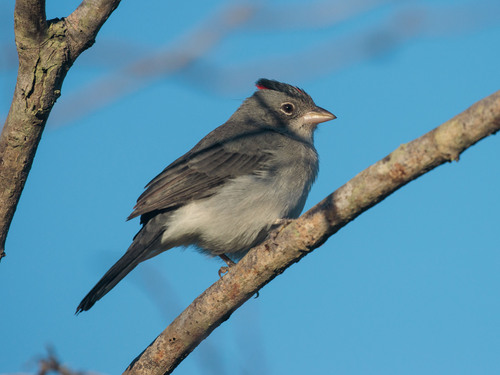
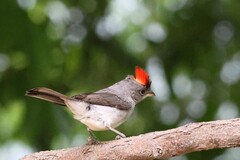
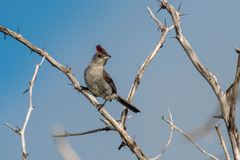
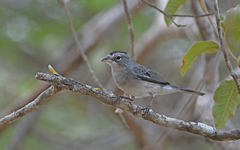

Pileated Finch

Pileated Finch

Coryphospingus pileatus

Silhouette: Sheatherius · PhyloPic

LCLeast ConcernNTVUENCR
Daily sighting probability ~10% · With luck
at Chapada Diamantina National Park

In 3 days ~30% in a week ~60%

69 Verified sightings at Chapada Diamantina National Park From 2019 to 2026
218 In all 4 parks
April Best month
☀️ Diurnal When it's spotted

About the Pileated Finch

The grey pileated finch (Coryphospingus pileatus), also known as the pileated finch, is a species of bird in the family Thraupidae, the tanagers and allies. It is found in Brazil, Colombia, Venezuela, and possibly Bolivia and French Guiana.

The grey pileated finch was first described in 1821 by the German naturalist Prince Maximilian of Wied-Neuwied with the binomial Fringilla pileata. In 1851 Jean Cabanis erected the genus Coryphospingus for pileatus and what is now the red pileated finch (C. cucullatus). The old and new genera were in the finch family Fringillidae but several early twentieth century studies showed that Coryphospingus belonged in its present tanager family. The two pileated "finches" form a superspecies and hybridize where their ranges overlap. The genera Coryphospingus, Lanio, Eucometis, and Tachyphonus are closely related.

The grey pileated finch has these three subspecies: It has a shortish tail and a longish bill. The... Wikipedia →

Sounds

Song0:08

Brazil · 2026

© Robson Silva e Silva · XC1084412 · CC BY-NC-SA 4.0

Call0:41

Brazil · 2024

© JAYRSON ARAUJO DE OLIVEIRA · XC898359 · CC BY-NC-SA 4.0

Canto/chamado0:42

Brazil · 2015

© Caio Brito · XC427517 · CC BY-NC-SA 4.0

Global Distribution

Parks Where Found

# Park Country Daily sighting probability
1 Serra da Canastra National Park 🇧🇷 Brazil
~20%
2 Chapada Diamantina National Park 🇧🇷 Brazil
~10%
3 Henri Pittier National Park 🇻🇪 Venezuela
<5%
4 Emas National Park 🇧🇷 Brazil
<5%

Cities Where Found

# City Country Daily sighting probability
1 Belo Horizonte 🇧🇷 Brazil
<5%
2 Valencia 🇻🇪 Venezuela
<5%
3 São Paulo 🇧🇷 Brazil
<5%

Before you go

What are the chances of seeing a Pileated Finch in Chapada Diamantina National Park?

With luck

About 10% of wildlife watchers report a Pileated Finch sighting in Chapada Diamantina National Park on a given day, based on 69 verified sightings from GBIF citizen-science data from 2019 to 2026. It is the 115th most-seen of the 271 birds we can rate there. Over three days the chance rises to about 30%, and over a week to about 60%, if each day is a fresh chance.

When is the best time to see a Pileated Finch in Chapada Diamantina National Park?

March–April and September

In those months about 20% of wildlife watchers report a Pileated Finch in Chapada Diamantina National Park on a given day, against under 5% in August, the lowest month.

What time of day is best to see a Pileated Finch?

Between 7 and 10 am

Across all the parks we cover, that three-hour window holds the most Pileated Finch sightings with a recorded time, and about 9 in 10 of them come between 6 am and 6 pm: it is a daytime animal.

Is Chapada Diamantina National Park the best place to see a Pileated Finch?

2nd of 4

Of the 4 parks where we can rate Pileated Finch sightings, Chapada Diamantina National Park ranks 2nd at about 10%. The best odds are in Serra da Canastra National Park (Brazil, about 20%).

Which relatives of the Pileated Finch live in Chapada Diamantina National Park?

Same family: Thraupidae

The closest relatives of the Pileated Finch that you can see in Chapada Diamantina National Park (family Thraupidae, Tanagers and Allies) are Bananaquit (about 60%), Blue Dacnis (about 50%) and Red-cowled Cardinal (about 50%), with each one's daily chance of a sighting.

Where does the Pileated Finch sighting chance come from?

GBIF citizen-science records

It is estimated from how often the Pileated Finch is recorded against all the birds logged in Chapada Diamantina National Park (69 verified sightings from 2019 to 2026), calibrated against known sighting rates. Figures are rounded to the nearest 10% because citizen-science data supports honest approximations, not decimals, and months with records from fewer than five people show "—". How it works.

← Back to Chapada Diamantina National Park