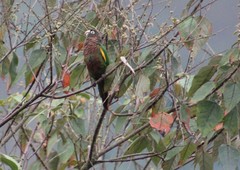
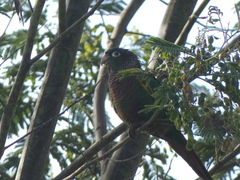
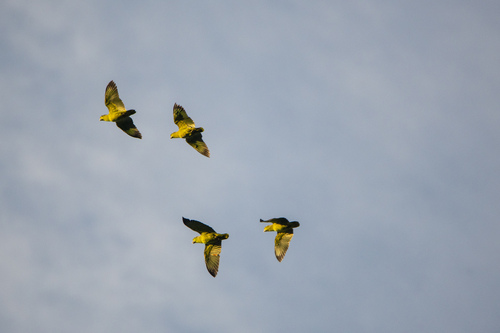
Brown-breasted Parakeet

Brown-breasted Parakeet

Pyrrhura calliptera

Silhouette: Sheatherius · PhyloPic

LCNTVUVulnerableENCR Endemic
Daily sighting probability ~20% · Possible
at Chingaza National Natural Park

In 3 days ~60% in a week ~80%

264 Verified sightings at Chingaza National Natural Park From 2019 to 2026
264 In 1 park
November Best month
☀️ Diurnal When it's spotted

About the Brown-breasted Parakeet

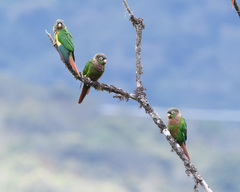
The flame-winged parakeet (Pyrrhura calliptera), also known as the brown-breasted parakeet, is a species of parrot in the family Psittacidae. It is endemic to forest edge and shrub at altitudes of 1,700–3,400 m (5,600–11,200 ft) above sea level on the east Andean slope in Colombia. It is threatened by habitat loss.

The species was first formally described as Conurus callipterus in 1854 by the French ornithologist Charles de Souancé, after studying a specimen from the collection of his uncle, François Victor Massena, 3rd Duke of Rivoli.

The genus name Pyrrhura is derived from the Ancient Greek purrhos (red) and oura (tail). The species epithet calliptera is also from Ancient Greek: kallos (beauty) and pteros (winged). The species is monotypic: no subspecies have been identified. The International Ornithologists' Union lists the species as flame-winged parakeet, the other four major taxonomic authorities refer to it as the brown-breasted parakeet.

A medium-sized parakeet, the brown-breasted parakeet measures 22–23 cm in length. The throat and upper breast are medium brown with light edges giving a scalloped appearance. The head of the bird... Wikipedia →

Sounds

Uncertain0:09

Colombia · 2021

© Valeria Cicuamía Guerrero · XC659882 · CC BY-NC-SA 4.0

Call0:14

Colombia · 2014

© Hans Matheve · XC401396 · CC BY-NC-ND 4.0

Song0:12

Colombia · 2016

© David Bradley · XC299362 · CC BY-NC-SA 4.0

Global Distribution

Parks Where Found

# Park Country Daily sighting probability
1 Chingaza National Natural Park 🇨🇴 Colombia
~20%

More parks will be added in future updates.

Before you go

What are the chances of seeing a Brown-breasted Parakeet in Chingaza National Natural Park?

Possible

About 20% of wildlife watchers report a Brown-breasted Parakeet sighting in Chingaza National Natural Park on a given day, based on 264 verified sightings from GBIF citizen-science data from 2019 to 2026. It is the 32nd most-seen of the 258 birds we can rate there. Over three days the chance rises to about 60%, and over a week to about 80%, if each day is a fresh chance.

When is the best time to see a Brown-breasted Parakeet in Chingaza National Natural Park?

May, September and November

In those months about 40% of wildlife watchers report a Brown-breasted Parakeet in Chingaza National Natural Park on a given day, against about 10% in January to April, the lowest months.

What time of day is best to see a Brown-breasted Parakeet?

Between 7 and 10 am

Across all the parks we cover, that three-hour window holds the most Brown-breasted Parakeet sightings with a recorded time, and about 8 in 10 of them come between 6 am and 6 pm: it is a daytime animal.

Where else can you see a Brown-breasted Parakeet?

Only Chingaza National Natural Park, in our data

Chingaza National Natural Park is the only park on Wallace's Line with enough records to rate Brown-breasted Parakeet sightings: about 20% of wildlife watchers there report one on a given day.

Where does the Brown-breasted Parakeet sighting chance come from?

GBIF citizen-science records

It is estimated from how often the Brown-breasted Parakeet is recorded against all the birds logged in Chingaza National Natural Park (264 verified sightings from 2019 to 2026), calibrated against known sighting rates. Figures are rounded to the nearest 10% because citizen-science data supports honest approximations, not decimals, and months with records from fewer than five people show "—". How it works.

← Back to Chingaza National Natural Park