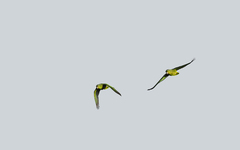
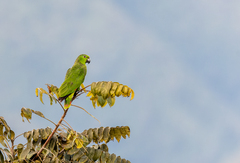
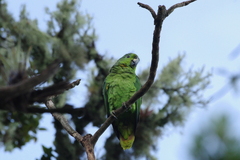
Scaly-naped Parrot

Scaly-naped Parrot

Amazona mercenaria

Silhouette: Ferran Sayol · PhyloPic

LCLeast ConcernNTVUENCR
Daily sighting probability <5% · Rare
at Chingaza National Natural Park

In 3 days ~10% in a week ~20%

29 Verified sightings at Chingaza National Natural Park From 2019 to 2026
845 In all 4 parks
May Best month
☀️ Diurnal When it's spotted

About the Scaly-naped Parrot

The scaly-naped amazon (Amazona mercenarius), also known as the scaly-naped parrot, mercenary amazon, Tschudi's amazon, mountain parrot, or gray-naped amazon is a species of parrot in the family Psittacidae. It is found along the Andes in the northern part of South America.

Its natural habitats are subtropical or tropical moist lowland forest and subtropical or tropical moist montane forest. There are two subspecies: A. m. canipalliata- It is similar to the nominate, but has hidden maroon marks instead of the red speculum at the bases of the first to third wing secondaries.

Adults are 34 cm (13.2) long and weigh 300 g (10.5 oz). Nominate forms are bright green in color, with dark green feathers tinged a dull blue/black and tipped with a dull black from the crown to the nape. The eyes are red with a pale gray eye-ring. The first to third secondary wing feathers have red bases, with the remaining wing feathers having green bases. The carpal edge is yellow mixed with red and orange. The tail is green with a yellow-green band, with the side tail feather being banded red and blue-purple and the outermost... Wikipedia →
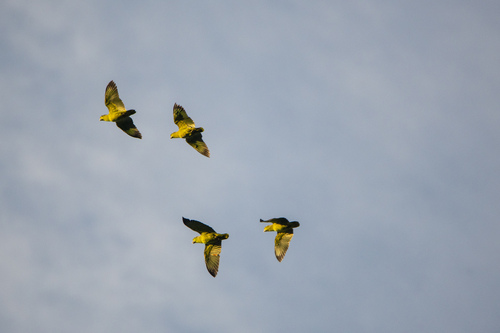
Sounds

Call0:14

Ecuador · 2025

© Manuel Sánchez-Nivicela · XC1163658 · CC BY-NC-ND 4.0

Flight call1:06

Peru · 2022

© Fabrice Schmitt · XC815679 · CC BY-NC-SA 4.0

Flight call0:19

Bolivia · 2023

© Niels Krabbe · XC778919 · CC BY-NC-SA 4.0

Global Distribution

Parks Where Found

# Park Country Daily sighting probability
1 Podocarpus National Park 🇪🇨 Ecuador
~20%
2 Farallones de Cali National Natural Park 🇨🇴 Colombia
~10%
3 Los Nevados National Natural Park 🇨🇴 Colombia
<5%
4 Chingaza National Natural Park 🇨🇴 Colombia
<5%

Cities Where Found

# City Country Daily sighting probability
1 Cali 🇨🇴 Colombia
<5%

Zoos & Centres Where Found

# Zoo / Centre Country
1 Ukumarí Biopark 🇨🇴 Colombia In captivity

Before you go

What are the chances of seeing a Scaly-naped Parrot in Chingaza National Natural Park?

Rare

Under 5% of wildlife watchers report a Scaly-naped Parrot sighting in Chingaza National Natural Park on a given day, based on 29 verified sightings from GBIF citizen-science data from 2019 to 2026. It is the 111th most-seen of the 258 birds we can rate there. Over three days the chance rises to about 10%, and over a week to about 20%, if each day is a fresh chance.

When is the best time to see a Scaly-naped Parrot in Chingaza National Natural Park?

May

In that month about 10% of wildlife watchers report a Scaly-naped Parrot in Chingaza National Natural Park on a given day, against under 5% in June to April, the lowest months.

What time of day is best to see a Scaly-naped Parrot?

Between 6 and 9 am

Across all the parks we cover, that three-hour window holds the most Scaly-naped Parrot sightings with a recorded time, and about 8 in 10 of them come between 6 am and 6 pm: it is a daytime animal.

Which relatives of the Scaly-naped Parrot live in Chingaza National Natural Park?

Same family: Psittacidae

The closest relatives of the Scaly-naped Parrot that you can see in Chingaza National Natural Park (family Psittacidae, New World and African Parrots) are Brown-breasted Parakeet (about 20%) and Red-bellied Macaw (about 10%), with each one's daily chance of a sighting.

Where does the Scaly-naped Parrot sighting chance come from?

GBIF citizen-science records

It is estimated from how often the Scaly-naped Parrot is recorded against all the birds logged in Chingaza National Natural Park (29 verified sightings from 2019 to 2026), calibrated against known sighting rates. Figures are rounded to the nearest 10% because citizen-science data supports honest approximations, not decimals, and months with records from fewer than five people show "—". How it works.

← Back to Chingaza National Natural Park