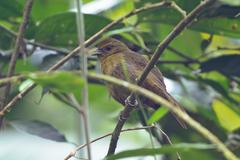
Oleaginous Hemispingus

Oleaginous Hemispingus

Sphenopsis frontalis

Silhouette: Sheatherius · PhyloPic

LCLeast ConcernNTVUENCR
Daily sighting probability <5% · Rare
at Chingaza National Natural Park

In 3 days <5%

7 Verified sightings at Chingaza National Natural Park From 2019 to 2026
266 In all 4 parks
July Best month
☀️ Diurnal When it's spotted

About the Oleaginous Hemispingus

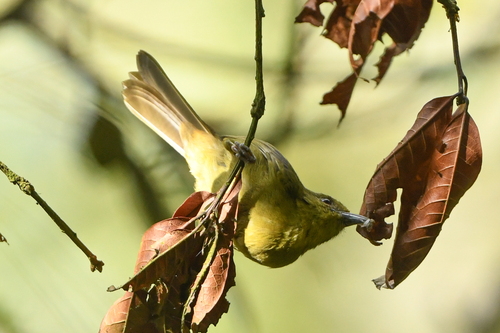
The oleaginous hemispingus (Sphenopsis frontalis) is a species of bird in the family Thraupidae. It is found in Colombia, Ecuador, Peru, and Venezuela. It inhabits wet montane rainforests at elevations of 1,400–2,700 m (4,600–8,900 ft). It is 14 cm (5.5 in) long and weighs 14–20 g (0.5–0.7 oz) on average. It has dull yellow underparts and olive-green upperparts. It is classified as being of least concern by the IUCN.

The oleaginous hemispingus was formally described as Hylophilus frontalis by the Swiss naturalist Johann Jakob von Tschudi in 1844 based on specimens collected from the Peruvian Andes. The specific epithet is derived from the Latin word frontalis, meaning "fronted". The common name means "having...appearance of oil", referring to its olive coloration.

The oleaginous hemispingus has five recognised subspecies. These subspecies are fairly well-differentiated morphologically and exhibit clinal variation in Venezuela as they get further from the Andes. Wikipedia →
Sounds

Song0:48

Colombia · 2023

© David Monroy Rengifo · XC837602 · CC BY-NC-SA 4.0

Duet1:21

Colombia · 2020

© Jerome Fischer · XC578578 · CC BY-NC-SA 4.0

Begging call0:21

Ecuador · 1997

© Mitch Lysinger · XC261262 · CC BY-NC-SA 4.0

Global Distribution

Parks Where Found

# Park Country Daily sighting probability
1 Los Nevados National Natural Park 🇨🇴 Colombia
<5%
2 Henri Pittier National Park 🇻🇪 Venezuela
<5%
3 Farallones de Cali National Natural Park 🇨🇴 Colombia
<5%
4 Chingaza National Natural Park 🇨🇴 Colombia
<5%

Before you go

What are the chances of seeing an Oleaginous Hemispingus in Chingaza National Natural Park?

Rare

Under 5% of wildlife watchers report an Oleaginous Hemispingus sighting in Chingaza National Natural Park on a given day, based on 7 verified sightings from GBIF citizen-science data from 2019 to 2026. It is the 208th most-seen of the 258 birds we can rate there. Over three days the chance rises to under 5%, if each day is a fresh chance.

When is the best time to see an Oleaginous Hemispingus in Chingaza National Natural Park?

Any time of year

In every month with enough records, under 5% of wildlife watchers report an Oleaginous Hemispingus in Chingaza National Natural Park on a given day, so our monthly data shows no clear season.

What time of day is best to see an Oleaginous Hemispingus?

Between 7 and 10 am

Across all the parks we cover, that three-hour window holds the most Oleaginous Hemispingus sightings with a recorded time, and about 8 in 10 of them come between 6 am and 6 pm: it is a daytime animal.

Where does the Oleaginous Hemispingus sighting chance come from?

GBIF citizen-science records

It is estimated from how often the Oleaginous Hemispingus is recorded against all the birds logged in Chingaza National Natural Park (7 verified sightings from 2019 to 2026), calibrated against known sighting rates. Figures are rounded to the nearest 10% because citizen-science data supports honest approximations, not decimals, and months with records from fewer than five people show "—". How it works.

← Back to Chingaza National Natural Park