Giant Ground Pangolin

Giant Ground Pangolin

Manis gigantea

Silhouette: T. Michael Keesey · PhyloPic

LCNTVUENEndangeredCR
Daily sighting probability ~30% · Possible
at Chinko Conservation Area

In 3 days ~70% in a week ~90%

29 Verified sightings at Chinko Conservation Area From 2019 to 2026
29 In 1 park
November Best month
🌙 Nocturnal When it's spotted

About the Giant Ground Pangolin

The giant pangolin (Smutsia gigantea) is a species of pangolin from genus Smutsia of subfamily Smutsiinae within the family Manidae. It is the largest living species of pangolins. Members of the species inhabit Africa with a range stretching along the equator from West Africa to Uganda. It subsists almost entirely on ants and termites.

The giant pangolin is the largest of all pangolin species. While its average mass has not been measured, one specimen was found to weigh between 30 kg (66 lb) and 40 kg (88 lb). Males are larger than females, with male body lengths about 137 cm (54 in) to 180 cm (71 in) and females about 112.5 cm (44.3 in) to 136.5 cm (53.7 in). Like all pangolins, the species is armored with large, brown to reddish-brown scales formed from keratin. Curiously, it also has eyelashes. The giant pangolin has a long snout, a long, thick tail, and large front claws.

The animal has a strong sense of smell and large anal glands. Its secretions may be significant to animal communication. The species walks with most of its weight on its columnar rear legs, and curls its front paws, walking on the outside of the wrists rather than the palms to protect the claws...
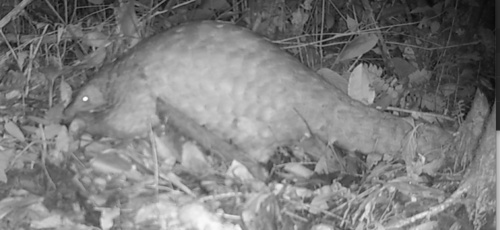
Wikipedia →

Global Distribution

Parks Where Found

# Park Country Daily sighting probability
1 Chinko Conservation Area 🇨🇫 Central African Republic
~30%

More parks will be added in future updates.

Before you go

What are the chances of seeing a Giant Ground Pangolin in Chinko Conservation Area?

Possible

About 30% of wildlife watchers report a Giant Ground Pangolin sighting in Chinko Conservation Area on a given day, based on 29 verified sightings from GBIF citizen-science data from 2019 to 2026. It is the 26th most-seen of the 53 mammals we can rate there. Over three days the chance rises to about 70%, and over a week to about 90%, if each day is a fresh chance.

When is the best time to see a Giant Ground Pangolin in Chinko Conservation Area?

November

In that month about 60% of wildlife watchers report a Giant Ground Pangolin in Chinko Conservation Area on a given day, against under 5% in February and July, the lowest months. That is one of Chinko Conservation Area's driest months, with about 15 mm of rain against 180 mm in August.

What time of day is best to see a Giant Ground Pangolin?

Between 11 pm and 2 am

Across all the parks we cover, that three-hour window holds the most Giant Ground Pangolin sightings with a recorded time, and about 7 in 10 of them come between 6 pm and 6 am: it is mostly seen at night.

Where else can you see a Giant Ground Pangolin?

Only Chinko Conservation Area, in our data

Chinko Conservation Area is the only park on Wallace's Line with enough records to rate Giant Ground Pangolin sightings: about 30% of wildlife watchers there report one on a given day.

Where does the Giant Ground Pangolin sighting chance come from?

GBIF citizen-science records

It is estimated from how often the Giant Ground Pangolin is recorded against all the mammals logged in Chinko Conservation Area (29 verified sightings from 2019 to 2026), calibrated against known sighting rates. Figures are rounded to the nearest 10% because citizen-science data supports honest approximations, not decimals, and months with records from fewer than five people show "—". How it works.

← Back to Chinko Conservation Area
