


Completed


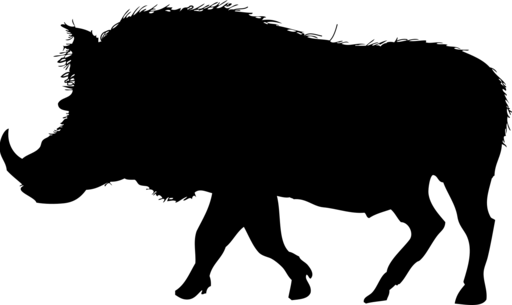
Common Warthog
Phacochoerus africanus
Silhouette: Steven Traver · PhyloPic
- KingdomAnimalia (Animals)
- PhylumChordata (Chordates)
- ClassMammalia (Mammals)
- OrderArtiodactyla (Even-toed Ungulates and Cetaceans)
- FamilySuidae (Suids)
- GenusPhacochoerus (Warthogs)
- SpeciesPhacochoerus africanus (Common Warthog)
In 3 days ~90% in a week >90%
60 Verified sightings at Chinko Conservation Area From 2019 to 2026
4,800 In all 44 parks
August Best month
☀️ Diurnal When it's spotted



Completed




Completed
About the Common Warthog
The common warthog (Phacochoerus africanus) is a wild member of the pig family (Suidae) found in grassland, savanna, and woodland in sub-Saharan Africa. In the past, it was commonly treated as a subspecies of P. aethiopicus, but today that scientific name is restricted to the desert warthog of northern Kenya, Somalia, and eastern Ethiopia.
The common warthog is a medium-sized species, with a head-and-body length ranging from 0.9 to 1.5 m (2 ft 11 in to 4 ft 11 in), and shoulder height from 63.5 to 85 cm (25.0 to 33.5 in). Females, at 45 to 75 kg (99 to 165 lb), are smaller and lighter than males, at 60 to 150 kg (130 to 330 lb). A warthog is identifiable by the two pairs of tusks protruding from the mouth and curving upwards. The lower pair, which is far shorter than the upper pair, becomes razor-sharp by rubbing against the upper pair every time the mouth is opened and closed. The upper canine teeth can grow to 25.5 cm (10.0 in) long and have a wide elliptical cross section, being about 4.5 cm (1.8 in) deep and 2.5 cm (0.98 in) wide. A tusk will curve 90° or more from the root, and will not lie flat on a table, as it curves somewhat backwards as...
Recent sightings of Common Warthog in Chinko Conservation Area
LIVEiNaturalistGlobal Distribution
Parks Where Found
Zoos & Centres Where Found
| # | Zoo / Centre | Country | |
|---|---|---|---|
| 1 | Disney's Animal Kingdom | 🇺🇸 United States | |
| 2 | San Diego Zoo | 🇺🇸 United States | |
| 3 | Pairi Daiza | 🇧🇪 Belgium | |
| 4 | Cincinnati Zoo and Botanical Garden | 🇺🇸 United States | |
| 5 | Barcelona Zoo | 🇪🇸 Spain | |
| 6 | Zlín-Lešná Zoo | 🇨🇿 Czechia | |
| 7 | Abilene Zoological Gardens | 🇺🇸 United States | |
| 8 | Zoo Miami | 🇺🇸 United States | |
| 9 | San Diego Zoo Safari Park | 🇺🇸 United States | |
| 10 | Safaripark Beekse Bergen | 🇳🇱 Netherlands | |
| 11 | Toronto Zoo | 🇨🇦 Canada | |
| 12 | Safari West | 🇺🇸 United States | |
| 13 | Living Desert Zoo and Gardens | 🇺🇸 United States | |
| 14 | Haller Park | 🇰🇪 Kenya | |
| 15 | Columbus Zoo and Aquarium | 🇺🇸 United States | |
| 16 | Bronx Zoo | 🇺🇸 United States | |
| 17 | Kansas City Zoo | 🇺🇸 United States | |
| 18 | Badoca Safari Park | 🇵🇹 Portugal | |
| 19 | Tallinn Zoo | 🇪🇪 Estonia | |
| 20 | Brookfield Zoo | 🇺🇸 United States | |
| 21 | Virginia Safari Park | 🇺🇸 United States | |
| 22 | Chester Zoo | 🇬🇧 United Kingdom | |
| 23 | Cheyenne Mountain Zoo | 🇺🇸 United States | |
| 24 | Oakland Zoo | 🇺🇸 United States | |
| 25 | Dallas Zoo | 🇺🇸 United States | |
| 26 | Phoenix Zoo | 🇺🇸 United States | |
| 27 | The Maryland Zoo | 🇺🇸 United States | |
| 28 | Jacksonville Zoo and Gardens | 🇺🇸 United States | |
| 29 | Wildlife World Zoo | 🇺🇸 United States | |
| 30 | São Paulo Zoo | 🇧🇷 Brazil | |
| 31 | Central Florida Zoo and Botanical Gardens | 🇺🇸 United States | |
| 32 | Kano Zoo | 🇳🇬 Nigeria | |
| 33 | Leofoo Village Theme Park | 🇹🇼 Taiwan | |
| 34 | Louisville Zoo | 🇺🇸 United States | |
| 35 | Kyiv Zoo | 🇺🇦 Ukraine | |
| 36 | Colchester Zoo | 🇬🇧 United Kingdom | |
| 37 | Southwick's Zoo | 🇺🇸 United States | |
| 38 | Berlin Zoological Garden | 🇩🇪 Germany | |
| 39 | Woodland Park Zoo | 🇺🇸 United States | |
| 40 | Louisiana Purchase Gardens and Zoo | 🇺🇸 United States | |
| 41 | Calgary Zoo | 🇨🇦 Canada | |
| 42 | Franklin Park Zoo | 🇺🇸 United States | |
| 43 | Night Safari | 🇸🇬 Singapore | |
| 44 | Indianapolis Zoo | 🇺🇸 United States | |
| 45 | Memphis Zoo | 🇺🇸 United States | |
| 46 | Metro Richmond Zoo | 🇺🇸 United States | |
| 47 | Singapore Zoo | 🇸🇬 Singapore | |
| 48 | Allwetterzoo Münster | 🇩🇪 Germany | |
| 49 | Explorer Village | 🇦🇪 United Arab Emirates | |
| 50 | Münster Zoo | 🇩🇪 Germany |
Closest Relatives at Chinko Conservation Area


Before you go
What are the chances of seeing a Common Warthog in Chinko Conservation Area?
Likely
About 50% of wildlife watchers report a Common Warthog sighting in Chinko Conservation Area on a given day, based on 60 verified sightings from GBIF citizen-science data from 2019 to 2026. It is the 11th most-seen of the 53 mammals we can rate there. Over three days the chance rises to about 90%, and over a week to over 90%, if each day is a fresh chance.
When is the best time to see a Common Warthog in Chinko Conservation Area?
August
In that month about 70% of wildlife watchers report a Common Warthog in Chinko Conservation Area on a given day, against under 5% in October, the lowest month. That is one of Chinko Conservation Area's wettest months, with about 180 mm of rain against almost none in January.
What time of day is best to see a Common Warthog?
Between 9 am and noon
Across all the parks we cover, that three-hour window holds the most Common Warthog sightings with a recorded time, and about 9 in 10 of them come between 6 am and 6 pm: it is a daytime animal.
Is Chinko Conservation Area the best place to see a Common Warthog?
25th of 44
Of the 44 parks where we can rate Common Warthog sightings, Chinko Conservation Area ranks 25th at about 50%. The best odds are in Djoudj National Bird Sanctuary (Senegal, about 90%), Mole National Park (Ghana, about 80%) and Kidepo Valley National Park (Uganda, about 80%). All parks ranked.
Which relatives of the Common Warthog live in Chinko Conservation Area?
Same family: Suidae
The closest relatives of the Common Warthog that you can see in Chinko Conservation Area (family Suidae, Suids) are Giant Forest Hog (about 60%) and Red River Hog (about 60%), with each one's daily chance of a sighting.
Where does the Common Warthog sighting chance come from?
GBIF citizen-science records
It is estimated from how often the Common Warthog is recorded against all the mammals logged in Chinko Conservation Area (60 verified sightings from 2019 to 2026), calibrated against known sighting rates. Figures are rounded to the nearest 10% because citizen-science data supports honest approximations, not decimals, and months with records from fewer than five people show "—". How it works.
