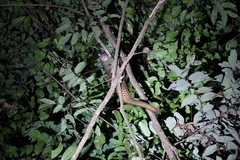
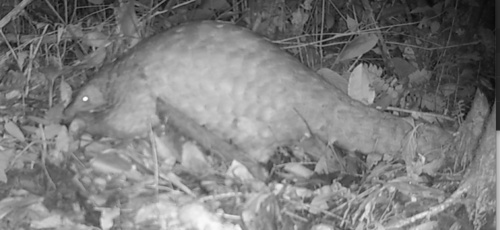
White-bellied Pangolin

White-bellied Pangolin

Manis tricuspis

Silhouette: Steven Traver · PhyloPic

LCNTVUENEndangeredCR
Daily sighting probability ~20% · Possible
at Chinko Conservation Area

In 3 days ~50% in a week ~80%

8 Verified sightings at Chinko Conservation Area From 2019 to 2026
14 In all 2 parks
March Best month
☀️🌙 Day & Night When it's spotted

About the White-bellied Pangolin

The white-bellied pangolin (Phataginus tricuspis) is one of eight extant species of pangolins ("scaly anteaters"), and is native to equatorial Africa. Also known as the tree pangolin or three-cusped pangolin, it is the most common of the African forest pangolins.

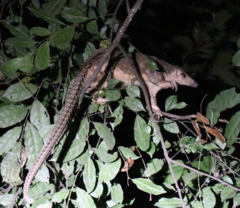
Phataginus tricuspis is a relatively small pangolin. The combined head and body length is 33–43 cm (13–17 in). The tail is 49–62 cm (19–24 in). Each dark brown to brownish yellow scale has three points, to which the specific name tricuspis refers. (The Greek meaning of Phataginus tricuspis is "number by order"),These scales cover the whole body besides the face, underbelly, and insides of the legs. The scales are made of keratin, as are human fingernails, and are anchored at the base to the pangolin's skin. The head is small, and the snout is elongated. The feet are short, and each foot has five long curved claws.

The white-bellied pangolin had belonged to the genus Manis and subgenus Phataginus before the latter was elevated to generic status. The white-bellied pangolin, along with the long-tailed pangolin...

Wikipedia →

Global Distribution

Parks Where Found

# Park Country Daily sighting probability
1 Chinko Conservation Area 🇨🇫 Central African Republic
~20%
2 Odzala-Kokoua National Park 🇨🇬 Republic of the Congo
~20%

Zoos & Centres Where Found

# Zoo / Centre Country
1 Brookfield Zoo 🇺🇸 United States In captivity
2 LUFASI Nature Park 🇳🇬 Nigeria In captivity
3 Mvog-Betsi Zoo 🇨🇲 Cameroon In captivity

Before you go

What are the chances of seeing a White-bellied Pangolin in Chinko Conservation Area?

Possible

About 20% of wildlife watchers report a White-bellied Pangolin sighting in Chinko Conservation Area on a given day, based on 8 verified sightings from GBIF citizen-science data from 2019 to 2026. It is the 49th most-seen of the 53 mammals we can rate there. Over three days the chance rises to about 50%, and over a week to about 80%, if each day is a fresh chance.

When is the best time to see a White-bellied Pangolin in Chinko Conservation Area?

March

In that month about 50% of wildlife watchers report a White-bellied Pangolin in Chinko Conservation Area on a given day, against under 5% in February, May–September and November–December, the lowest months. That is one of Chinko Conservation Area's driest months, with about 30 mm of rain against 180 mm in August.

What time of day is best to see a White-bellied Pangolin?

Between 8 and 11 pm

Across all the parks we cover, that three-hour window holds the most White-bellied Pangolin sightings with a recorded time, and about half of them come between 6 am and 6 pm: it is seen both by day and at night.

Is Chinko Conservation Area the best place to see a White-bellied Pangolin?

Yes

Of the 2 parks where we can rate White-bellied Pangolin sightings, Chinko Conservation Area has the highest daily chance: about 20%. Next come Odzala-Kokoua National Park (Republic of the Congo, about 20%).

Where does the White-bellied Pangolin sighting chance come from?

GBIF citizen-science records

It is estimated from how often the White-bellied Pangolin is recorded against all the mammals logged in Chinko Conservation Area (8 verified sightings from 2019 to 2026), calibrated against known sighting rates. Figures are rounded to the nearest 10% because citizen-science data supports honest approximations, not decimals, and months with records from fewer than five people show "—". How it works.

← Back to Chinko Conservation Area