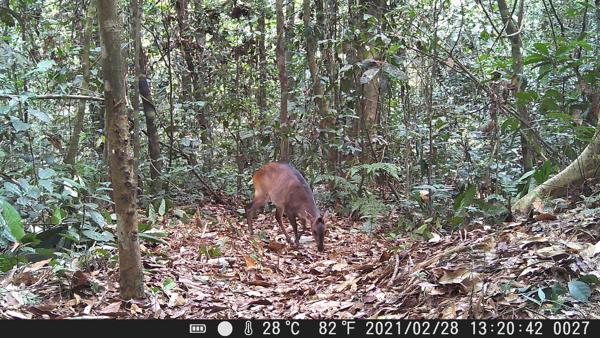
Light-backed Duiker

Light-backed Duiker

Cephalophus silvicultor

Silhouette: Kai Caspar · PhyloPic

LCNTNear ThreatenedVUENCR
Daily sighting probability ~60% · Likely
at Chinko Conservation Area

In 3 days ~90% in a week >90%

95 Verified sightings at Chinko Conservation Area From 2019 to 2026
107 In all 2 parks
February Best month
🌅 Crepuscular When it's spotted

About the Light-backed Duiker

The yellow-backed duiker (Cephalophus silvicultor) is a shy, forest-dwelling antelope of the order Artiodactyla, from the family Bovidae. Yellow-backed duikers are the most widely-distributed of all duikers. They are found mainly in Central and Western Africa, ranging from Senegal and Gambia on the western coast, through to the Democratic Republic of the Congo to western Uganda; their distribution continues southward into Rwanda, Burundi, and most of Zambia.

The scientific name of the yellow-backed duiker is Cephalophus silvicultor. It is the type species of Cephalophus, and placed in the subfamily Cephalophinae and family Bovidae. The species was first described by Swedish botanist Adam Afzelius in the journal Nova Acta Regiæ Societatis Scientiarum Upsaliensis in 1815. The generic name has possibly originated from the combination of the New Latin word cephal, meaning head, and the Greek word lophos, meaning crest. The specific name silvicultor is composed by two Latin words: silva, meaning wood, and cultus, which relates to cultivation. This refers to its habitat.

In 1981, Colin Groves and Peter Grubb identified three subgenera of Cephalophus: Cephalophula...

Wikipedia →

Global Distribution

Parks Where Found

# Park Country Daily sighting probability
1 Chinko Conservation Area 🇨🇫 Central African Republic
~60%
2 Odzala-Kokoua National Park 🇨🇬 Republic of the Congo
~20%

Zoos & Centres Where Found

# Zoo / Centre Country
1 Denver Zoo 🇺🇸 United States In captivity
2 Zoo Miami 🇺🇸 United States In captivity
3 San Diego Zoo Safari Park 🇺🇸 United States In captivity
4 Brookfield Zoo 🇺🇸 United States In captivity
5 Nashville Zoo at Grassmere 🇺🇸 United States In captivity
6 Omaha’s Henry Doorly Zoo and Aquarium 🇺🇸 United States In captivity
7 Gatorland 🇺🇸 United States In captivity
8 Zoo Knoxville 🇺🇸 United States In captivity
9 Akron Zoo 🇺🇸 United States In captivity
10 Gladys Porter Zoo 🇺🇸 United States In captivity

Before you go

What are the chances of seeing a Light-backed Duiker in Chinko Conservation Area?

Likely

About 60% of wildlife watchers report a Light-backed Duiker sighting in Chinko Conservation Area on a given day, based on 95 verified sightings from GBIF citizen-science data from 2019 to 2026. It is the 4th most-seen of the 53 mammals we can rate there. Over three days the chance rises to about 90%, and over a week to over 90%, if each day is a fresh chance.

When is the best time to see a Light-backed Duiker in Chinko Conservation Area?

January–February and September

In those months about 70% of wildlife watchers report a Light-backed Duiker in Chinko Conservation Area on a given day, against about 40% in April and August, the lowest months.

What time of day is best to see a Light-backed Duiker?

Between 5 and 8 am

Across all the parks we cover, that three-hour window holds the most Light-backed Duiker sightings with a recorded time, and about half of them come between 6 am and 6 pm: it is most active around dawn and dusk.

Is Chinko Conservation Area the best place to see a Light-backed Duiker?

Yes

Of the 2 parks where we can rate Light-backed Duiker sightings, Chinko Conservation Area has the highest daily chance: about 60%. Next come Odzala-Kokoua National Park (Republic of the Congo, about 20%).

Which relatives of the Light-backed Duiker live in Chinko Conservation Area?

Same genus: Cephalophus

The closest relatives of the Light-backed Duiker that you can see in Chinko Conservation Area (genus Cephalophus, Forest Duikers) are Weyns's Duiker (about 50%), Red-Flanked Duiker (about 40%) and Bay Duiker (about 40%), with each one's daily chance of a sighting.

Where does the Light-backed Duiker sighting chance come from?

GBIF citizen-science records

It is estimated from how often the Light-backed Duiker is recorded against all the mammals logged in Chinko Conservation Area (95 verified sightings from 2019 to 2026), calibrated against known sighting rates. Figures are rounded to the nearest 10% because citizen-science data supports honest approximations, not decimals, and months with records from fewer than five people show "—". How it works.

← Back to Chinko Conservation Area