About the Greater Vasa Parrot
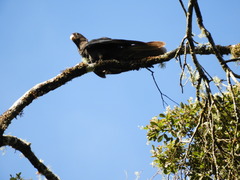
The greater vasa parrot (Coracopsis vasa) is one of two species of vasa parrot, the other being the lesser vasa parrot (C. nigra). The greater vasa parrot can be found throughout Madagascar and the Comoros. The bird was first described in 1812 by George Shaw. There are three subspecies:
The bird is placed in the genus Mascarinus by some authorities. The greater vasa parrot's breeding season is uncertain, but is probably between October and December. It has a very unusual breeding biology and mating system; females are 25% larger than males, and are, physically, dominant. The species lives in loose, polygynandrous groups wherein each female has at least 3-8 sexual partners. The males have re-evolved a phallus, and copulations can last up to 90 minutes. Copulations come in two lengths—short (1–3 seconds) and long durations (averaging 36 minutes), with the latter involving a copulatory tie. A copulatory tie usually applies to mammals, such as canids and felids, where the two animals are unable to physically part during mating due to the swelling, and structure, of... Wikipedia →