Mascarene Martin

Mascarene Martin

Phedina borbonica

Silhouette: Sheatherius · PhyloPic

LCLeast ConcernNTVUENCR
Daily sighting probability ~40% · Likely
at Antananarivo

In 3 days ~80% in a week >90%

482 Verified sightings at Antananarivo
667 In all 4 parks From 2019 to 2026
June Best month
☀️ Diurnal When it's spotted

About the Mascarene Martin

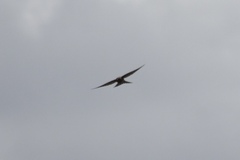
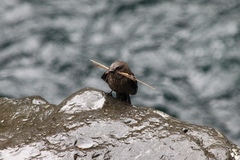
The Mascarene martin or Mascarene swallow (Phedina borbonica) is a passerine bird in the swallow family that breeds in Madagascar and in the Mascarene Islands. The nominate subspecies occurs on Mauritius and Réunion and has never been found away from the Mascarene Islands, but the smaller Madagascan subspecies, P. b. madagascariensis, is migratory and has been recorded wintering in East Africa or wandering to other Indian Ocean islands.

The Mascarene martin is a small swallow that has grey-brown underparts becoming white on the throat and lower abdomen, dark grey-brown upperparts and a slightly forked tail. The underparts are heavily streaked with black. It nests in small colonies anywhere with suitably sheltered sites for constructing a nest, such as ledges, buildings, tunnels, caves or amongst rocks. The nest is a shallow cup of twigs and other plant material, and the normal clutch is two or three brown-spotted white eggs. The incubation and fledging times are unknown. The Mascarene martin has a heavy flight with slow wingbeats interspersed with glides, and frequently perches on wires. It feeds on insects in flight, often hunting low over the ground or vegetation. In eastern Africa, open habitats such as deforested areas are frequently used for hunting. A number of internal and external parasites have been detected in this species.

Tropical cyclones can adversely affect populations on the smaller islands, but the Mascarene martin is a locally common bird with an apparently stable population and is classed as a species of Least Concern by the International Union for Conservation of Nature (IUCN). Its legal protection ranges from none on the French overseas department of Réunion to a status on Mauritius as a "species of wildlife in respect of which more severe penalties are provided". Wikipedia →

Sounds

Flight call0:44

Madagascar · 2023

© Paul Lenrumé · XC836206 · CC BY-NC-SA 4.0

Call0:43

Madagascar · 2020

© Ken Behrens · XC622777 · CC BY-NC-SA 4.0

Song0:09

Mauritius · 2015

© Albert Lastukhin & Alexandr Shirjaev · XC212891 · CC BY-NC-SA 4.0

Global Distribution

Parks Where Found

# Park Country Daily sighting probability
1 Mantadia National Park 🇲🇬 Madagascar
~40%
2 Ranomafana National Park 🇲🇬 Madagascar
~40%
3 Ankarafantsika National Park 🇲🇬 Madagascar
~10%
4 Berenty Reserve 🇲🇬 Madagascar
~10%

Cities Where Found

# City Country Daily sighting probability
1 Antananarivo 🇲🇬 Madagascar
~40%

Before you go

What are the chances of seeing a Mascarene Martin in Antananarivo?

Likely

About 40% of wildlife watchers report a Mascarene Martin sighting in Antananarivo on a given day, based on 482 verified sightings from GBIF citizen-science data. It is the 23rd most-seen of the 69 birds we can rate there. Over three days the chance rises to about 80%, and over a week to over 90%, if each day is a fresh chance.

When is the best time to see a Mascarene Martin in Antananarivo?

June

In that month about 60% of wildlife watchers report a Mascarene Martin in Antananarivo on a given day, against about 20% in April and December, the lowest months. That is one of Antananarivo's driest months, with about 85 mm of rain against 480 mm in January.

What time of day is best to see a Mascarene Martin?

Between 7 and 10 am

Across all the parks we cover, that three-hour window holds the most Mascarene Martin sightings with a recorded time, and about 7 in 10 of them come between 6 am and 6 pm: it is a daytime animal.

Where else can you see a Mascarene Martin?

Only Antananarivo, in our data

Antananarivo is the only city on Wallace's Line with enough records to rate Mascarene Martin sightings: about 40% of wildlife watchers there report one on a given day.

Where does the Mascarene Martin sighting chance come from?

GBIF citizen-science records

It is estimated from how often the Mascarene Martin is recorded against all the birds logged in Antananarivo (482 verified sightings), calibrated against known sighting rates. Figures are rounded to the nearest 10% because citizen-science data supports honest approximations, not decimals, and months with records from fewer than five people show "—". How it works.

← Back to Antananarivo