Torrent Duck

Torrent Duck

Merganetta armata

Silhouette: Edwin Price · PhyloPic

LCLeast ConcernNTVUENCR
Daily sighting probability ~10% · With luck
at Arequipa

In 3 days ~20% in a week ~40%

79 Verified sightings at Arequipa
647 In all 6 parks From 2019 to 2026
January Best month
☀️ Diurnal When it's spotted

About the Torrent Duck

The torrent duck (Merganetta armata) is a member of the duck, goose and swan family Anatidae. It is the only member of the genus Merganetta. It is placed in the shelduck subfamily Tadorninae after the "perching duck" assemblage to which it was formerly assigned was dissolved because it turned out to be paraphyletic.

This 43–46-centimetre (17–18 in) long species is a resident breeder in the Andes of South America, nesting in small waterside caves and other sheltered spots. Like the blue duck, it holds territories on fast-flowing mountain rivers, usually above 1,500 metres (4,900 ft). It is a powerful swimmer and diver even in white water but is reluctant to fly more than short distances. It is not particularly wary when located.

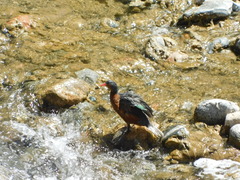
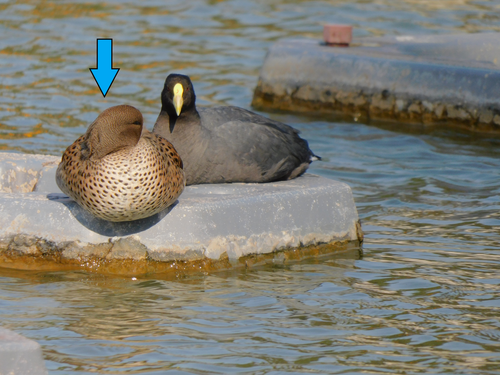
Male torrent ducks have a striking black and white head and neck pattern and a red bill. In-flight, they show dark wings with green speculum. Females of all subspecies are smaller than the drakes; they have orange underparts and throat, with the head and upperparts grey and a yellower bill. Juveniles are pale grey above and whitish below.

The male's call is a shrill whistle, while the female's is a throatier whistle. This is a declining species due to competition for its invertebrate food from introduced trout, pollution, forest destruction, and damming of mountain rivers for hydroelectric schemes. The Chilean population seems relatively stable, while the more northern ones are more seriously affected. However, the overall population is still large enough to warrant classification as a Species of Least Concern in the IUCN Redlist. Wikipedia →


Sounds

Alarm call0:46

Chile · 2019

© Cristian Pinto · XC581872 · CC BY-NC-SA 4.0

Call0:28

Colombia · 2014

© Hans Matheve · XC401548 · CC BY-NC-ND 4.0

Global Distribution

Parks Where Found

# Park Country Daily sighting probability
1 Torres del Paine National Park 🇨🇱 Chile
~10%
2 Lauca National Park 🇨🇱 Chile
~10%
3 Farallones de Cali National Natural Park 🇨🇴 Colombia
~10%
4 Los Nevados National Natural Park 🇨🇴 Colombia
<5%
5 Vicente Pérez Rosales National Park 🇨🇱 Chile
<5%
6 Podocarpus National Park 🇪🇨 Ecuador
<5%

Cities Where Found

# City Country Daily sighting probability
1 Arequipa 🇵🇪 Peru
~10%

Before you go

What are the chances of seeing a Torrent Duck in Arequipa?

With luck

About 10% of wildlife watchers report a Torrent Duck sighting in Arequipa on a given day, based on 79 verified sightings from GBIF citizen-science data. It is the 28th most-seen of the 61 birds we can rate there. Over three days the chance rises to about 20%, and over a week to about 40%, if each day is a fresh chance.

When is the best time to see a Torrent Duck in Arequipa?

January

In that month about 20% of wildlife watchers report a Torrent Duck in Arequipa on a given day, against under 5% in March–April and June–August, the lowest months. That is one of Arequipa's wettest months, with about 35 mm of rain against almost none in June.

What time of day is best to see a Torrent Duck?

Between 1 and 4 pm

Across all the parks we cover, that three-hour window holds the most Torrent Duck sightings with a recorded time, and about 9 in 10 of them come between 6 am and 6 pm: it is a daytime animal.

Where else can you see a Torrent Duck?

Only Arequipa, in our data

Arequipa is the only city on Wallace's Line with enough records to rate Torrent Duck sightings: about 10% of wildlife watchers there report one on a given day.

Where does the Torrent Duck sighting chance come from?

GBIF citizen-science records

It is estimated from how often the Torrent Duck is recorded against all the birds logged in Arequipa (79 verified sightings), calibrated against known sighting rates. Figures are rounded to the nearest 10% because citizen-science data supports honest approximations, not decimals, and months with records from fewer than five people show "—". How it works.

← Back to Arequipa