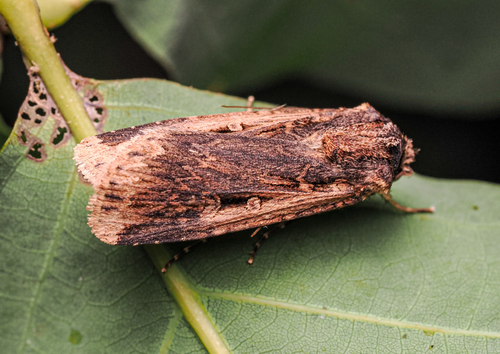
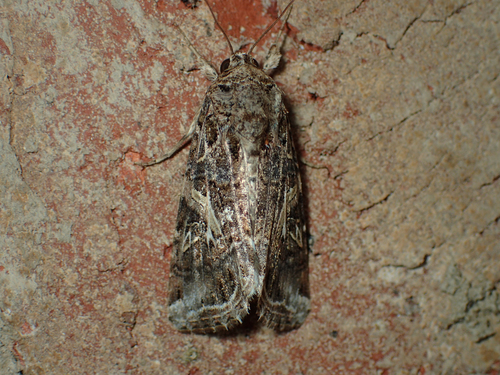
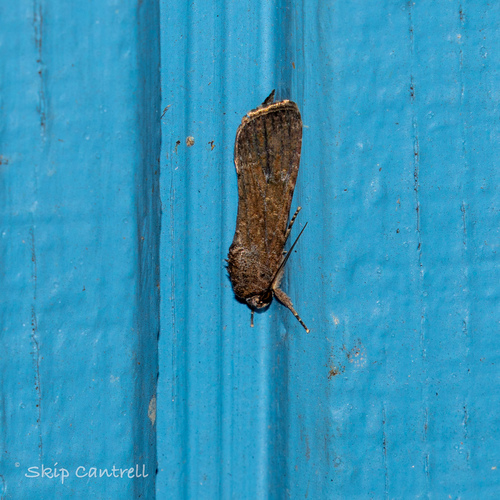
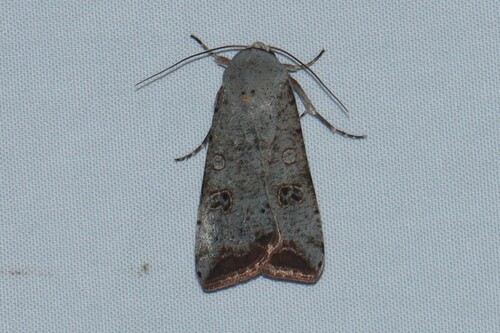
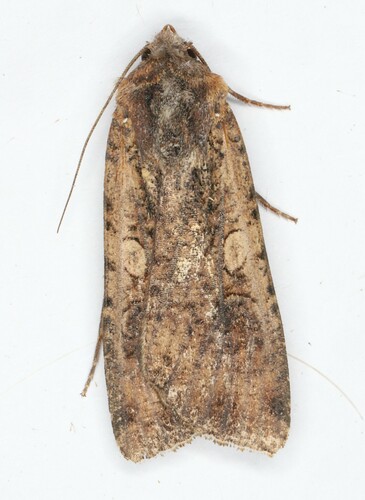
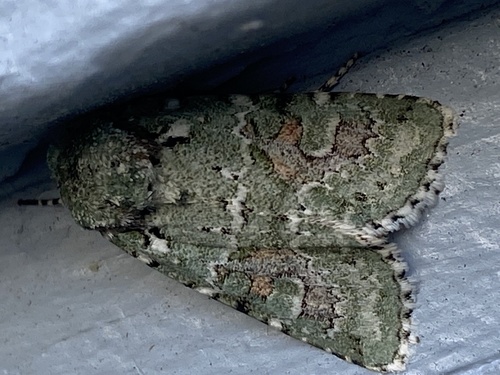
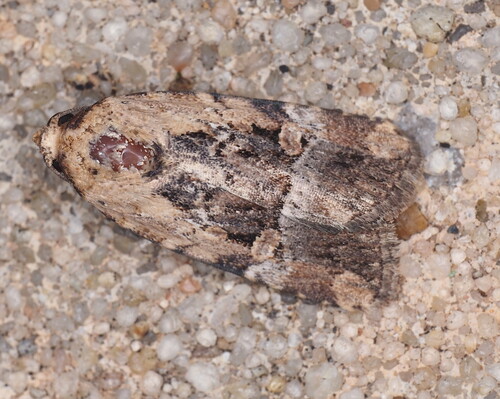
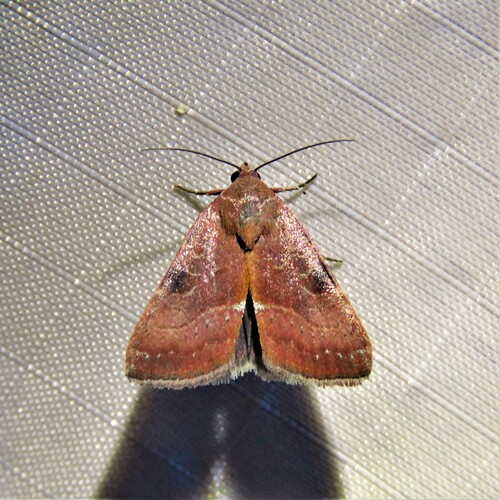
Alfalfa Looper Moth

Alfalfa Looper Moth

Tathorhynchus exsiccata

Daily sighting probability <5% · Rare
at Austin

In 3 days ~10% in a week ~20%

10 Verified sightings at Austin
27 In all 2 parks From 2019 to 2026
November Best month
🌙 Nocturnal When it's spotted

About the Alfalfa Looper Moth

Tathorhynchus is a monotypic genus of moth in the family Erebidae erected by George Hampson in 1894. Its only species, Tathorhynchus exsiccata, the Levant blackneck or double-spotted snout, was first described by Julius Lederer in 1855. The nominate form is found on the Canary Islands and in North Africa, tropical Asia and tropical Africa. It has been introduced in Dominica and Argentina. Subspecies Tathorhynchus exsiccata fallax is found in the northern half of Australia, as well as Norfolk Island and New Zealand.

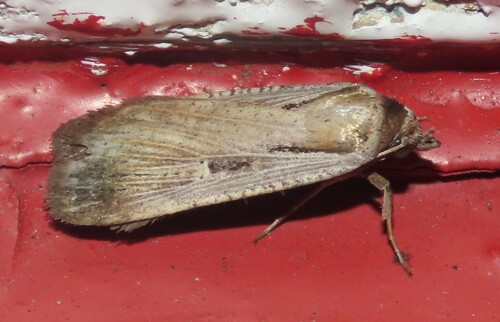
This species was transferred to Lygephila exsiccata by Goater et al. in 2003, but was returned to Tathorhynchus Hampson by Fibiger and Hacker in 2005. T. exsiccata Led. (= vinctalis Walk.) Forewing whitish, thickly suffused with grey brown, darker towards termen; the orbicular and reniform stigmata marked by pale spots separated by a black dash; another beyond reniform; outer line pale preceded by black marks; a terminal row of black lunules; hindwing greyish white, darker terminally.

The wingspan is about 40 mm. Tathorhynchus exsiccata exsiccata Tathorhynchus exsiccata fallax The larvae... Wikipedia →
Global Distribution

Parks Where Found

# Park Country Daily sighting probability
1 Big Bend National Park 🇺🇸 United States
~10%
2 Kruger National Park 🇿🇦 South Africa
<5%

Cities Where Found

# City Country Daily sighting probability
1 Austin 🇺🇸 United States
<5%

Before you go

What are the chances of seeing an Alfalfa Looper Moth in Austin?

Rare

Under 5% of wildlife watchers report an Alfalfa Looper Moth sighting in Austin on a given day, based on 10 verified sightings from GBIF citizen-science data. It is the 1145th most-seen of the 1624 insects we can rate there. Over three days the chance rises to about 10%, and over a week to about 20%, if each day is a fresh chance.

When is the best time to see an Alfalfa Looper Moth in Austin?

Any time of year

In every month with enough records, under 5% of wildlife watchers report an Alfalfa Looper Moth in Austin on a given day, so our monthly data shows no clear season.

What time of day is best to see an Alfalfa Looper Moth?

Between 7 and 10 pm

Across all the parks we cover, that three-hour window holds the most Alfalfa Looper Moth sightings with a recorded time, and about 8 in 10 of them come between 6 pm and 6 am: it is mostly seen at night.

Where else can you see an Alfalfa Looper Moth?

Only Austin, in our data

Austin is the only city on Wallace's Line with enough records to rate Alfalfa Looper Moth sightings: under 5% of wildlife watchers there report one on a given day.

Which relatives of the Alfalfa Looper Moth live in Austin?

Same family: Noctuidae

The closest relatives of the Alfalfa Looper Moth that you can see in Austin (family Noctuidae, Cutworm Moths and Allies) are Wedgling Moth (about 20%), Harp-Winged Tripudia Moth (about 20%) and Armyworm Moth (about 20%), with each one's daily chance of a sighting.

Where does the Alfalfa Looper Moth sighting chance come from?

GBIF citizen-science records

It is estimated from how often the Alfalfa Looper Moth is recorded against all the insects logged in Austin (10 verified sightings), calibrated against known sighting rates. Figures are rounded to the nearest 10% because citizen-science data supports honest approximations, not decimals, and months with records from fewer than five people show "—". How it works.

← Back to Austin