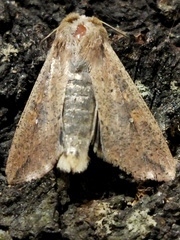
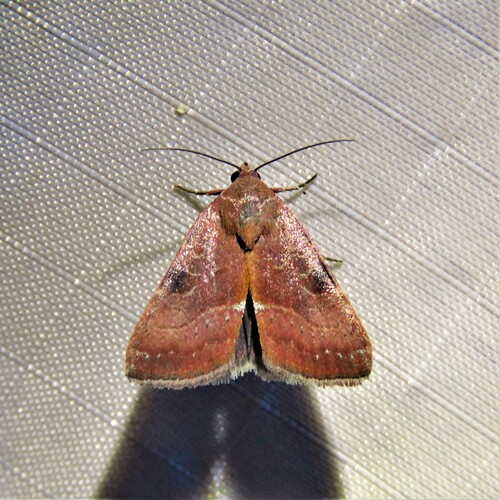
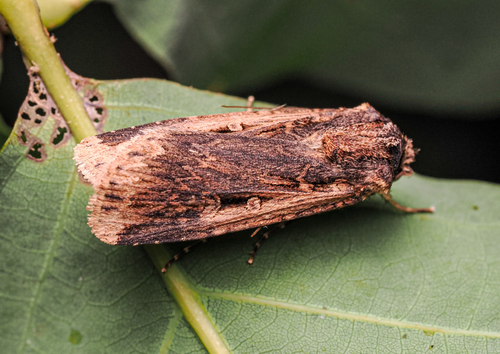
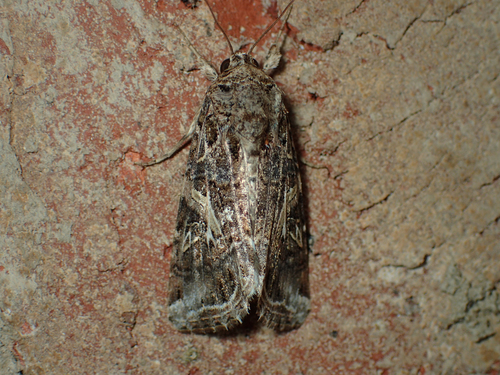
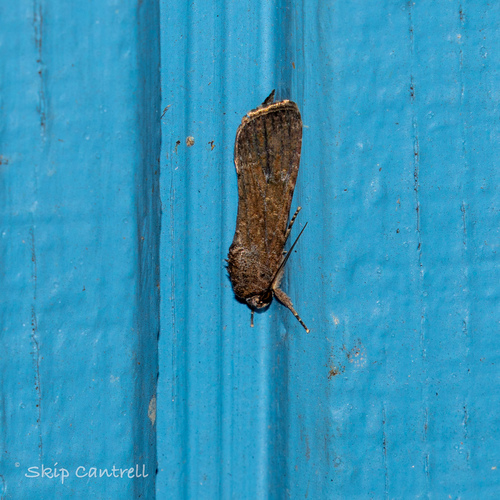
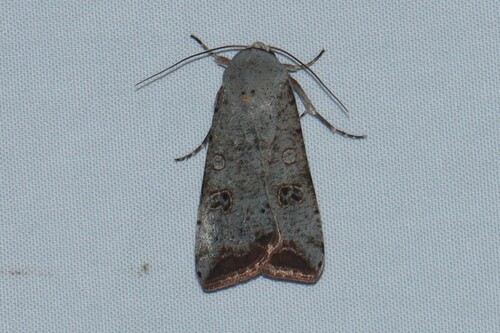
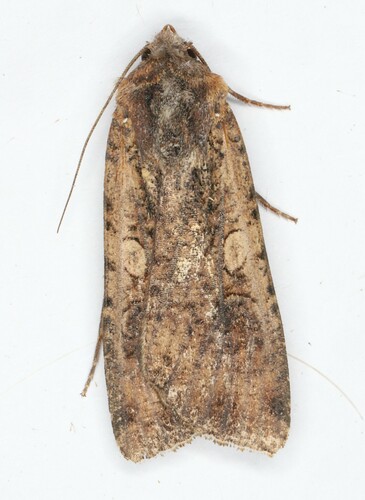
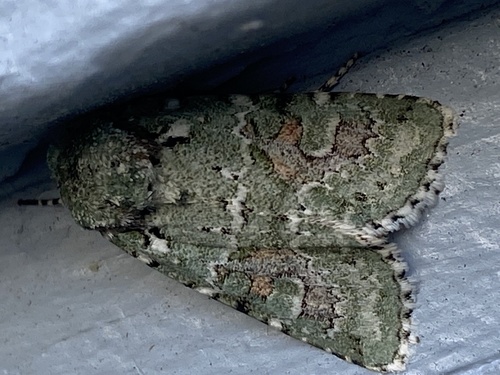
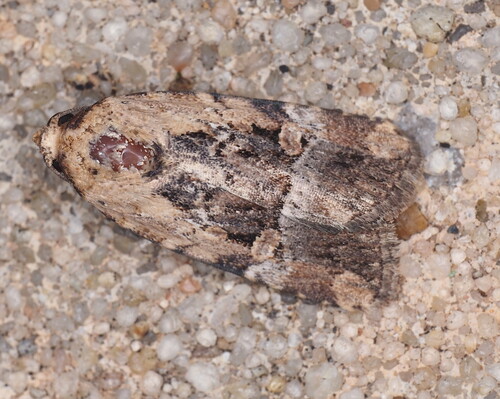
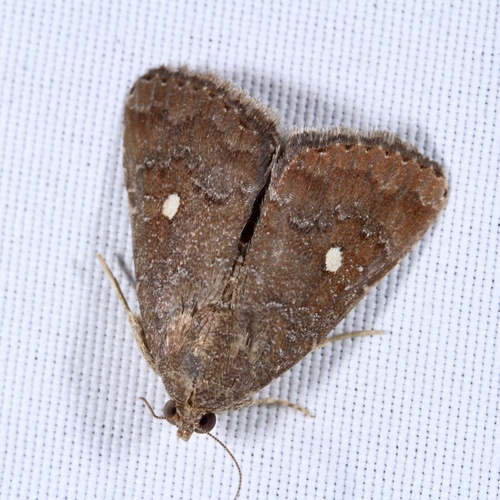
Armyworm Moth

Armyworm Moth

Mythimna unipuncta

Daily sighting probability ~20% · Possible
at Austin

In 3 days ~40% in a week ~70%

566 Verified sightings at Austin
97 In all 8 parks From 2019 to 2026
February Best month
🌙 Nocturnal When it's spotted

About the Armyworm Moth

Mythimna unipuncta, the true armyworm moth, white-speck moth, common armyworm, or rice armyworm, is a species of moth in the family Noctuidae. The species was first described by Adrian Hardy Haworth in 1809. Mythimna unipuncta occurs in most of North America south of the Arctic, as well as parts of South America, Europe, Africa, and Asia. Although thought to be Neotropical in origin, it has been introduced elsewhere, and is often regarded as an agricultural pest. They are known as armyworms because the caterpillars move in lines as a massive group, like an army, from field to field, damaging crops.

The true armyworm has a distinct migration pattern in which they travel north in the spring and south in the fall to ensure that mating occurs in a favorable environment in the summer. While progressing through the life cycle stages of egg, larva, pupa, and adult, this species must avoid attack from predatory bugs, birds, wasp and fly parasitoids, and bacterial and fungal diseases. As polygamous insects, females release sex pheromones and choose multiple males as mates. The production and release of the pheromones are influenced by temperature, photoperiod, and the juvenile hormone. Hearing is an important sense for the true armyworm, necessary for mating and evading bat predation. Wikipedia →

Global Distribution

Parks Where Found

# Park Country Daily sighting probability
1 Guadalupe Mountains National Park 🇺🇸 United States
~10%
2 Big Bend National Park 🇺🇸 United States
~10%
3 Pyrénées National Park 🇫🇷 France
~10%
4 Shenandoah National Park 🇺🇸 United States
~10%
5 Point Pelee National Park 🇨🇦 Canada
~10%
6 Cévennes National Park 🇫🇷 France
<5%
7 Acadia National Park 🇺🇸 United States
<5%
8 Cumbres de Monterrey National Park 🇲🇽 Mexico
<5%

Cities Where Found

# City Country Daily sighting probability
1 Porto 🇵🇹 Portugal
~20%
2 Austin 🇺🇸 United States
~20%
3 Turin 🇮🇹 Italy
~10%
4 Chicago 🇺🇸 United States
~10%
5 Dallas 🇺🇸 United States
~10%
6 Sacramento 🇺🇸 United States
~10%
7 Boston 🇺🇸 United States
~10%
8 San Antonio 🇺🇸 United States
~10%
9 Puebla 🇲🇽 México
~10%
10 Milan 🇮🇹 Italy
~10%

Before you go

What are the chances of seeing an Armyworm Moth in Austin?

Possible

About 20% of wildlife watchers report an Armyworm Moth sighting in Austin on a given day, based on 566 verified sightings from GBIF citizen-science data. It is the 34th most-seen of the 1624 insects we can rate there. Over three days the chance rises to about 40%, and over a week to about 70%, if each day is a fresh chance.

When is the best time to see an Armyworm Moth in Austin?

February

In that month about 40% of wildlife watchers report an Armyworm Moth in Austin on a given day, against under 5% in May and July, the lowest months.

What time of day is best to see an Armyworm Moth?

Between 9 pm and midnight

Across all the parks we cover, that three-hour window holds the most Armyworm Moth sightings with a recorded time, and about 7 in 10 of them come between 6 pm and 6 am: it is mostly seen at night.

Is Austin the best place to see an Armyworm Moth?

Among the best

Of the 34 cities where we can rate Armyworm Moth sightings, Austin ranks 2nd at about 20%, level with the leaders once rounded. The best odds are in Porto (Portugal, about 20%).

Which relatives of the Armyworm Moth live in Austin?

Same family: Noctuidae

The closest relatives of the Armyworm Moth that you can see in Austin (family Noctuidae, Cutworm Moths and Allies) are Wedgling Moth (about 20%), Harp-Winged Tripudia Moth (about 20%) and Subterranean Dart (about 10%), with each one's daily chance of a sighting.

Where does the Armyworm Moth sighting chance come from?

GBIF citizen-science records

It is estimated from how often the Armyworm Moth is recorded against all the insects logged in Austin (566 verified sightings), calibrated against known sighting rates. Figures are rounded to the nearest 10% because citizen-science data supports honest approximations, not decimals, and months with records from fewer than five people show "—". How it works.

← Back to Austin