Giant Walkingstick

Giant Walkingstick

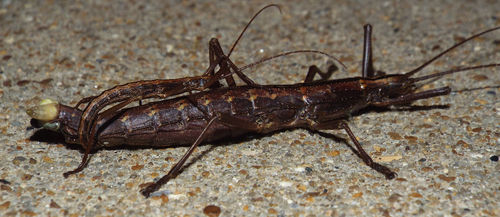
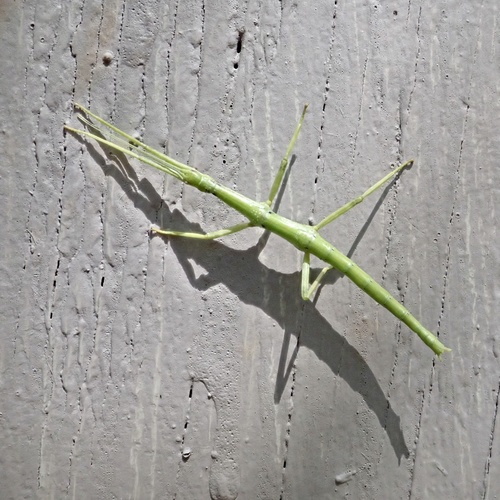
Megaphasma denticrus

Daily sighting probability <5% · Rare
at Austin

In 3 days ~10% in a week ~20%

32 Verified sightings at Austin
June Best month

About the Giant Walkingstick

Megaphasma denticrus, the giant walkingstick, is a species of phasmid or stick insect in the family Diapheromeridae. They inhabit a range spanning wooded areas of Texas, Oklahoma, and parts of Mexico. It is the largest insect in North America, growing up to 7 inches in length. Giant walkingsticks exhibit sexual dimorphism, with females generally being significantly larger than males. Giant walkingsticks have spines on their middle and hind legs; males have only a single, larger spine on each hind leg. Giant walkingsticks vary in color from shades of green to brown. Males also tend to be more brightly colored than females.

The giant walkingstick can be found as far east as Indiana, Alabama, and Kentucky; north to Wisconsin; west to New Mexico; and south to Mexico. However, they can be found most commonly in wooded areas of Texas, Oklahoma, and parts of Mexico.

Giant walkingsticks' preferred habitat and diet includes grass, grapevines, oak trees, elms, and mesquites.. The insects eat the foliage of these plants, and use camouflage to blend into the woody parts of their habitat.. Some evidence from captive rearing suggests that dietary... Wikipedia →
Global Distribution

Parks Where Found

# Park Country Daily sighting probability

More parks will be added in future updates.

Cities Where Found

# City Country Daily sighting probability
1 San Antonio 🇺🇸 United States
~10%
2 Austin 🇺🇸 United States
<5%
3 Dallas 🇺🇸 United States
<5%

Before you go

What are the chances of seeing a Giant Walkingstick in Austin?

Rare

Under 5% of wildlife watchers report a Giant Walkingstick sighting in Austin on a given day, based on 32 verified sightings from GBIF citizen-science data. It is the 639th most-seen of the 1624 insects we can rate there. Over three days the chance rises to about 10%, and over a week to about 20%, if each day is a fresh chance.

When is the best time to see a Giant Walkingstick in Austin?

June

In that month about 10% of wildlife watchers report a Giant Walkingstick in Austin on a given day, against under 5% in July to May, the lowest months.

Is Austin the best place to see a Giant Walkingstick?

2nd of 3

Of the 3 cities where we can rate Giant Walkingstick sightings, Austin ranks 2nd at under 5%. The best odds are in San Antonio (United States, about 10%).

Where does the Giant Walkingstick sighting chance come from?

GBIF citizen-science records

It is estimated from how often the Giant Walkingstick is recorded against all the insects logged in Austin (32 verified sightings), calibrated against known sighting rates. Figures are rounded to the nearest 10% because citizen-science data supports honest approximations, not decimals, and months with records from fewer than five people show "—". How it works.

← Back to Austin