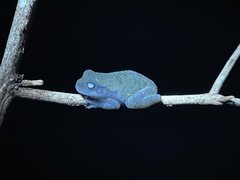
Cope's Gray Tree Frog

Cope's Gray Tree Frog

Dryophytes chrysoscelis

Silhouette: Robbi Bishop-Taylor · PhyloPic

LCLeast ConcernNTVUENCR
Daily sighting probability ~10% · With luck
at Baltimore

In 3 days ~20% in a week ~50%

28 Verified sightings at Baltimore
101 In all 2 parks From 2019 to 2026
May Best month
☀️🌙 Day & Night When it's spotted

About the Cope's Gray Tree Frog

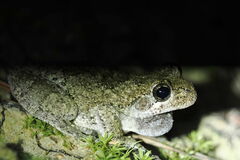
Cope's gray treefrog (Dryophytes chrysoscelis) is a species of treefrog found in the United States and Canada. It is almost indistinguishable from the gray treefrog (Dryophytes versicolor), and shares much of its geographic range. Both species are variable in color, mottled gray to gray-green, resembling the bark of trees. These are treefrogs of woodland habitats, though they will sometimes travel into more open areas to reach a breeding pond. The only readily noticeable difference between the two species is the mating call — Cope's has a faster-paced and slightly higher-pitched call than D. versicolor. In addition, D. chrysoscelis is reported to be slightly smaller, more arboreal, and more tolerant of dry conditions than D. versicolor.

Edward Drinker Cope described the species in 1880. The specific name, chrysoscelis, is from Greek chrysos, gold, and scelis, leg. Microscopic inspection of the chromosomes of D. chrysoscelis and D. versicolor reveals differences in chromosome number. D. chrysoscelis is diploid, having two complete sets of chromosomes, the usual condition in vertebrates. D. versicolor is tetraploid, having double the usual number of chromosomes. Generally... Wikipedia →

Sounds

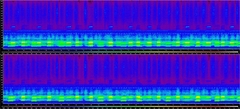
Advertisement call0:12

United States · 2016

© Chris Harrison · XC1046110 · CC BY-NC-SA 4.0

Recording0:08

United States · 2026

© Robert Hoard · iNaturalist · CC BY 4.0

Recording0:05

United States · 2026

© laned228 · iNaturalist · CC BY-NC 4.0

Global Distribution

Parks Where Found

# Park Country Daily sighting probability
1 Congaree National Park 🇺🇸 United States
~30%
2 Great Smoky Mountains National Park 🇺🇸 United States
~20%

Cities Where Found

# City Country Daily sighting probability
1 Washington 🇺🇸 United States
~10%
2 Baltimore 🇺🇸 United States
~10%
3 Minneapolis [Saint Paul] 🇺🇸 United States
~10%

Zoos & Centres Where Found

# Zoo / Centre Country
1 National Zoological Park 🇺🇸 United States In captivity
2 The Maryland Zoo 🇺🇸 United States In captivity
3 Zoo Atlanta 🇺🇸 United States In captivity
4 Virginia Aquarium 🇺🇸 United States In captivity
5 North Carolina Aquarium on Roanoke Island 🇺🇸 United States In captivity
6 South Carolina Aquarium 🇺🇸 United States In captivity
7 Tennessee Aquarium 🇺🇸 United States In captivity

Before you go

What are the chances of seeing a Cope's Gray Tree Frog in Baltimore?

With luck

About 10% of wildlife watchers report a Cope's Gray Tree Frog sighting in Baltimore on a given day, based on 28 verified sightings from GBIF citizen-science data. It is the 5th most-seen of the 11 amphibians we can rate there. Over three days the chance rises to about 20%, and over a week to about 50%, if each day is a fresh chance.

When is the best time to see a Cope's Gray Tree Frog in Baltimore?

May and July

In those months about 20% of wildlife watchers report a Cope's Gray Tree Frog in Baltimore on a given day, against under 5% in August and November–April, the lowest months.

What time of day is best to see a Cope's Gray Tree Frog?

Between 8 and 11 pm

Across all the parks we cover, that three-hour window holds the most Cope's Gray Tree Frog sightings with a recorded time, and about half of them come between 6 am and 6 pm: it is seen both by day and at night.

Is Baltimore the best place to see a Cope's Gray Tree Frog?

Among the best

Of the 3 cities where we can rate Cope's Gray Tree Frog sightings, Baltimore ranks 2nd at about 10%, level with the leaders once rounded. The best odds are in Washington (United States, about 10%).

Where does the Cope's Gray Tree Frog sighting chance come from?

GBIF citizen-science records

It is estimated from how often the Cope's Gray Tree Frog is recorded against all the amphibians logged in Baltimore (28 verified sightings), calibrated against known sighting rates. Figures are rounded to the nearest 10% because citizen-science data supports honest approximations, not decimals, and months with records from fewer than five people show "—". How it works.

← Back to Baltimore