Pallas's Leaf-Warbler

Pallas's Leaf-Warbler

Phylloscopus proregulus

Silhouette: Margot Michaud · PhyloPic

LCLeast ConcernNTVUENCR
Daily sighting probability <5% · Rare
at Barcelona

In 3 days <5% in a week ~10%

65 Verified sightings at Barcelona
124 In all 2 parks From 2019 to 2026
December Best month
☀️ Diurnal When it's spotted

About the Pallas's Leaf-Warbler

Pallas's leaf warbler (Phylloscopus proregulus) or Pallas's warbler is a bird that breeds in mountain forests from southern Siberia east to northern Mongolia and northeast China. It is named after the German zoologist Peter Simon Pallas, who first formally described it. This leaf warbler is strongly migratory, wintering mainly in south China and adjacent areas of southeast Asia, although in recent decades increasing numbers have been found in Europe in autumn.

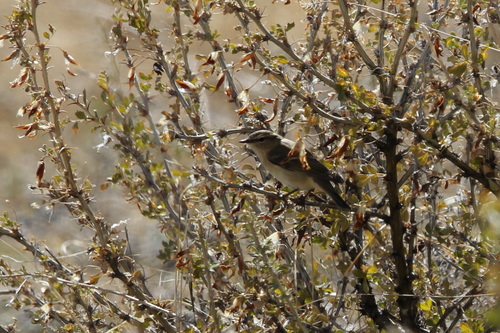
Pallas's leaf warbler is one of the smallest Palearctic warblers, with a relatively large head and short tail. It has greenish upperparts and white underparts, a lemon-yellow rump, and yellow double wingbars, supercilia and central crown stripe. It is similar in appearance to several other Asian warblers, including some that were formerly considered to be subspecies of it, although its distinctive vocalisations aid identification.

The female builds a cup nest in a tree or bush, and incubates the four to six eggs, which hatch after 12–13 days. The chicks are fed mainly by the female and fledge when they are 12–14 days old; both parents then bring food for about a week. Pallas's leaf warbler is insectivorous, feeding on the adults, larvae and pupae of small insects and spiders. Birds forage in bushes and trees, picking items from leaves or catching prey in short flights or while hovering. The Pallas's leaf warbler has a large range, and its numbers are believed to be stable. It therefore is evaluated as of "least concern" by the International Union for Conservation of Nature (IUCN). Wikipedia →

Sounds

Song0:12

South Korea · 2025

© Se-Jun Choi · XC1152783 · CC BY-NC-ND 4.0

Subsong0:56

Mongolia · 2026

© Ding Li Yong · XC1137937 · CC BY-NC-ND 4.0

Call0:22

China · 2026

© Bo Shunqi 薄顺奇 · XC1107050 · CC BY-NC-SA 4.0

Global Distribution

Parks Where Found

# Park Country Daily sighting probability
1 Gobi Gurvansaikhan National Park 🇲🇳 Mongolia
~20%
2 Doi Inthanon National Park 🇹🇭 Thailand
<5%

Cities Where Found

# City Country Daily sighting probability
1 Shijiazhuang 🇨🇳 China
~30%
2 Changsha 🇨🇳 China
~30%
3 Guiyang 🇨🇳 China
~30%
4 Shanghai 🇨🇳 China
~20%
5 Chongqing 🇨🇳 China
~20%
6 Tianjin 🇨🇳 China
~20%
7 Nanchang 🇨🇳 China
~20%
8 Wuhan 🇨🇳 China
~20%
9 Hefei 🇨🇳 China
~20%
10 Kunming 🇨🇳 China
~20%

Before you go

What are the chances of seeing a Pallas's Leaf-Warbler in Barcelona?

Rare

Under 5% of wildlife watchers report a Pallas's Leaf-Warbler sighting in Barcelona on a given day, based on 65 verified sightings from GBIF citizen-science data. It is the 121st most-seen of the 215 birds we can rate there. Over three days the chance rises to under 5%, and over a week to about 10%, if each day is a fresh chance.

When is the best time to see a Pallas's Leaf-Warbler in Barcelona?

December

In that month about 10% of wildlife watchers report a Pallas's Leaf-Warbler in Barcelona on a given day, against under 5% in January to November, the lowest months.

What time of day is best to see a Pallas's Leaf-Warbler?

Between 9 am and noon

Across all the parks we cover, that three-hour window holds the most Pallas's Leaf-Warbler sightings with a recorded time, and about 9 in 10 of them come between 6 am and 6 pm: it is a daytime animal.

Is Barcelona the best place to see a Pallas's Leaf-Warbler?

35th of 38

Of the 38 cities where we can rate Pallas's Leaf-Warbler sightings, Barcelona ranks 35th at under 5%. The best odds are in Shijiazhuang (China, about 30%), Changsha (China, about 30%) and Guiyang (China, about 30%).

Where does the Pallas's Leaf-Warbler sighting chance come from?

GBIF citizen-science records

It is estimated from how often the Pallas's Leaf-Warbler is recorded against all the birds logged in Barcelona (65 verified sightings), calibrated against known sighting rates. Figures are rounded to the nearest 10% because citizen-science data supports honest approximations, not decimals, and months with records from fewer than five people show "—". How it works.

← Back to Barcelona