Footman Moth

Footman Moth

Nepita conferta

Daily sighting probability ~30% · Possible
at Bengaluru

In 3 days ~60% in a week ~90%

262 Verified sightings at Bengaluru
29 In all 3 parks From 2019 to 2026
August Best month
☀️🌙 Day & Night When it's spotted

About the Footman Moth

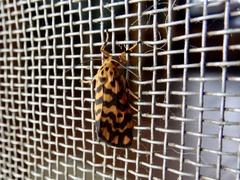
Nepita is a monotypic genus of moth in the subfamily Arctiinae erected by Frederic Moore in 1860. Its only species, Nepita conferta, the footman moth, was first described by Francis Walker in 1854. It is found in India and Sri Lanka.

Palpi porrect (extending forward), extending beyond the frons, and fringed with hair below. Antennae roughly scaled. Tibia with long spurs. Forewings are broad and short. Veins 3 to 5 from close to angle of cell and vein 6 from below upper angle. Veins 7 to 9 stalked and vein 11 anastomosing with vein 12. Hindwings with stalked vein 4 and 5 and 6 and 7. From 8 from beyond middle of cell.

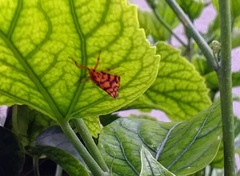
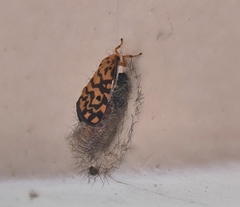
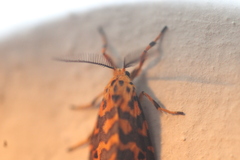
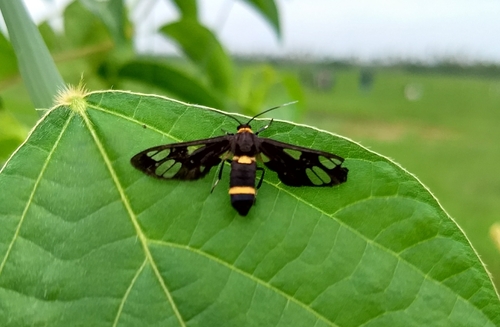
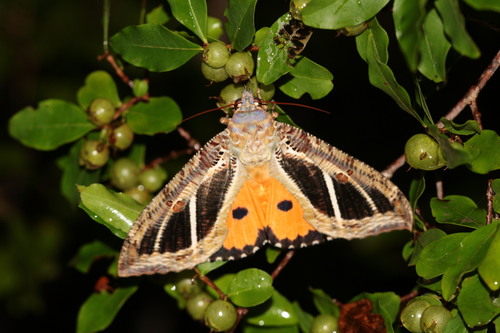
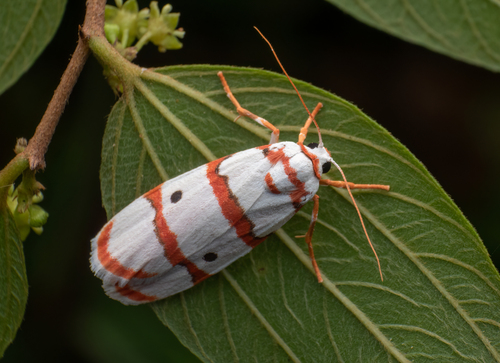
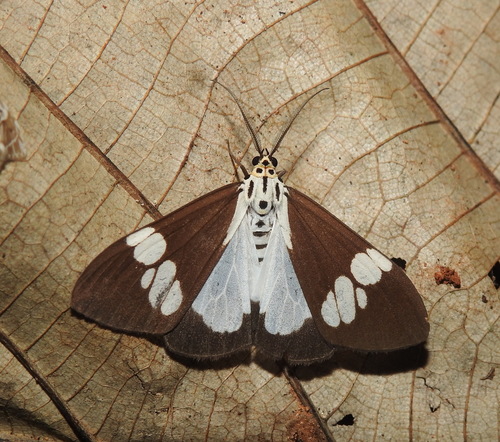
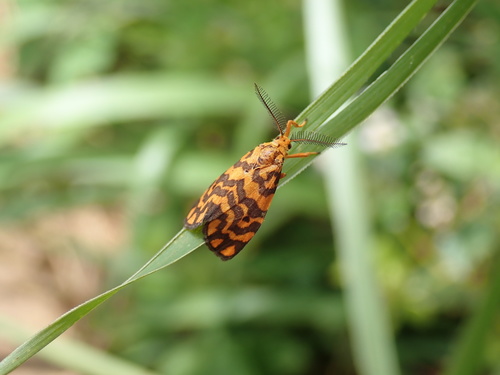
Male antennae bipectinate with short branches. Head and thorax orange, where thorax with black spots. Abdomen black, orange below and at extremity. Forewings orange with some black marks at base. Antemedial and medial bands are curved and waved, which coalesce at median vein. There is a black spot on discocellulars. The post medial band is waved and excurved round end of cell. A series of submarginal spots and streaks present, often conjoined into a band. Margin and cilia are black. Hindwings have orange base, and a broad marginal black band. The spots... Wikipedia →
Global Distribution

Parks Where Found

# Park Country Daily sighting probability
1 Kanha National Park 🇮🇳 India
~30%
2 Sinharaja Forest Reserve 🇱🇰 Sri Lanka
~20%
3 Eravikulam National Park 🇮🇳 India
~20%

Cities Where Found

# City Country Daily sighting probability
1 Bengaluru 🇮🇳 India
~30%
2 Ponnani 🇮🇳 India
~20%
3 Mysuru 🇮🇳 India
~10%
4 Pune 🇮🇳 India
~10%
5 Mumbai 🇮🇳 India
~10%
6 Kozhikode 🇮🇳 India
~10%
7 Kochi 🇮🇳 India
~10%

Before you go

What are the chances of seeing a Footman Moth in Bengaluru?

Possible

About 30% of wildlife watchers report a Footman Moth sighting in Bengaluru on a given day, based on 262 verified sightings from GBIF citizen-science data. It is the 16th most-seen of the 477 insects we can rate there. Over three days the chance rises to about 60%, and over a week to about 90%, if each day is a fresh chance.

When is the best time to see a Footman Moth in Bengaluru?

July to October

In those months about 40% of wildlife watchers report a Footman Moth in Bengaluru on a given day, against under 5% in February–April and December, the lowest months. Those are among Bengaluru's wettest months, with about 130 mm of rain a month against almost none in January.

What time of day is best to see a Footman Moth?

Between 11 am and 2 pm

Across all the parks we cover, that three-hour window holds the most Footman Moth sightings with a recorded time, and about half of them come between 6 pm and 6 am: it is seen both by day and at night.

Is Bengaluru the best place to see a Footman Moth?

Yes

Of the 7 cities where we can rate Footman Moth sightings, Bengaluru has the highest daily chance: about 30%. Next come Ponnani (India, about 20%) and Mysuru (India, about 10%).

Which relatives of the Footman Moth live in Bengaluru?

Same family: Erebidae

The closest relatives of the Footman Moth that you can see in Bengaluru (family Erebidae, Underwing, Tiger, Tussock, and Allied Moths) are Sandalwood Defoliator (about 20%), Handmaiden Moth (about 20%) and Castor Semi-Looper (about 20%), with each one's daily chance of a sighting.

Where does the Footman Moth sighting chance come from?

GBIF citizen-science records

It is estimated from how often the Footman Moth is recorded against all the insects logged in Bengaluru (262 verified sightings), calibrated against known sighting rates. Figures are rounded to the nearest 10% because citizen-science data supports honest approximations, not decimals, and months with records from fewer than five people show "—". How it works.

← Back to Bengaluru