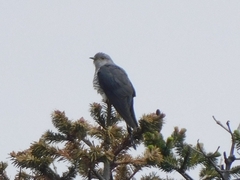
Lesser Cuckoo

Lesser Cuckoo

Cuculus poliocephalus

Silhouette: Nicolas Huet le Jeune and Jean-Gabriel Prêtre (vectorized by T. Michael Keesey) · PhyloPic

LCLeast ConcernNTVUENCR
Daily sighting probability <5% · Rare
at Bengaluru

In 3 days <5%

36 Verified sightings at Bengaluru
173 In all 5 parks From 2019 to 2026
November Best month
☀️ Diurnal When it's spotted

About the Lesser Cuckoo

The lesser cuckoo (Cuculus poliocephalus) is a species of cuckoo in the family Cuculidae. It is native to East Asia and the Himalayas; it winters to East Africa and Sri Lanka. In Japan, the bird is called hototogisu (ホトトギス/杜鵑) and frequently praised in senryu for its song.

It has been celebrated by numerous waka poets since the anthology Kokin wakashū (920). Sei Shōnagon in her essay The Pillow Book (1002) mentions a trip she and other courtiers mounted on just to hear this bird, and it was expected of them that they would compose poetry on the occasion. It is also the central image in poem 81 by Tokudaiji Sanesada in the anthology of 100 poems, the Hyakunin Isshu.

The Japanese haiku magazine Hototogisu takes its name from the bird, and the magazine's mastermind Masaoka Shiki's adopted pen name, Shiki (子規) also refers to the lesser cuckoo; shiki corresponds to the Chinese zǐguī (子規), which is an alias for its standard name dùjuān (杜鵑).

In Chinese, dùjuān is a generic name and the species' common name is xiāodùjuān (小杜鵑). In Korean literature, the song of the lesser cuckoo represents the sound of sadness. Wikipedia →

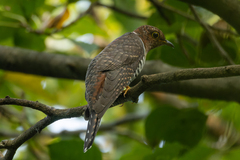
Sounds

Song0:09

China · 2025

© Yang Li · XC1005688 · CC BY-NC-SA 4.0

Call0:19

Bhutan · 2024

© Sandeep- Birding Xtreme India · XC918764 · CC BY-NC-SA 4.0

Song0:48

China · 2025

© Ding Li Yong · XC1005513 · CC BY-NC-ND 4.0

Global Distribution

Parks Where Found

# Park Country Daily sighting probability
1 Nikko National Park 🇯🇵 Japan
~20%
2 Jiuzhaigou National Park 🇨🇳 China
~20%
3 Langtang National Park 🇳🇵 Nepal
~10%
4 Udawalawe National Park 🇱🇰 Sri Lanka
<5%
5 Taroko National Park 🇹🇼 Taiwan
<5%

Cities Where Found

# City Country Daily sighting probability
1 Sendai 🇯🇵 Japan
<5%
2 Hangzhou 🇨🇳 China
<5%
3 Kolkata 🇮🇳 India
<5%
4 Dhaka 🇧🇩 Bangladesh
<5%
5 Suzhou 🇨🇳 China
<5%
6 Tokyo 🇯🇵 Japan
<5%
7 Nagoya 🇯🇵 Japan
<5%
8 Osaka 🇯🇵 Japan
<5%
9 Guangzhou 🇨🇳 China
<5%
10 Shanghai 🇨🇳 China
<5%

Before you go

What are the chances of seeing a Lesser Cuckoo in Bengaluru?

Rare

Under 5% of wildlife watchers report a Lesser Cuckoo sighting in Bengaluru on a given day, based on 36 verified sightings from GBIF citizen-science data. It is the 206th most-seen of the 247 birds we can rate there. Over three days the chance rises to under 5%, if each day is a fresh chance.

When is the best time to see a Lesser Cuckoo in Bengaluru?

Any time of year

In every month with enough records, under 5% of wildlife watchers report a Lesser Cuckoo in Bengaluru on a given day, so our monthly data shows no clear season.

What time of day is best to see a Lesser Cuckoo?

Between 8 and 11 am

Across all the parks we cover, that three-hour window holds the most Lesser Cuckoo sightings with a recorded time, and about 7 in 10 of them come between 6 am and 6 pm: it is a daytime animal.

Is Bengaluru the best place to see a Lesser Cuckoo?

Among the best

Of the 11 cities where we can rate Lesser Cuckoo sightings, Bengaluru ranks 11th at under 5%, level with the leaders once rounded. The best odds are in Sendai (Japan, under 5%), Hangzhou (China, under 5%) and Kolkata (India, under 5%).

Where does the Lesser Cuckoo sighting chance come from?

GBIF citizen-science records

It is estimated from how often the Lesser Cuckoo is recorded against all the birds logged in Bengaluru (36 verified sightings), calibrated against known sighting rates. Figures are rounded to the nearest 10% because citizen-science data supports honest approximations, not decimals, and months with records from fewer than five people show "—". How it works.

← Back to Bengaluru