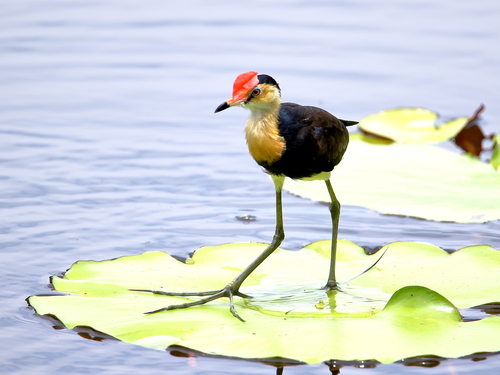
Comb-crested Jacana

Comb-crested Jacana

Irediparra gallinacea

Silhouette: Burton Robert, USFWS · PhyloPic

LCLeast ConcernNTVUENCR
Daily sighting probability ~20% · Possible
at Brisbane

In 3 days ~40% in a week ~70%

2,590 Verified sightings at Brisbane
1,051 In all 2 parks From 2019 to 2026
June Best month
☀️ Diurnal When it's spotted

About the Comb-crested Jacana

The comb-crested jacana (Irediparra gallinacea), also known as the lotusbird or lilytrotter (though these names are sometimes used to describe Jacanidae as a whole), is the only species of jacana in the genus Irediparra. Like other jacana species, it is adapted to the floating vegetation of tropical freshwater wetlands.

This species is unmistakable. It has a black crown and hindneck with a fleshy red wattle covering the forehead and forecrown, contrasting with a white face and throat. The comb is pinker in breeding adults, more orange when not breeding. There is a broad black band on the lower breast with white belly. The underwing and flight feathers, which show most prominently in flight, are black. Back and upperwing mainly grey-brown with black primary coverts, rump and tail. The long legs with extremely long toes trail in flight. The male is slightly smaller than the female and measures 20–22 cm (7.9–8.7 in) in length and weighs 68–84 g (2.4–3.0 oz). The female measures 24–27 cm (9.4–10.6 in) in length and weighs 120–150 g (4.2–5.3 oz). The wingspan ranges from 39 to 46 cm (15 to 18 in).

The bird occurs in south-eastern Borneo... Wikipedia →

Sounds

Call0:51

Australia · 2022

© James Lambert · XC707010 · CC BY-NC-ND 4.0

Alarm call0:06

Australia · 2018

© Greg McLachlan · XC434097 · CC BY-NC-SA 4.0

Call0:11

Australia · 2018

© Marc Anderson · XC436723 · CC BY-NC-ND 4.0

Global Distribution

Parks Where Found

# Park Country Daily sighting probability
1 Kakadu National Park 🇦🇺 Australia
~50%
2 Daintree National Park 🇦🇺 Australia
<5%

Cities Where Found

# City Country Daily sighting probability
1 Brisbane 🇦🇺 Australia
~20%

Before you go

What are the chances of seeing a Comb-crested Jacana in Brisbane?

Possible

About 20% of wildlife watchers report a Comb-crested Jacana sighting in Brisbane on a given day, based on 2,590 verified sightings from GBIF citizen-science data. It is the 56th most-seen of the 237 birds we can rate there. Over three days the chance rises to about 40%, and over a week to about 70%, if each day is a fresh chance.

When is the best time to see a Comb-crested Jacana in Brisbane?

May–September and December–March

In those months about 20% of wildlife watchers report a Comb-crested Jacana in Brisbane on a given day, against about 10% in April and October–November, the lowest months.

What time of day is best to see a Comb-crested Jacana?

Between 1 and 4 pm

Across all the parks we cover, that three-hour window holds the most Comb-crested Jacana sightings with a recorded time, and about 9 in 10 of them come between 6 am and 6 pm: it is a daytime animal.

Where else can you see a Comb-crested Jacana?

Only Brisbane, in our data

Brisbane is the only city on Wallace's Line with enough records to rate Comb-crested Jacana sightings: about 20% of wildlife watchers there report one on a given day.

Which relatives of the Comb-crested Jacana live in Brisbane?

Same order: Charadriiformes

The closest relatives of the Comb-crested Jacana that you can see in Brisbane (order Charadriiformes, Shorebirds and Allies) are Masked Lapwing (about 50%), White-headed Stilt (about 10%) and Bush Stone-curlew (about 10%), with each one's daily chance of a sighting.

Where does the Comb-crested Jacana sighting chance come from?

GBIF citizen-science records

It is estimated from how often the Comb-crested Jacana is recorded against all the birds logged in Brisbane (2,590 verified sightings), calibrated against known sighting rates. Figures are rounded to the nearest 10% because citizen-science data supports honest approximations, not decimals, and months with records from fewer than five people show "—". How it works.

← Back to Brisbane