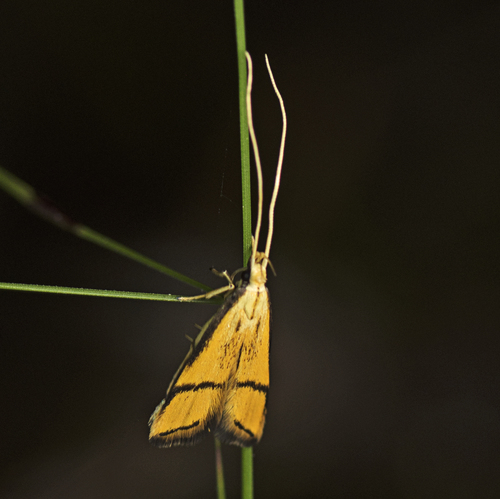



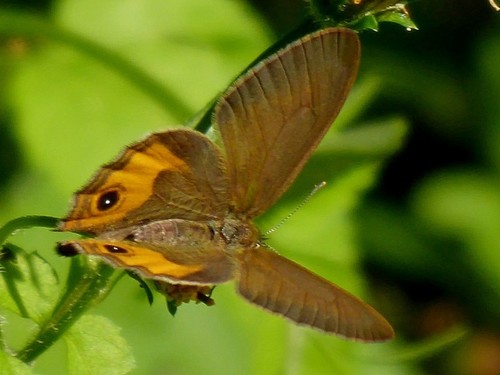
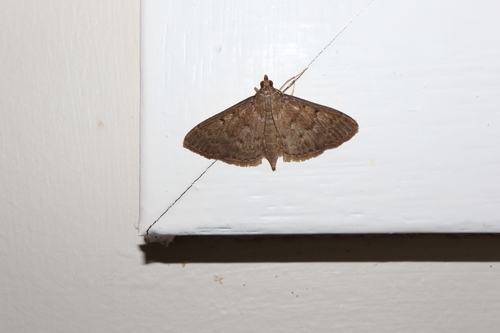
Crocanthes prasinopis

Crocanthes prasinopis

Crocanthes prasinopis

Daily sighting probability <5% · Rare
at Brisbane

In 3 days ~10% in a week ~30%

32 Verified sightings at Brisbane
33 In all 3 parks From 2019 to 2026
August Best month
🌅 Crepuscular When it's spotted

About the Crocanthes prasinopis

Crocanthes prasinopis is a species of moth of the family Lecithoceridae. It is found in most Australia and New Guinea. The wingspan is 13–15 mm (0.51–0.59 in). The forewings are rather deep yellow with ochreous-fuscous markings, with purple reflections. There is a costal streak from the base to two-fifths and a patch occupying the terminal half of the wing, the anterior edge straight or seldom bent, irregular, dark fuscous, running from the middle of the costa to beyond the middle of the dorsum, enclosing a roundish suffused central deep yellow blotch. The hindwings are whitish-yellowish, posteriorly suffused with fuscous, darker towards the apex. There is a dark grey transverse discal mark.

The larvae feed on moist dead gum leaves in leaf litter. Young larvae are pink, while later instars are brown. Pupation takes place in the leaf litter between two leaves in a silken shelter covered with hairs and detritus. Wikipedia →

Global Distribution

Parks Where Found

# Park Country Daily sighting probability
1 Lamington National Park 🇦🇺 Australia
~10%
2 Blue Mountains National Park 🇦🇺 Australia
~10%
3 Springbrook National Park 🇦🇺 Australia
~10%

Cities Where Found

# City Country Daily sighting probability
1 Brisbane 🇦🇺 Australia
<5%

Before you go

What are the chances of seeing a Crocanthes prasinopis in Brisbane?

Rare

Under 5% of wildlife watchers report a Crocanthes prasinopis sighting in Brisbane on a given day, based on 32 verified sightings from GBIF citizen-science data. It is the 352nd most-seen of the 1083 insects we can rate there. Over three days the chance rises to about 10%, and over a week to about 30%, if each day is a fresh chance.

When is the best time to see a Crocanthes prasinopis in Brisbane?

April–May, August and December

In those months about 10% of wildlife watchers report a Crocanthes prasinopis in Brisbane on a given day, against under 5% in January–March, June–July and September–November, the lowest months.

What time of day is best to see a Crocanthes prasinopis?

Between 7 and 10 pm

Across all the parks we cover, that three-hour window holds the most Crocanthes prasinopis sightings with a recorded time, and about half of them come between 6 pm and 6 am: it is most active around dawn and dusk.

Where else can you see a Crocanthes prasinopis?

Only Brisbane, in our data

Brisbane is the only city on Wallace's Line with enough records to rate Crocanthes prasinopis sightings: under 5% of wildlife watchers there report one on a given day.

Where does the Crocanthes prasinopis sighting chance come from?

GBIF citizen-science records

It is estimated from how often the Crocanthes prasinopis is recorded against all the insects logged in Brisbane (32 verified sightings), calibrated against known sighting rates. Figures are rounded to the nearest 10% because citizen-science data supports honest approximations, not decimals, and months with records from fewer than five people show "—". How it works.

← Back to Brisbane