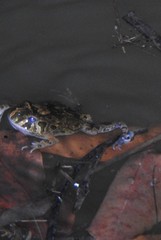
Ornate Burrowing Frog

Ornate Burrowing Frog

Platyplectrum ornatum

Silhouette: Dmitry Bogdanov (vectorized by T. Michael Keesey) · PhyloPic

LCLeast ConcernNTVUENCR Endemic
Daily sighting probability ~10% · With luck
at Brisbane

In 3 days ~20% in a week ~40%

84 Verified sightings at Brisbane
17 In all 3 parks From 2019 to 2026
November Best month
🌙 Nocturnal When it's spotted

About the Ornate Burrowing Frog

The ornate burrowing frog (Platyplectrum ornatum) is a species of ground frog native to Australia. It was moved to the genus Opisthodon in 2006, following a major revision of amphibians, and is now classified in the genus Platyplectrum.

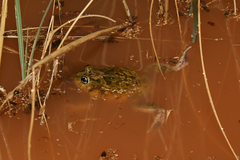
This frog is a relatively small and stubby species, growing no larger than 50 mm. It ranges in colour from grey to brown to yellow, and the dorsal surface patterns vary greatly between specimens. There is usually a butterfly-shaped patch behind the eyes. The dorsum is generally covered with red-tipped warts, and skin folds are present towards the head. The legs and arms are barred or spotted with darker markings. Toes have a slight webbing, while fingers have none.

It has the smallest genome known to any frog, and is even smaller than that of many birds. This is an adaptation to the desert environment where it lives. Because the ponds where they breed dries up fast in the desert, the tadpoles has to go through metamorphosis as fast as possible, which can occur just eleven days after the eggs were fertilized. A small genome gives small cells, and the smaller the cells are, the faster the tadpoles transform into small frogs and can escape... Wikipedia →

Sounds

Advertisement call0:15

Australia · 2022

© Marc Anderson · XC883163 · CC BY-NC-ND 4.0

Recording0:11

Australia · 2023

© Chris Harrison · iNaturalist · CC BY-NC 4.0

Recording0:20

Australia · 2026

© Juliet · iNaturalist · CC BY-NC 4.0

Global Distribution

Parks Where Found

# Park Country Daily sighting probability
1 Kakadu National Park 🇦🇺 Australia
~10%
2 Lamington National Park 🇦🇺 Australia
~10%
3 Daintree National Park 🇦🇺 Australia
~10%

Cities Where Found

# City Country Daily sighting probability
1 Brisbane 🇦🇺 Australia
~10%

Before you go

What are the chances of seeing an Ornate Burrowing Frog in Brisbane?

With luck

About 10% of wildlife watchers report an Ornate Burrowing Frog sighting in Brisbane on a given day, based on 84 verified sightings from GBIF citizen-science data. It is the 6th most-seen of the 9 amphibians we can rate there. Over three days the chance rises to about 20%, and over a week to about 40%, if each day is a fresh chance.

When is the best time to see an Ornate Burrowing Frog in Brisbane?

August and October–April

In those months about 10% of wildlife watchers report an Ornate Burrowing Frog in Brisbane on a given day, against under 5% in May–July and September, the lowest months.

What time of day is best to see an Ornate Burrowing Frog?

Between 7 and 10 pm

Across all the parks we cover, that three-hour window holds the most Ornate Burrowing Frog sightings with a recorded time, and about 8 in 10 of them come between 6 pm and 6 am: it is mostly seen at night.

Where else can you see an Ornate Burrowing Frog?

Only Brisbane, in our data

Brisbane is the only city on Wallace's Line with enough records to rate Ornate Burrowing Frog sightings: about 10% of wildlife watchers there report one on a given day.

Which relatives of the Ornate Burrowing Frog live in Brisbane?

Same family: Limnodynastidae

The closest relatives of the Ornate Burrowing Frog that you can see in Brisbane (family Limnodynastidae, Foam-nesting Ground Frogs) are Striped Marsh Frog (about 20%) and Tusked Frog (about 10%), with each one's daily chance of a sighting.

Where does the Ornate Burrowing Frog sighting chance come from?

GBIF citizen-science records

It is estimated from how often the Ornate Burrowing Frog is recorded against all the amphibians logged in Brisbane (84 verified sightings), calibrated against known sighting rates. Figures are rounded to the nearest 10% because citizen-science data supports honest approximations, not decimals, and months with records from fewer than five people show "—". How it works.

← Back to Brisbane