Rufous-tailed Bush-hen

Rufous-tailed Bush-hen

Amaurornis olivacea

LCLeast ConcernNTVUENCR
Daily sighting probability <5% · Rare
at Brisbane

In 3 days ~10% in a week ~20%

582 Verified sightings at Brisbane
78 In all 3 parks From 2019 to 2026
March Best month
☀️ Diurnal When it's spotted

About the Rufous-tailed Bush-hen

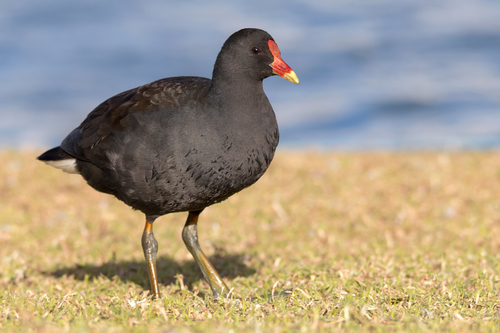
The pale-vented bush-hen or rufous-tailed bush-hen (Amaurornis moluccana) is a medium sized waterbird, mainly blue-grey with a buff vent and undertail. It is found in Australia, the Moluccan Islands, New Guinea, the Bismarck Archipelago and the Solomon Islands. Its natural habitat is subtropical or tropical moist lowland forests.

The pale-vented bush-hen is a member of the family Rallidae which includes crakes and rails. The genus name Amaurornis (Reichenbach 1853) is from the Greek for dark, shadowy or dim, amauros, and bird, ornis. The species name Amaurornis moluccana (Wallace, 1865) means "Moluccan dark and shadowy bird" and relates its original discovery in the Moluccan Islands, Indonesia. The term pale-vented came into use in the late 1990s as a descriptive term, when the species of bush hens in Australia and New Guinea were separated from the Plain Bush-hen (A. olivaceus) endemic to the Philippines.

It is widely known in Australia as simply "bush-hen" but has also been known as rufous-tailed or rufous-vented rail, crake or moorhen or brown rail. Gould believed he had found a new species, Gallinula ruficrissa in 1869 giving it the common name of... Wikipedia →

Sounds

Duet0:29

Indonesia · 2026

© Ding Li Yong · XC1166568 · CC BY-NC-ND 4.0

Song0:34

Australia · 2022

© Marc Anderson · XC1070738 · CC BY-NC-ND 4.0

Call0:38

Indonesia · 1997

© Teus Luijendijk · XC615169 · CC BY-NC-ND 4.0

Global Distribution

Parks Where Found

# Park Country Daily sighting probability
1 Daintree National Park 🇦🇺 Australia
<5%
2 Noosa National Park 🇦🇺 Australia
<5%
3 Raja Ampat 🇮🇩 Indonesia
<5%

Cities Where Found

# City Country Daily sighting probability
1 Davao City 🇵🇭 Philippines
<5%
2 Brisbane 🇦🇺 Australia
<5%
3 Manila 🇵🇭 Philippines
<5%

Before you go

What are the chances of seeing a Rufous-tailed Bush-hen in Brisbane?

Rare

Under 5% of wildlife watchers report a Rufous-tailed Bush-hen sighting in Brisbane on a given day, based on 582 verified sightings from GBIF citizen-science data. It is the 116th most-seen of the 237 birds we can rate there. Over three days the chance rises to about 10%, and over a week to about 20%, if each day is a fresh chance.

When is the best time to see a Rufous-tailed Bush-hen in Brisbane?

March

In that month about 10% of wildlife watchers report a Rufous-tailed Bush-hen in Brisbane on a given day, against under 5% in April to February, the lowest months. That is one of Brisbane's wettest months, with about 140 mm of rain against 40 mm in July.

What time of day is best to see a Rufous-tailed Bush-hen?

Between 5 and 8 am

Across all the parks we cover, that three-hour window holds the most Rufous-tailed Bush-hen sightings with a recorded time, and about 8 in 10 of them come between 6 am and 6 pm: it is a daytime animal.

Is Brisbane the best place to see a Rufous-tailed Bush-hen?

Among the best

Of the 3 cities where we can rate Rufous-tailed Bush-hen sightings, Brisbane ranks 2nd at under 5%, level with the leaders once rounded. The best odds are in Davao City (Philippines, under 5%).

Which relatives of the Rufous-tailed Bush-hen live in Brisbane?

Same family: Rallidae

The closest relatives of the Rufous-tailed Bush-hen that you can see in Brisbane (family Rallidae, Rails, Gallinules, and Coots) are Dusky Moorhen (about 60%), South-west Pacific Swamphen (about 50%) and Eurasian Coot (about 20%), with each one's daily chance of a sighting.

Where does the Rufous-tailed Bush-hen sighting chance come from?

GBIF citizen-science records

It is estimated from how often the Rufous-tailed Bush-hen is recorded against all the birds logged in Brisbane (582 verified sightings), calibrated against known sighting rates. Figures are rounded to the nearest 10% because citizen-science data supports honest approximations, not decimals, and months with records from fewer than five people show "—". How it works.

← Back to Brisbane
