Daily sighting probability <5% · Rare
at Brisbane

In 3 days ~10% in a week ~20%

6 Verified sightings at Brisbane
23 In all 2 parks From 2019 to 2026
January Best month
☀️ Diurnal When it's spotted

About the Sceliphron laetum

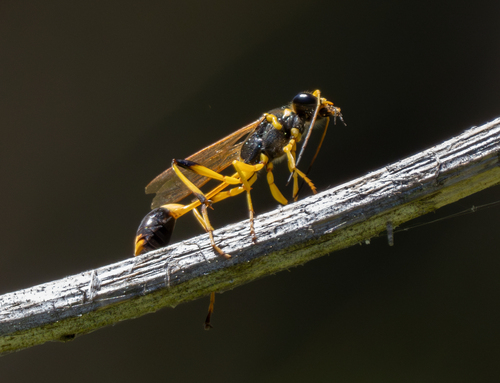
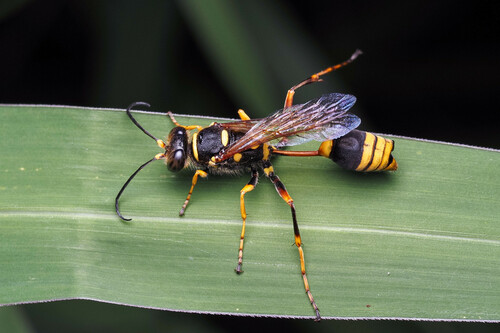
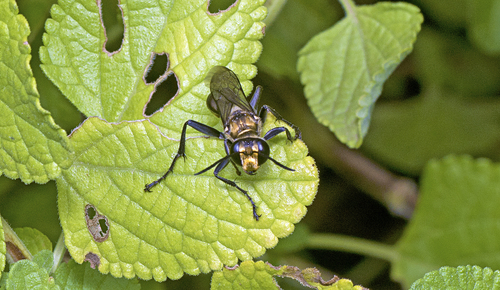
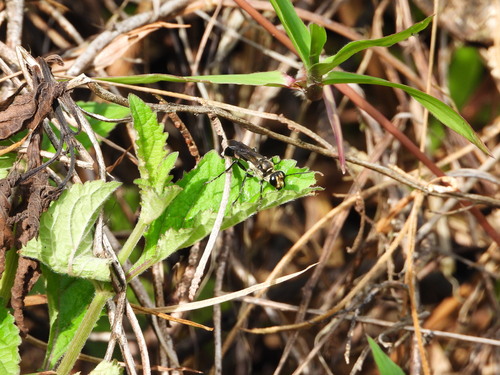
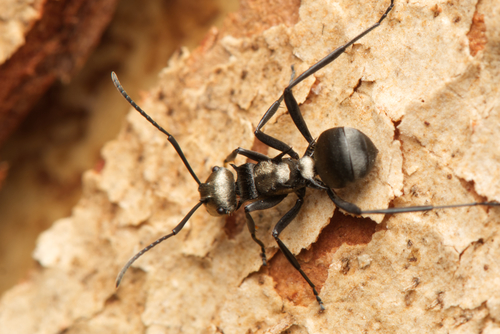
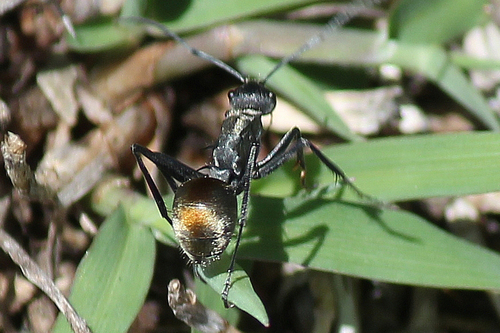
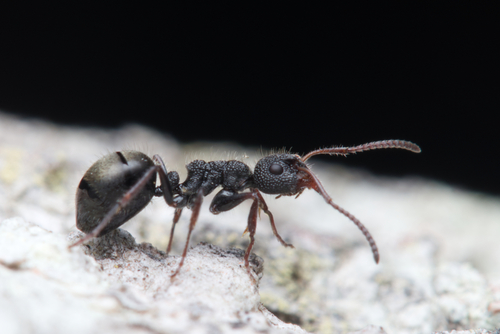
Sceliphron laetum is a wasp in the family Sphecidae, the mud-dauber wasps. Like other members of this genus, it is a solitary species and builds cells out of mud in which to rear its young, provisioning them with paralysed spiders, and laying an egg in each. This wasp is native to Australia and southeastern Asia.

Like other members of the family Specidae, the first abdominal segment of S. laetum has been modified into an elongated, slender petiole. This wasp is 17 to 26 millimetres (0.67 to 1.02 in) long and is largely black, with bold yellow markings. It has membranous wings which fold over the body when at rest. Its head is clad with yellow hairs which thin out ventrally. It lacks an area of bare yellow skin on the lower part of the face which is present in the otherwise similar Sceliphron formosum. The thorax has one or more yellow patches dorsally between the wings. The hind tip of the thorax, the petiole and the front part of the gaster are yellow, the bulbous central portion of the gaster is black and its apex is yellow. The legs are yellow with some black markings.

Sceliphron laetum is native to most of Australia and parts of southeastern... Wikipedia →

Global Distribution

Parks Where Found

# Park Country Daily sighting probability
1 Kakadu National Park 🇦🇺 Australia
~10%
2 Daintree National Park 🇦🇺 Australia
~10%

Cities Where Found

# City Country Daily sighting probability
1 Sydney 🇦🇺 Australia
<5%
2 Brisbane 🇦🇺 Australia
<5%

Before you go

What are the chances of seeing a Sceliphron laetum in Brisbane?

Rare

Under 5% of wildlife watchers report a Sceliphron laetum sighting in Brisbane on a given day, based on 6 verified sightings from GBIF citizen-science data. It is the 914th most-seen of the 1083 insects we can rate there. Over three days the chance rises to about 10%, and over a week to about 20%, if each day is a fresh chance.

When is the best time to see a Sceliphron laetum in Brisbane?

Any time of year

In every month with enough records, under 5% of wildlife watchers report a Sceliphron laetum in Brisbane on a given day, so our monthly data shows no clear season.

What time of day is best to see a Sceliphron laetum?

Between 2 and 5 pm

Across all the parks we cover, that three-hour window holds the most Sceliphron laetum sightings with a recorded time, and about 7 in 10 of them come between 6 am and 6 pm: it is a daytime animal.

Is Brisbane the best place to see a Sceliphron laetum?

Among the best

Of the 2 cities where we can rate Sceliphron laetum sightings, Brisbane ranks 2nd at under 5%, level with the leaders once rounded. The best odds are in Sydney (Australia, under 5%).

Where does the Sceliphron laetum sighting chance come from?

GBIF citizen-science records

It is estimated from how often the Sceliphron laetum is recorded against all the insects logged in Brisbane (6 verified sightings), calibrated against known sighting rates. Figures are rounded to the nearest 10% because citizen-science data supports honest approximations, not decimals, and months with records from fewer than five people show "—". How it works.

← Back to Brisbane