Austral Negrito

Austral Negrito

Lessonia rufa

Silhouette: Emily Willoughby · PhyloPic

LCLeast ConcernNTVUENCR
Daily sighting probability <5% · Rare
at Buenos Aires

In 3 days <5%

55 Verified sightings at Buenos Aires
1,382 In all 6 parks From 2019 to 2026
May Best month
☀️ Diurnal When it's spotted

About the Austral Negrito

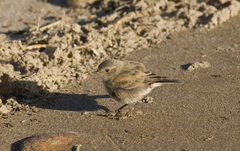
The austral negrito or Patagonian negrito (Lessonia rufa) is a species of bird in the family Tyrannidae, the tyrant flycatchers. It is found in Argentina, Bolivia, Brazil, Chile, Paraguay, and Uruguay and has occurred as a vagrant in Peru and on the Falkland Islands.

The austral negrito was formally described in 1789 by the German naturalist Johann Friedrich Gmelin in his revised and expanded edition of Carl Linnaeus's Systema Naturae. He placed it with the larks in the genus Alauda and coined the binomial name Alauda rufa. The specific epithet is from Latin rufus meaning "red", "ruddy" or "rufous". Gmelin based his description on "L'alouette noire à dos fauve" from Buenos Aires that had been described in 1778 by the French polymath, the Comte de Buffon and illustrated with a hand-colored engraving by François-Nicolas Martinet.

The austral negrito now shares genus Lessonia with the Andean negrito (L. oreas); that genus was erected in 1832 by William Swainson. The two were long considered conspecific. Late in the twentieth century they were separated based primarily on plumage differences, and a 2014 publication added differences in feather structure and... Wikipedia →

Sounds

Call0:11

Chile · 2011

© Andrew Spencer · XC90646 · CC BY-NC-ND 2.5

Call0:15

Argentina

© Bernabe Lopez-Lanus · XC46687 · CC BY-NC-SA 3.0

Call0:48

Argentina · 2005

© Meena Haribal · XC620648 · CC BY-NC-SA 4.0

Global Distribution

Parks Where Found

# Park Country Daily sighting probability
1 Torres del Paine National Park 🇨🇱 Chile
~50%
2 Nahuel Huapi National Park 🇦🇷 Argentina
~30%
3 Tierra del Fuego National Park 🇦🇷 Argentina
~10%
4 Península Valdés 🇦🇷 Argentina
~10%
5 Vicente Pérez Rosales National Park 🇨🇱 Chile
<5%
6 Iberá National Park 🇦🇷 Argentina
<5%

Cities Where Found

# City Country Daily sighting probability
1 Santiago 🇨🇱 Chile
<5%
2 Buenos Aires 🇦🇷 Argentina
<5%
3 Montevideo 🇺🇾 Uruguay
<5%

Before you go

What are the chances of seeing an Austral Negrito in Buenos Aires?

Rare

Under 5% of wildlife watchers report an Austral Negrito sighting in Buenos Aires on a given day, based on 55 verified sightings from GBIF citizen-science data. It is the 212th most-seen of the 274 birds we can rate there. Over three days the chance rises to under 5%, if each day is a fresh chance.

When is the best time to see an Austral Negrito in Buenos Aires?

Any time of year

In every month with enough records, under 5% of wildlife watchers report an Austral Negrito in Buenos Aires on a given day, so our monthly data shows no clear season.

What time of day is best to see an Austral Negrito?

Between 3 and 6 pm

Across all the parks we cover, that three-hour window holds the most Austral Negrito sightings with a recorded time, and about 9 in 10 of them come between 6 am and 6 pm: it is a daytime animal.

Is Buenos Aires the best place to see an Austral Negrito?

Among the best

Of the 3 cities where we can rate Austral Negrito sightings, Buenos Aires ranks 2nd at under 5%, level with the leaders once rounded. The best odds are in Santiago (Chile, under 5%).

Which relatives of the Austral Negrito live in Buenos Aires?

Same family: Tyrannidae

The closest relatives of the Austral Negrito that you can see in Buenos Aires (family Tyrannidae, Tyrant Flycatchers) are Great Kiskadee (about 90%), Cattle Tyrant (about 50%) and White-crested Tyrannulet (about 30%), with each one's daily chance of a sighting.

Where does the Austral Negrito sighting chance come from?

GBIF citizen-science records

It is estimated from how often the Austral Negrito is recorded against all the birds logged in Buenos Aires (55 verified sightings), calibrated against known sighting rates. Figures are rounded to the nearest 10% because citizen-science data supports honest approximations, not decimals, and months with records from fewer than five people show "—". How it works.

← Back to Buenos Aires