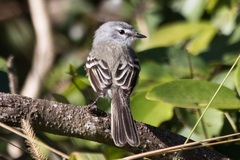
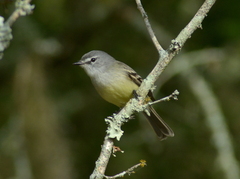
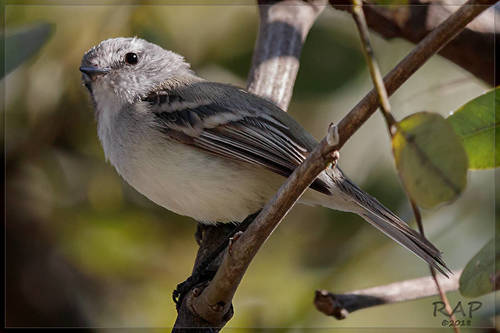
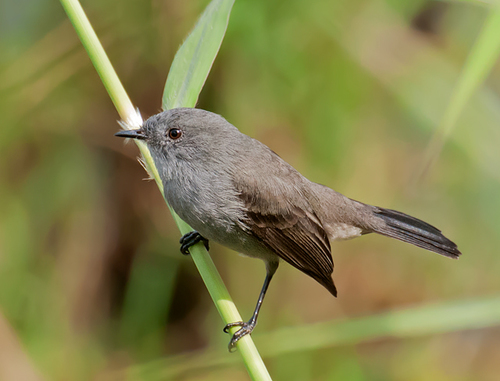
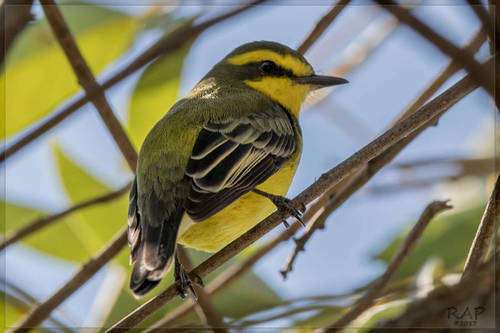
White-crested Tyrannulet

White-crested Tyrannulet

Serpophaga subcristata

Silhouette: Emily Willoughby · PhyloPic

LCLeast ConcernNTVUENCR
Daily sighting probability ~30% · Possible
at Buenos Aires

In 3 days ~70% in a week ~90%

5,508 Verified sightings at Buenos Aires
926 In all 10 parks From 2019 to 2026
July Best month
☀️ Diurnal When it's spotted

About the White-crested Tyrannulet

The white-crested tyrannulet (Serpophaga subcristata) is a small species of bird in the family Tyrannidae, the tyrant flycatchers. It is found in Argentina, Bolivia, Brazil, Paraguay, and Uruguay. The white-crested tyrannulet was originally described as Sylvia subcristata, thought to be a member of what at the time was the Old World warbler family.

Subspecies S. s. munda was originally described as a full species. BirdLife International's Handbook of the Birds of the World lumped it into the white-crested tyrannulet in 2020. The Clements taxonomy followed suit in 2022 as did the South American Classification Committee of the American Ornithological Society and the International Ornithological Committee in 2023. In addition, what is now Straneck's tyrannulet (S. griseicapilla) was long confused with the white-crested tyrannulet but was eventually recognized as a full species based largely on their very different vocalizations.

The white-crested tyrannulet is 11 cm (4.3... Wikipedia →

Sounds

Song0:12

Argentina · 2022

© Marcos E. Sosa · XC1012164 · CC BY-NC-SA 4.0

Call0:12

Argentina · 2023

© Bernard BOUSQUET · XC827317 · CC BY-NC-SA 4.0

Song0:42

Brazil · 2022

© Aluisio Ribeiro · XC803041 · CC BY-NC-SA 4.0

Global Distribution

Parks Where Found

# Park Country Daily sighting probability
1 El Palmar National Park 🇦🇷 Argentina
~50%
2 Serra da Canastra National Park 🇧🇷 Brazil
~20%
3 Iberá National Park 🇦🇷 Argentina
~20%
4 Itatiaia National Park 🇧🇷 Brazil
~10%
5 El Impenetrable National Park 🇦🇷 Argentina
~10%
6 Chapada Diamantina National Park 🇧🇷 Brazil
<5%
7 Amboró National Park 🇧🇴 Bolivia
<5%
8 Serra dos Órgãos National Park 🇧🇷 Brazil
<5%
9 Iguazú National Park 🇦🇷 Argentina
<5%
10 Iguaçu National Park 🇧🇷 Brazil
<5%

Cities Where Found

# City Country Daily sighting probability
1 Buenos Aires 🇦🇷 Argentina
~30%
2 Rosario 🇦🇷 Argentina
~30%
3 Cochabamba 🇧🇴 Bolivia
~20%
4 Montevideo 🇺🇾 Uruguay
~20%
5 Curitiba 🇧🇷 Brazil
~20%
6 Mendoza 🇦🇷 Argentina
~10%
7 Campinas 🇧🇷 Brazil
~10%
8 Porto Alegre 🇧🇷 Brazil
~10%
9 Belo Horizonte 🇧🇷 Brazil
~10%
10 Asuncion 🇵🇾 Paraguay
<5%

Before you go

What are the chances of seeing a White-crested Tyrannulet in Buenos Aires?

Possible

About 30% of wildlife watchers report a White-crested Tyrannulet sighting in Buenos Aires on a given day, based on 5,508 verified sightings from GBIF citizen-science data. It is the 32nd most-seen of the 274 birds we can rate there. Over three days the chance rises to about 70%, and over a week to about 90%, if each day is a fresh chance.

When is the best time to see a White-crested Tyrannulet in Buenos Aires?

June and July

In those months about 50% of wildlife watchers report a White-crested Tyrannulet in Buenos Aires on a given day, against about 20% in February and March, the lowest months.

What time of day is best to see a White-crested Tyrannulet?

Between 9 am and noon

Across all the parks we cover, that three-hour window holds the most White-crested Tyrannulet sightings with a recorded time, and about 9 in 10 of them come between 6 am and 6 pm: it is a daytime animal.

Is Buenos Aires the best place to see a White-crested Tyrannulet?

Yes

Of the 14 cities where we can rate White-crested Tyrannulet sightings, Buenos Aires has the highest daily chance: about 30%. Next come Rosario (Argentina, about 30%) and Cochabamba (Bolivia, about 20%).

Where does the White-crested Tyrannulet sighting chance come from?

GBIF citizen-science records

It is estimated from how often the White-crested Tyrannulet is recorded against all the birds logged in Buenos Aires (5,508 verified sightings), calibrated against known sighting rates. Figures are rounded to the nearest 10% because citizen-science data supports honest approximations, not decimals, and months with records from fewer than five people show "—". How it works.

← Back to Buenos Aires