Black-headed Duck

Black-headed Duck

Heteronetta atricapilla

Silhouette: Sheatherius · PhyloPic

LCLeast ConcernNTVUENCR
Daily sighting probability <5% · Rare
at Buenos Aires

In 3 days ~10% in a week ~20%

415 Verified sightings at Buenos Aires
March Best month
☀️ Diurnal When it's spotted

About the Black-headed Duck

The black-headed duck (Heteronetta atricapilla) is a South American duck in subfamily Oxyurinae of family Anatidae. It is found in Argentina, Bolivia, Brazil, Chile, Paraguay, and Uruguay. The black-headed duck is the only member of genus Heteronetta and has no subspecies. It is closely related to the "stiff-tailed" ducks of genera Nomonyx, Oxyura, and Biziura.

The black-headed duck is the most basal living member of its subfamily, and it lacks the stiff tail and swollen bill of its relatives. Overall much resembling a fairly typical diving duck, its plumage and other peculiarities indicate it may not be a very close relative of the other stiff-tailed ducks, but rather the product of convergent evolution from the ancestors of the stiff-tailed ducks.

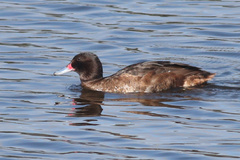
The black-headed duck is about 35 cm (14 in) long. Males weigh an average of about 510 g (18 oz) and females 565 g (20 oz). The species has a distinctive shape, with a long body and disproportionately short wings. Its bill has a black maxilla and an orange mandible; the maxilla has a rosy patch at its base during the breeding season. Adult males have a glossy black head and upper neck and... Wikipedia →

Sounds

Call0:09

Chile · 2017

© Cristian Pinto · XC492781 · CC BY-NC-SA 4.0

Song0:47

Argentina · 2001

© Bernabe Lopez-Lanus · XC44447 · CC BY-NC-SA 3.0

Global Distribution

Parks Where Found

# Park Country Daily sighting probability

More parks will be added in future updates.

Cities Where Found

# City Country Daily sighting probability
1 Buenos Aires 🇦🇷 Argentina
<5%

Zoos & Centres Where Found

# Zoo / Centre Country
1 Dresden Zoo 🇩🇪 Germany In captivity
2 Slimbridge Wetland Centre 🇬🇧 United Kingdom In captivity

Before you go

What are the chances of seeing a Black-headed Duck in Buenos Aires?

Rare

Under 5% of wildlife watchers report a Black-headed Duck sighting in Buenos Aires on a given day, based on 415 verified sightings from GBIF citizen-science data. It is the 149th most-seen of the 274 birds we can rate there. Over three days the chance rises to about 10%, and over a week to about 20%, if each day is a fresh chance.

When is the best time to see a Black-headed Duck in Buenos Aires?

January to March

In those months about 10% of wildlife watchers report a Black-headed Duck in Buenos Aires on a given day, against under 5% in April to December, the lowest months.

What time of day is best to see a Black-headed Duck?

Between 9 am and noon

Across all the parks we cover, that three-hour window holds the most Black-headed Duck sightings with a recorded time, and about 8 in 10 of them come between 6 am and 6 pm: it is a daytime animal.

Where else can you see a Black-headed Duck?

Only Buenos Aires, in our data

Buenos Aires is the only city on Wallace's Line with enough records to rate Black-headed Duck sightings: under 5% of wildlife watchers there report one on a given day.

Which relatives of the Black-headed Duck live in Buenos Aires?

Same family: Anatidae

The closest relatives of the Black-headed Duck that you can see in Buenos Aires (family Anatidae, Ducks, Geese, and Swans) are Rosybill Pochard (about 30%), Speckled Teal (about 30%) and Silver Teal (about 20%), with each one's daily chance of a sighting.

Where does the Black-headed Duck sighting chance come from?

GBIF citizen-science records

It is estimated from how often the Black-headed Duck is recorded against all the birds logged in Buenos Aires (415 verified sightings), calibrated against known sighting rates. Figures are rounded to the nearest 10% because citizen-science data supports honest approximations, not decimals, and months with records from fewer than five people show "—". How it works.

← Back to Buenos Aires