Rosybill Pochard

Rosybill Pochard

Netta peposaca

Silhouette: Sheatherius · PhyloPic

LCLeast ConcernNTVUENCR
Daily sighting probability ~30% · Possible
at Buenos Aires

In 3 days ~70% in a week ~90%

4,954 Verified sightings at Buenos Aires
99 In 1 park From 2019 to 2026
March Best month
☀️ Diurnal When it's spotted

About the Rosybill Pochard

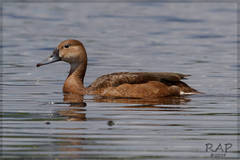
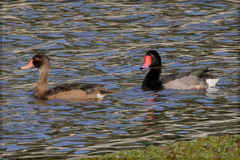
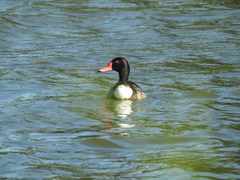
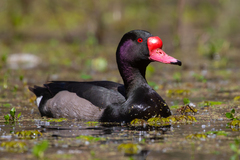
The rosy-billed pochard (Netta peposaca), alternatively named rosybill or rosybill pochard, is a member of family Anatidae. Though classified as a diving duck, this pochard feeds more like a dabbling duck feeding on seeds roots, sedges, aquatic plants and other grasses. Netta is Ancient Greek for "duck" and peposaca is a transcription of the Guaraní name of this species which means "showy wings", referring to the broad white stripe that is only visible with stretched out wings. Male characteristic features include a bright red bill with a rounded knob at the base.

The rosy-billed pochard is endemic to South America. It is found in Argentina, central Chile, Paraguay, Uruguay and southern Brazil. The population in southern Argentina migrates northward during the austral winter, reaching Brazil and southern Bolivia. It is a vagrant to the Falkland Islands.

The rosy-billed pochard is one of five pochard species that make up the genus Netta, which is one of 31 genera of the subfamily Anatinae. Within subfamily Anatinae, there is a tribe called Aythini. This tribe was thought to be limited to the Northern Hemisphere (what was believed to be the Palearctic), and experienced... Wikipedia →

Sounds

Alarm call0:15

Argentina

© Bernabe Lopez-Lanus · XC48344 · CC BY-NC-SA 3.0

Call0:09

Brazil · 2005

© Peter Boesman · XC226686 · CC BY-NC-ND 4.0

Flight call0:06

Brazil · 2008

© Fernando Jacobs · XC23277 · CC BY-NC-ND 2.5

Global Distribution

Parks Where Found

# Park Country Daily sighting probability
1 Iberá National Park 🇦🇷 Argentina
~10%

More parks will be added in future updates.

Cities Where Found

# City Country Daily sighting probability
1 Buenos Aires 🇦🇷 Argentina
~30%
2 Cochabamba 🇧🇴 Bolivia
~30%
3 Curitiba 🇧🇷 Brazil
<5%
4 Montevideo 🇺🇾 Uruguay
<5%
5 São Paulo 🇧🇷 Brazil
<5%

Zoos & Centres Where Found

# Zoo / Centre Country
1 Disney's Animal Kingdom 🇺🇸 United States In captivity
2 Busch Gardens Tampa 🇺🇸 United States In captivity
3 SeaWorld San Diego 🇺🇸 United States In captivity
4 San Diego Zoo 🇺🇸 United States In captivity
5 Leipzig Zoological Garden 🇩🇪 Germany In captivity
6 Tierpark Berlin 🇩🇪 Germany In captivity
7 Zürich Zoo 🇨🇭 Switzerland In captivity
8 Barcelona Zoo 🇪🇸 Spain In captivity
9 North Carolina Zoo 🇺🇸 United States In captivity
10 Jihlava Zoo 🇨🇿 Czechia In captivity
11 Zoo Miami 🇺🇸 United States In captivity
12 Bronx Zoo 🇺🇸 United States In captivity
13 SeaWorld San Antonio 🇺🇸 United States In captivity
14 Brookfield Zoo 🇺🇸 United States In captivity
15 Dallas Zoo 🇺🇸 United States In captivity
16 Slimbridge Wetland Centre 🇬🇧 United Kingdom In captivity
17 Wildlife World Zoo 🇺🇸 United States In captivity
18 Parc animalier de Gramat 🇫🇷 France In captivity
19 Berlin Zoological Garden 🇩🇪 Germany In captivity
20 Caldwell Zoo 🇺🇸 United States In captivity
21 Temaikén 🇦🇷 Argentina In captivity
22 Zoologischer Garten Leipzig 🇩🇪 Germany In captivity
23 Fort Worth Zoo 🇺🇸 United States In captivity
24 San Antonio Zoo 🇺🇸 United States In captivity
25 Cologne Zoological Garden 🇩🇪 Germany In captivity
26 Honolulu Zoo 🇺🇸 United States In captivity
27 Córdoba Zoo 🇦🇷 Argentina In captivity
28 Augsburg Zoo 🇩🇪 Germany In captivity
29 Hirschfeld Wildlife Park 🇩🇪 Germany In captivity
30 Aquarama Barcelona 🇪🇸 Spain In captivity
31 Cleres Zoological Park 🇫🇷 France In captivity
32 Rio de Janeiro Zoological Garden 🇧🇷 Brazil In captivity
33 Alexandria Zoological Park 🇺🇸 United States In captivity
34 Vogelpark Avifauna 🇳🇱 Netherlands In captivity
35 Izu Shaboten Zoo 🇯🇵 Japan In captivity
36 Zoologischer Garten Halle 🇩🇪 Germany In captivity
37 Touroparc Zoo 🇫🇷 France In captivity
38 Palm Beach Zoo 🇺🇸 United States In captivity
39 Bird Park Steinen 🇩🇪 Germany In captivity
40 Santillana Zoo 🇪🇸 Spain In captivity
41 Zoo Koki (Parque zoológico y botánico) 🇪🇸 Spain In captivity
42 Animal Park 🇨🇭 Switzerland In captivity
43 Sewerby Zoo 🇬🇧 United Kingdom In captivity
44 Aquarium Berlin 🇩🇪 Germany In captivity
45 Freilandanlage, Wasserstern 1904, Terrarien, Aquarien 🇩🇪 Germany In captivity
46 Cologne Zoo Aquarium 🇩🇪 Germany In captivity
47 Montreal Biodome 🇨🇦 Canada In captivity

Before you go

What are the chances of seeing a Rosybill Pochard in Buenos Aires?

Possible

About 30% of wildlife watchers report a Rosybill Pochard sighting in Buenos Aires on a given day, based on 4,954 verified sightings from GBIF citizen-science data. It is the 39th most-seen of the 274 birds we can rate there. Over three days the chance rises to about 70%, and over a week to about 90%, if each day is a fresh chance.

When is the best time to see a Rosybill Pochard in Buenos Aires?

January to March

In those months about 40% of wildlife watchers report a Rosybill Pochard in Buenos Aires on a given day, against about 20% in May, the lowest month.

What time of day is best to see a Rosybill Pochard?

Between 9 am and noon

Across all the parks we cover, that three-hour window holds the most Rosybill Pochard sightings with a recorded time, and about 9 in 10 of them come between 6 am and 6 pm: it is a daytime animal.

Is Buenos Aires the best place to see a Rosybill Pochard?

Yes

Of the 5 cities where we can rate Rosybill Pochard sightings, Buenos Aires has the highest daily chance: about 30%. Next come Cochabamba (Bolivia, about 30%) and Curitiba (Brazil, under 5%).

Which relatives of the Rosybill Pochard live in Buenos Aires?

Same family: Anatidae

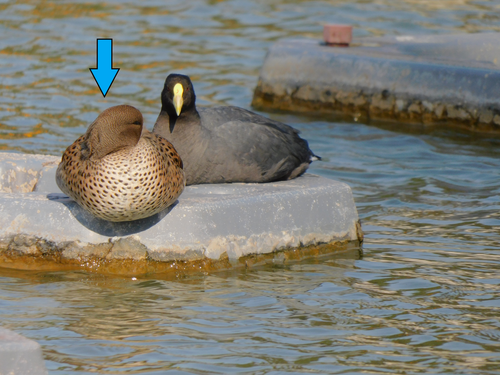
The closest relatives of the Rosybill Pochard that you can see in Buenos Aires (family Anatidae, Ducks, Geese, and Swans) are Speckled Teal (about 30%), Silver Teal (about 20%) and Coscoroba Swan (about 20%), with each one's daily chance of a sighting.

Where does the Rosybill Pochard sighting chance come from?

GBIF citizen-science records

It is estimated from how often the Rosybill Pochard is recorded against all the birds logged in Buenos Aires (4,954 verified sightings), calibrated against known sighting rates. Figures are rounded to the nearest 10% because citizen-science data supports honest approximations, not decimals, and months with records from fewer than five people show "—". How it works.

← Back to Buenos Aires