Black-necked Swan

Black-necked Swan

Cygnus melancoryphus

Silhouette: Edwin Price · PhyloPic

LCLeast ConcernNTVUENCR
Daily sighting probability ~10% · With luck
at Buenos Aires

In 3 days ~40% in a week ~60%

2,088 Verified sightings at Buenos Aires
501 In all 4 parks From 2019 to 2026
March Best month
☀️ Diurnal When it's spotted

About the Black-necked Swan

The black-necked swan (Cygnus melancoryphus) is a species of waterfowl in the tribe Cygnini of the subfamily Anserinae. It is found in Argentina, Brazil, Chile, Uruguay, and the Falkland Islands. The black-necked swan has occasionally been placed by itself in the genus Sthenelides. Its closest relatives are the black swan (C. atratus) and mute swan (C. olor). It is monotypic.

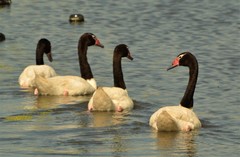
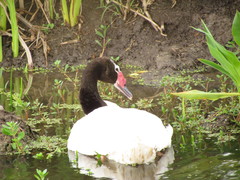
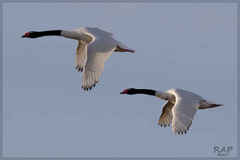
The black-necked swan is the only member of its genus that breeds in the neotropics and is the largest waterfowl native to South America. Adults are 102 to 124 cm (40 to 49 in) in length. Its wingspan in winter averages 160 cm (5.2 ft), less at 136 cm (4.46 ft) in spring, due to loss of some primary feathers while moulting. Males weigh 4.6 to 8.7 kg (10 to 19 lb) and females 3.5 to 4.4 kg (7.7 to 9.7 lb). The black-necked swan is the lightest true swan on average. The sexes are alike. Adults' body plumage is white and the neck and head black; the latter usually has a white stripe behind the eye. They have a prominent red knob at the base of their bill. Juveniles are grayish rather than white and lack the knob until their third or fourth year. Wikipedia →

Sounds

Call0:23

Chile · 2018

© Peter Boesman · XC449901 · CC BY-NC-ND 4.0

Song0:20

Chile · 2006

© Bernabe Lopez-Lanus · XC52078 · CC BY-NC-SA 3.0

Call0:07

Argentina · 2019

© Bobby Wilcox · XC470296 · CC BY-NC-SA 4.0

Global Distribution

Parks Where Found

# Park Country Daily sighting probability
1 Torres del Paine National Park 🇨🇱 Chile
~20%
2 Tierra del Fuego National Park 🇦🇷 Argentina
~20%
3 Península Valdés 🇦🇷 Argentina
<5%
4 Nahuel Huapi National Park 🇦🇷 Argentina
<5%

Cities Where Found

# City Country Daily sighting probability
1 Buenos Aires 🇦🇷 Argentina
~10%
2 Montevideo 🇺🇾 Uruguay
<5%

Zoos & Centres Where Found

# Zoo / Centre Country
1 Disney's Animal Kingdom 🇺🇸 United States In captivity
2 Busch Gardens Tampa 🇺🇸 United States In captivity
3 San Diego Zoo 🇺🇸 United States In captivity
4 Moscow Zoo 🇷🇺 Russia In captivity
5 Tierpark Berlin 🇩🇪 Germany In captivity
6 Parque das Aves 🇧🇷 Brazil In captivity
7 Barcelona Zoo 🇪🇸 Spain In captivity
8 Réserve africaine de Sigean 🇫🇷 France In captivity
9 Zoo d'Amiens 🇫🇷 France In captivity
10 Zoo Miami 🇺🇸 United States In captivity
11 Taipei Zoo 🇹🇼 Taiwan In captivity
12 Parque Zoológico 🇧🇷 Brazil In captivity
13 Kansas City Zoo 🇺🇸 United States In captivity
14 Chimelong Safari Park 🇨🇳 China In captivity
15 Curitiba Zoo 🇧🇷 Brazil In captivity
16 Omaha’s Henry Doorly Zoo and Aquarium 🇺🇸 United States In captivity
17 Shenzhen Safari Park 🇨🇳 China In captivity
18 Zoo and Botanical Garden of Branféré 🇫🇷 France In captivity
19 Oakland Zoo 🇺🇸 United States In captivity
20 Suzhou Shangfangshan Forest Zoo 🇨🇳 China In captivity
21 National Zoological Garden of South Africa 🇿🇦 South Africa In captivity
22 Slimbridge Wetland Centre 🇬🇧 United Kingdom In captivity
23 Cape May County Park & Zoo 🇺🇸 United States In captivity
24 Silesian Zoological Garden 🇵🇱 Poland In captivity
25 Wildlife World Zoo 🇺🇸 United States In captivity
26 São Paulo Zoo 🇧🇷 Brazil In captivity
27 Birmingham Zoo 🇺🇸 United States In captivity
28 Zoológico de San Juan de Aragón 🇲🇽 Mexico In captivity
29 Guangzhou Zoo 🇨🇳 China In captivity
30 Oklahoma City Zoo and Botanical Garden 🇺🇸 United States In captivity
31 Kyiv Zoo 🇺🇦 Ukraine In captivity
32 Saint Louis Zoo 🇺🇸 United States In captivity
33 Berlin Zoological Garden 🇩🇪 Germany In captivity
34 Caldwell Zoo 🇺🇸 United States In captivity
35 Wrocław Zoological Garden 🇵🇱 Poland In captivity
36 Louisiana Purchase Gardens and Zoo 🇺🇸 United States In captivity
37 Paignton Zoo 🇬🇧 United Kingdom In captivity
38 San Francisco Zoo 🇺🇸 United States In captivity
39 Temaikén 🇦🇷 Argentina In captivity
40 Boulder Ridge Wild Animal Park 🇺🇸 United States In captivity
41 Fort Worth Zoo 🇺🇸 United States In captivity
42 Karlsruhe Zoo 🇩🇪 Germany In captivity
43 San Antonio Zoo 🇺🇸 United States In captivity
44 Blackpool Zoo 🇬🇧 United Kingdom In captivity
45 Cologne Zoological Garden 🇩🇪 Germany In captivity
46 Philadelphia Zoo 🇺🇸 United States In captivity
47 Saigon Zoo and Botanical Gardens 🇻🇳 Vietnam In captivity
48 Chapultepec Zoo 🇲🇽 Mexico In captivity
49 Krakow Zoo 🇵🇱 Poland In captivity
50 Bird Paradise 🇸🇬 Singapore In captivity

Before you go

What are the chances of seeing a Black-necked Swan in Buenos Aires?

With luck

About 10% of wildlife watchers report a Black-necked Swan sighting in Buenos Aires on a given day, based on 2,088 verified sightings from GBIF citizen-science data. It is the 80th most-seen of the 274 birds we can rate there. Over three days the chance rises to about 40%, and over a week to about 60%, if each day is a fresh chance.

When is the best time to see a Black-necked Swan in Buenos Aires?

January–April and July–August

In those months about 20% of wildlife watchers report a Black-necked Swan in Buenos Aires on a given day, against about 10% in May–June and September–December, the lowest months.

What time of day is best to see a Black-necked Swan?

Between 3 and 6 pm

Across all the parks we cover, that three-hour window holds the most Black-necked Swan sightings with a recorded time, and about 9 in 10 of them come between 6 am and 6 pm: it is a daytime animal.

Is Buenos Aires the best place to see a Black-necked Swan?

Yes

Of the 2 cities where we can rate Black-necked Swan sightings, Buenos Aires has the highest daily chance: about 10%. Next come Montevideo (Uruguay, under 5%).

Which relatives of the Black-necked Swan live in Buenos Aires?

Same family: Anatidae

The closest relatives of the Black-necked Swan that you can see in Buenos Aires (family Anatidae, Ducks, Geese, and Swans) are Rosybill Pochard (about 30%), Speckled Teal (about 30%) and Silver Teal (about 20%), with each one's daily chance of a sighting.

Where does the Black-necked Swan sighting chance come from?

GBIF citizen-science records

It is estimated from how often the Black-necked Swan is recorded against all the birds logged in Buenos Aires (2,088 verified sightings), calibrated against known sighting rates. Figures are rounded to the nearest 10% because citizen-science data supports honest approximations, not decimals, and months with records from fewer than five people show "—". How it works.

← Back to Buenos Aires