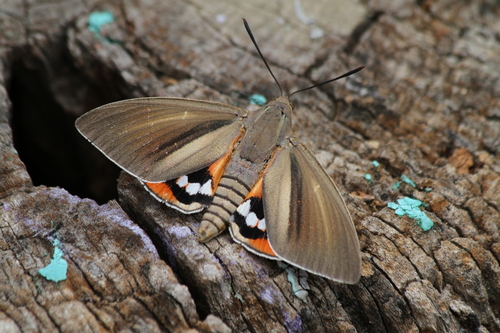
Palm Moth

Palm Moth

Paysandisia archon

Daily sighting probability ~10% · With luck
at Buenos Aires

In 3 days ~20% in a week ~40%

128 Verified sightings at Buenos Aires
21 In all 2 parks From 2019 to 2026
February Best month
☀️ Diurnal When it's spotted

About the Palm Moth

Paysandisia archon is a moth of the family Castniidae. It is native to Uruguay and central Argentina and has been accidentally introduced to Europe, where it is spreading rapidly. It is considered the only member of the genus Paysandisia.

German naturalist Hermann Burmeister described the species in 1879 as Castnia archon. This is a very large moth with a wingspan of 90–110 mm. The forewings are dark green with brown streaking, the hindwings are bright red with bold black and white markings. The females, generally larger than the males, are easily recognized by the prominent ovipositor. Like other castniids, this species flies by day and has clubbed antennae and is easily mistaken for a butterfly. The adults fly from June to September.

The larva is whitish and maggot-like and feeds in the stems and trunks of palms (see list below for recorded food plants). In its natural range, the damage done by the larvae is unobtrusive and the species is not considered a pest but the species is causing increasing concern in Europe because of the sometimes fatal damage being caused to native and exotic palms. The species pupates in a cocoon incorporating palm fibres within the larval gallery.

�... Wikipedia →

Global Distribution

Parks Where Found

# Park Country Daily sighting probability
1 Cévennes National Park 🇫🇷 France
~10%
2 Pyrénées National Park 🇫🇷 France
<5%

Cities Where Found

# City Country Daily sighting probability
1 Rome 🇮🇹 Italy
~20%
2 Barcelona 🇪🇸 Spain
~10%
3 Buenos Aires 🇦🇷 Argentina
~10%
4 Madrid 🇪🇸 Spain
~10%
5 Lyon 🇫🇷 France
~10%
6 Milan 🇮🇹 Italy
<5%

Before you go

What are the chances of seeing a Palm Moth in Buenos Aires?

With luck

About 10% of wildlife watchers report a Palm Moth sighting in Buenos Aires on a given day, based on 128 verified sightings from GBIF citizen-science data. It is the 86th most-seen of the 558 insects we can rate there. Over three days the chance rises to about 20%, and over a week to about 40%, if each day is a fresh chance.

When is the best time to see a Palm Moth in Buenos Aires?

February

In that month about 20% of wildlife watchers report a Palm Moth in Buenos Aires on a given day, against under 5% in April to November, the lowest months.

What time of day is best to see a Palm Moth?

Between noon and 3 pm

Across all the parks we cover, that three-hour window holds the most Palm Moth sightings with a recorded time, and about 9 in 10 of them come between 6 am and 6 pm: it is a daytime animal.

Is Buenos Aires the best place to see a Palm Moth?

3rd of 6

Of the 6 cities where we can rate Palm Moth sightings, Buenos Aires ranks 3rd at about 10%. The best odds are in Rome (Italy, about 20%) and Barcelona (Spain, about 10%).

Which relatives of the Palm Moth live in Buenos Aires?

Same order: Lepidoptera

The closest relatives of the Palm Moth that you can see in Buenos Aires (order Lepidoptera, Butterflies and Moths) are Gulf Fritillary (about 40%), Southern Monarch (about 30%) and Junonia lavinia (about 30%), with each one's daily chance of a sighting.

Where does the Palm Moth sighting chance come from?

GBIF citizen-science records

It is estimated from how often the Palm Moth is recorded against all the insects logged in Buenos Aires (128 verified sightings), calibrated against known sighting rates. Figures are rounded to the nearest 10% because citizen-science data supports honest approximations, not decimals, and months with records from fewer than five people show "—". How it works.

← Back to Buenos Aires