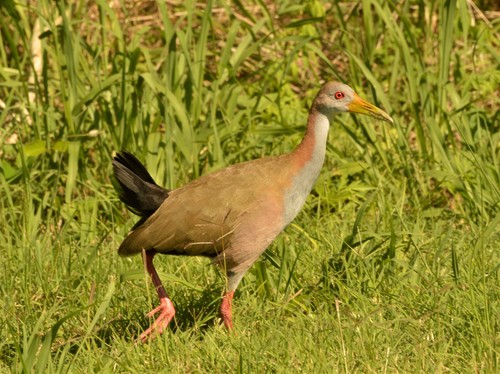
Red-fronted Coot

Red-fronted Coot

Fulica rufifrons

Silhouette: Andy Wilson · PhyloPic

LCLeast ConcernNTVUENCR
Daily sighting probability ~20% · Possible
at Buenos Aires

In 3 days ~50% in a week ~80%

3,086 Verified sightings at Buenos Aires
14 In 1 park From 2019 to 2026
August Best month
☀️ Diurnal When it's spotted

About the Red-fronted Coot

The red-fronted coot (Fulica rufifrons) is a species of bird in subfamily Rallinae of family Rallidae, the rails, gallinules, and coots. It is found in Argentina, Bolivia, Brazil, Chile, Peru, and Uruguay. The red-fronted coot is monotypic.

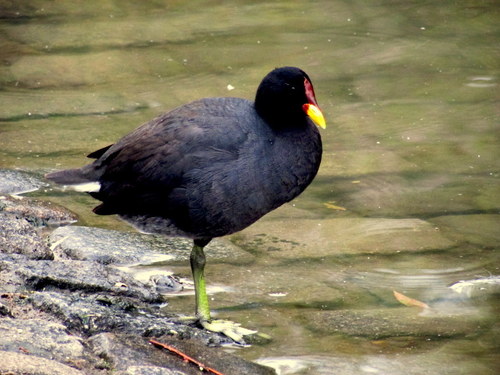
The red-fronted coot is 38 to 43 cm (15 to 17 in) long. Male specimens can weigh between 685 and 735 g (24 and 26 oz) and females can weigh around 550 g (19 oz). The sexes are alike. Adults have a yellow bill, a dark chestnut-red frontal shield, and olive legs and feet. Unique among coots, their feet are not lobed. Their plumage is almost entirely dark slate gray except for white undertail coverts. Juveniles have a blackish bill, white spots on the throat, and gray-brown plumage with the same white undertail coverts as adults.

The red-fronted coot is found coastally from southern Peru to central Chile, in at least one site in Bolivia, and from southeastern Brazil south through Uruguay to east central Argentina. It has also occurred as a vagrant in Paraguay and the Falkland Islands, though the last sighting at the latter location was in 1924. Clements extends its range... Wikipedia →
Sounds

Call0:16

Chile · 2022

© Cristian Pinto Fernandez · XC696740 · CC BY-NC-SA 4.0

Song0:39

Argentina · 2011

© Bernabe Lopez-Lanus · XC95260 · CC BY-NC-ND 2.5

Alarm call0:28

Chile · 2010

© Daniel González Amat · XC45453 · CC BY-NC-ND 2.5

Global Distribution

Parks Where Found

# Park Country Daily sighting probability
1 Vicente Pérez Rosales National Park 🇨🇱 Chile
<5%

More parks will be added in future updates.

Cities Where Found

# City Country Daily sighting probability
1 Buenos Aires 🇦🇷 Argentina
~20%
2 Cordoba 🇦🇷 Argentina
<5%
3 Cochabamba 🇧🇴 Bolivia
<5%
4 Santiago 🇨🇱 Chile
<5%
5 Montevideo 🇺🇾 Uruguay
<5%

Zoos & Centres Where Found

# Zoo / Centre Country
1 Mundo Marino 🇦🇷 Argentina In captivity

Before you go

What are the chances of seeing a Red-fronted Coot in Buenos Aires?

Possible

About 20% of wildlife watchers report a Red-fronted Coot sighting in Buenos Aires on a given day, based on 3,086 verified sightings from GBIF citizen-science data. It is the 64th most-seen of the 274 birds we can rate there. Over three days the chance rises to about 50%, and over a week to about 80%, if each day is a fresh chance.

When is the best time to see a Red-fronted Coot in Buenos Aires?

July and August

In those months about 30% of wildlife watchers report a Red-fronted Coot in Buenos Aires on a given day, against about 20% in September to June, the lowest months.

What time of day is best to see a Red-fronted Coot?

Between 10 am and 1 pm

Across all the parks we cover, that three-hour window holds the most Red-fronted Coot sightings with a recorded time, and about 9 in 10 of them come between 6 am and 6 pm: it is a daytime animal.

Is Buenos Aires the best place to see a Red-fronted Coot?

Yes

Of the 5 cities where we can rate Red-fronted Coot sightings, Buenos Aires has the highest daily chance: about 20%. Next come Cordoba (Argentina, under 5%) and Cochabamba (Bolivia, under 5%).

Which relatives of the Red-fronted Coot live in Buenos Aires?

Same genus: Fulica

The closest relatives of the Red-fronted Coot that you can see in Buenos Aires (genus Fulica, Coots) are White-winged Coot (about 20%) and Red-gartered Coot (about 20%), with each one's daily chance of a sighting.

Where does the Red-fronted Coot sighting chance come from?

GBIF citizen-science records

It is estimated from how often the Red-fronted Coot is recorded against all the birds logged in Buenos Aires (3,086 verified sightings), calibrated against known sighting rates. Figures are rounded to the nearest 10% because citizen-science data supports honest approximations, not decimals, and months with records from fewer than five people show "—". How it works.

← Back to Buenos Aires