
Red-gartered Coot

Red-gartered Coot

Fulica armillata

Silhouette: Andy Wilson · PhyloPic

LCLeast ConcernNTVUENCR
Daily sighting probability ~20% · Possible
at Buenos Aires

In 3 days ~50% in a week ~80%

3,265 Verified sightings at Buenos Aires
1,293 In all 4 parks From 2019 to 2026
March Best month
☀️ Diurnal When it's spotted

About the Red-gartered Coot

The red-gartered coot (Fulica armillata) is a species of bird in subfamily Rallinae of family Rallidae, the rails, gallinules, and coots. It is found in Argentina, Brazil, Chile, Paraguay, and Uruguay. The red-gartered coot is monotypic.

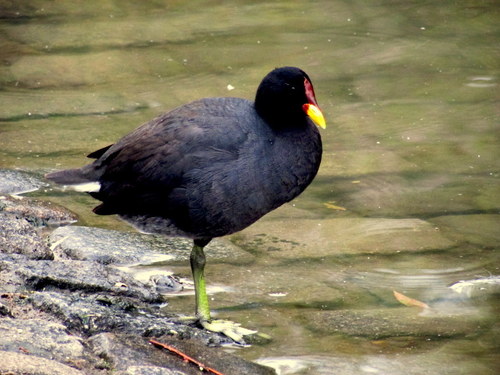
The red-gartered coot is 43 to 51 cm (17 to 20 in) long. The sexes are alike. Adults have a yellow bill and frontal shield with a patch of red between them. (The bill is sometimes reddish.) Their legs are orange-yellow to yellow with a pale red "garter" above the ankle. Their plumage is slaty gray that is blacker on the head and neck. Their undertail coverts are white. Immature birds have a paler bill than adults and olive legs and feet. Juveniles are drab gray-brown with dusky mottling on a white head and neck.

The red-gartered coot is found from central and southern Chile, Paraguay, and southeastern Brazil south through Argentina to Tierra del Fuego. It has reached the Falkland Islands as a vagrant, and sight records in Bolivia lead the South American Classification Committee of the American Ornithological Society to classify it as hypothetical in that country. Fossils... Wikipedia →

Sounds

Song0:10

Brazil · 2020

© JAYRSON ARAUJO DE OLIVEIRA · XC528388 · CC BY-NC-SA 4.0

Call0:10

Chile · 2018

© Peter Boesman · XC449930 · CC BY-NC-ND 4.0

Alarm call0:14

Chile · 2010

© Daniel González Amat · XC45449 · CC BY-NC-ND 2.5

Global Distribution

Parks Where Found

# Park Country Daily sighting probability
1 Torres del Paine National Park 🇨🇱 Chile
~50%
2 Nahuel Huapi National Park 🇦🇷 Argentina
~20%
3 Tijuca National Park 🇧🇷 Brazil
~10%
4 Vicente Pérez Rosales National Park 🇨🇱 Chile
<5%

Cities Where Found

# City Country Daily sighting probability
1 Buenos Aires 🇦🇷 Argentina
~20%
2 Montevideo 🇺🇾 Uruguay
~20%
3 Cordoba 🇦🇷 Argentina
~10%
4 Rio de Janeiro 🇧🇷 Brazil
~10%
5 Santiago 🇨🇱 Chile
<5%

Zoos & Centres Where Found

# Zoo / Centre Country
1 Zoológico de Concepción 🇨🇱 Chile In captivity

Before you go

What are the chances of seeing a Red-gartered Coot in Buenos Aires?

Possible

About 20% of wildlife watchers report a Red-gartered Coot sighting in Buenos Aires on a given day, based on 3,265 verified sightings from GBIF citizen-science data. It is the 62nd most-seen of the 274 birds we can rate there. Over three days the chance rises to about 50%, and over a week to about 80%, if each day is a fresh chance.

When is the best time to see a Red-gartered Coot in Buenos Aires?

March

In that month about 30% of wildlife watchers report a Red-gartered Coot in Buenos Aires on a given day, against about 20% in April to February, the lowest months.

What time of day is best to see a Red-gartered Coot?

Between 2 and 5 pm

Across all the parks we cover, that three-hour window holds the most Red-gartered Coot sightings with a recorded time, and about 9 in 10 of them come between 6 am and 6 pm: it is a daytime animal.

Is Buenos Aires the best place to see a Red-gartered Coot?

Yes

Of the 5 cities where we can rate Red-gartered Coot sightings, Buenos Aires has the highest daily chance: about 20%. Next come Montevideo (Uruguay, about 20%) and Cordoba (Argentina, about 10%).

Which relatives of the Red-gartered Coot live in Buenos Aires?

Same genus: Fulica

The closest relatives of the Red-gartered Coot that you can see in Buenos Aires (genus Fulica, Coots) are White-winged Coot (about 20%) and Red-fronted Coot (about 20%), with each one's daily chance of a sighting.

Where does the Red-gartered Coot sighting chance come from?

GBIF citizen-science records

It is estimated from how often the Red-gartered Coot is recorded against all the birds logged in Buenos Aires (3,265 verified sightings), calibrated against known sighting rates. Figures are rounded to the nearest 10% because citizen-science data supports honest approximations, not decimals, and months with records from fewer than five people show "—". How it works.

← Back to Buenos Aires