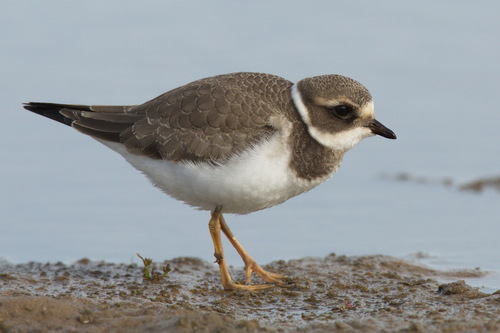
Senegal Thick-knee

Senegal Thick-knee

Burhinus senegalensis

Silhouette: Auckland Museum · PhyloPic

LCLeast ConcernNTVUENCR
Daily sighting probability ~10% · With luck
at Cairo

In 3 days ~40% in a week ~70%

52 Verified sightings at Cairo
545 In all 6 parks From 2019 to 2026
April Best month
☀️ Diurnal When it's spotted

About the Senegal Thick-knee

The Senegal thick-knee (Burhinus senegalensis) is a stone-curlew, a group of waders in the family Burhinidae. Their vernacular scientific name refers to the prominent joints in the long yellow or greenish legs. It is a resident breeder in Africa between the Sahara and the equator, and in the Nile valley.

Senegal thick-knees are medium-large waders with strong black and yellow black bills, large yellow eyes — which give them a reptilian appearance — and cryptic plumage. They are similar but slightly smaller than the Eurasian stone-curlew, which winters in Africa. The long dark bill, single black bar on the folded wing, and darker cheek stripe are distinctions from the European species. Senegal thick-knee is striking in flight, with a broad white wing bar.

This species has a preference for dry open habitats with some bare ground, preferably near water. It lays two blotchy light brown eggs on a ground scrape. It is most active at dawn and dusk. The song is a loud pi-pi-pi-pi-pi-pi-pi.

Food is insects, crustaceans and other invertebrates. It will also take other small prey. The field characters... Wikipedia →

Sounds

Call0:16

Ethiopia · 2026

© He Wenjin/文进 · XC1073895 · CC BY-NC-SA 4.0

Song0:42

Senegal · 2024

© Frank Lambert · XC1041324 · CC BY-NC-ND 4.0

Nocturnal flight call0:09

Senegal · 2023

© Christian Kerihuel · XC780487 · CC BY-NC-SA 4.0

Global Distribution

Parks Where Found

# Park Country Daily sighting probability
1 Niokolo-Koba National Park 🇸🇳 Senegal
~50%
2 Murchison Falls National Park 🇺🇬 Uganda
~20%
3 Awash National Park 🇪🇹 Ethiopia
~10%
4 Virunga National Park 🇨🇩 Democratic Republic of the Congo
<5%
5 Lake Mburo National Park 🇺🇬 Uganda
<5%
6 Queen Elizabeth National Park 🇺🇬 Uganda
<5%

Cities Where Found

# City Country Daily sighting probability
1 Accra 🇬🇭 Ghana
~50%
2 Serrekunda 🇬🇲 Gambia
~30%
3 Dakar 🇸🇳 Senegal
~30%
4 Cairo 🇪🇬 Egypt
~10%
5 Luxor 🇪🇬 Egypt
~10%
6 Lagos 🇳🇬 Nigeria
~10%
7 Abuja 🇳🇬 Nigeria
<5%

Before you go

What are the chances of seeing a Senegal Thick-knee in Cairo?

With luck

About 10% of wildlife watchers report a Senegal Thick-knee sighting in Cairo on a given day, based on 52 verified sightings from GBIF citizen-science data. It is the 37th most-seen of the 92 birds we can rate there. Over three days the chance rises to about 40%, and over a week to about 70%, if each day is a fresh chance.

When is the best time to see a Senegal Thick-knee in Cairo?

April and June

In those months about 30% of wildlife watchers report a Senegal Thick-knee in Cairo on a given day, against under 5% in March, the lowest month.

What time of day is best to see a Senegal Thick-knee?

Between 10 am and 1 pm

Across all the parks we cover, that three-hour window holds the most Senegal Thick-knee sightings with a recorded time, and about 8 in 10 of them come between 6 am and 6 pm: it is a daytime animal.

Is Cairo the best place to see a Senegal Thick-knee?

4th of 7

Of the 7 cities where we can rate Senegal Thick-knee sightings, Cairo ranks 4th at about 10%. The best odds are in Accra (Ghana, about 50%), Serrekunda (Gambia, about 30%) and Dakar (Senegal, about 30%).

Which relatives of the Senegal Thick-knee live in Cairo?

Same order: Charadriiformes

The closest relatives of the Senegal Thick-knee that you can see in Cairo (order Charadriiformes, Shorebirds and Allies) are Spur-winged Lapwing (about 50%), Whiskered Tern (about 30%) and Black-headed Gull (about 10%), with each one's daily chance of a sighting.

Where does the Senegal Thick-knee sighting chance come from?

GBIF citizen-science records

It is estimated from how often the Senegal Thick-knee is recorded against all the birds logged in Cairo (52 verified sightings), calibrated against known sighting rates. Figures are rounded to the nearest 10% because citizen-science data supports honest approximations, not decimals, and months with records from fewer than five people show "—". How it works.

← Back to Cairo