Rohan's Globular Frog

Rohan's Globular Frog

Uperodon rohani

Silhouette: PhyloPic

LCLeast ConcernNTVUENCR Endemic
Daily sighting probability ~10% · With luck
at Colombo [Sri Jayawardenepura Kotte]

In 3 days ~20% in a week ~40%

5 Verified sightings at Colombo [Sri Jayawardenepura Kotte]
40 In all 2 parks From 2019 to 2026
April Best month
🌅 Crepuscular When it's spotted

About the Rohan's Globular Frog

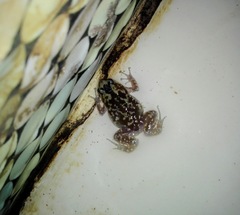
Uperodon rohani, commonly known as Rohan's globular frog, is a species of Microhylid frog. It is endemic to Sri Lanka. It was named after scientist Rohan Pethiyagoda, known for his works on Sri Lankan fishes and amphibians, among others.

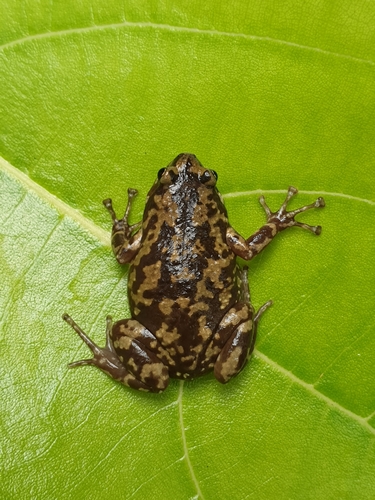
It was previously considered conspecific with Uperodon variegatus, but was separated in 2018. The genetic difference between them is large, around 2.8%. It is a small frog, typically around 26–34 millimetres (2.6–3.4 cm) long in males and 28–35 millimetres (2.8–3.5 cm) in females. It is maroon with slightly pale olive yellow spots, blotches and streaks. Near its belly and thigh there are densely packed olive speckles. It has a partially translucent foot and ankle.

It is found throughout Sri Lanka, but is most abundant in the lowlands. It is found in wet environments, such as ponds and puddles. It regularly interacts with humans, being common in water bodies and reservoirs, agricultural land such as paddyfields, and moist locations within houses and buildings, such as bathrooms. Wikipedia →
Global Distribution

Parks Where Found

# Park Country Daily sighting probability
1 Wilpattu National Park 🇱🇰 Sri Lanka
~40%
2 Minneriya National Park 🇱🇰 Sri Lanka
~30%

Cities Where Found

# City Country Daily sighting probability
1 Colombo [Sri Jayawardenepura Kotte] 🇱🇰 Sri Lanka
~10%

Before you go

What are the chances of seeing a Rohan's Globular Frog in Colombo [Sri Jayawardenepura Kotte]?

With luck

About 10% of wildlife watchers report a Rohan's Globular Frog sighting in Colombo [Sri Jayawardenepura Kotte] on a given day, based on 5 verified sightings from GBIF citizen-science data. It is the 7th most-seen of the 7 amphibians we can rate there. Over three days the chance rises to about 20%, and over a week to about 40%, if each day is a fresh chance.

When is the best time to see a Rohan's Globular Frog in Colombo [Sri Jayawardenepura Kotte]?

January–April and August

In those months about 10% of wildlife watchers report a Rohan's Globular Frog in Colombo [Sri Jayawardenepura Kotte] on a given day, against under 5% in May–July and September–December, the lowest months.

What time of day is best to see a Rohan's Globular Frog?

Between 3 and 6 pm

Across all the parks we cover, that three-hour window holds the most Rohan's Globular Frog sightings with a recorded time, and about 6 in 10 of them come between 6 am and 6 pm: it is most active around dawn and dusk.

Where else can you see a Rohan's Globular Frog?

Only Colombo [Sri Jayawardenepura Kotte], in our data

Colombo [Sri Jayawardenepura Kotte] is the only city on Wallace's Line with enough records to rate Rohan's Globular Frog sightings: about 10% of wildlife watchers there report one on a given day.

Where does the Rohan's Globular Frog sighting chance come from?

GBIF citizen-science records

It is estimated from how often the Rohan's Globular Frog is recorded against all the amphibians logged in Colombo [Sri Jayawardenepura Kotte] (5 verified sightings), calibrated against known sighting rates. Figures are rounded to the nearest 10% because citizen-science data supports honest approximations, not decimals, and months with records from fewer than five people show "—". How it works.

← Back to Colombo [Sri Jayawardenepura Kotte]