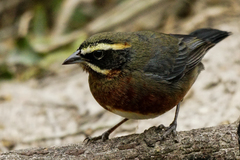
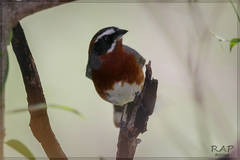
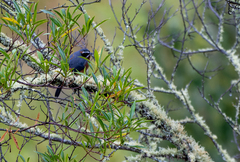
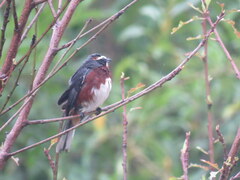

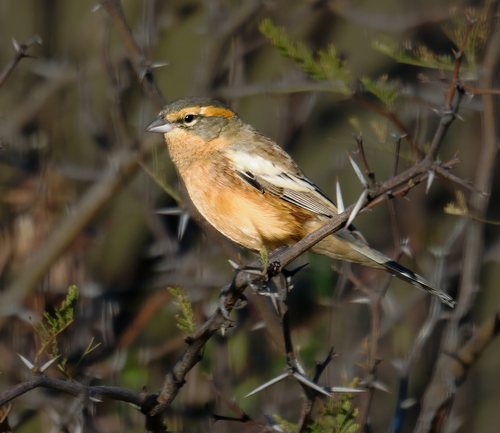
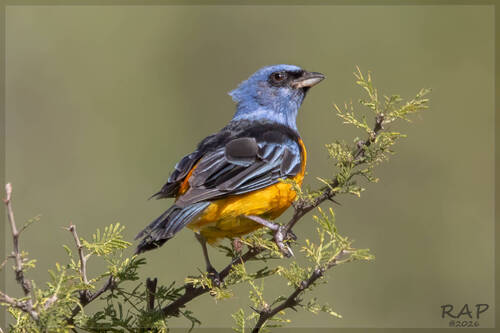
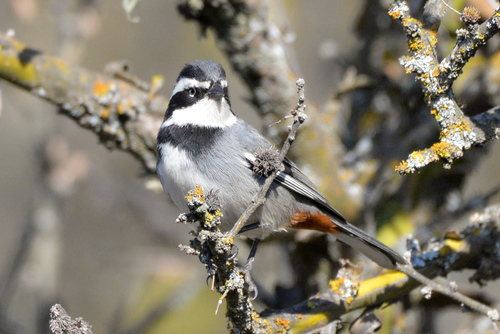
Black-and-chestnut Warbling-Finch (Black-and-chestnut)

Black-and-chestnut Warbling-Finch (Black-and-chestnut)

Poospiza whitii

Silhouette: Sheatherius · PhyloPic

LCLeast ConcernNTVUENCR
Daily sighting probability ~10% · With luck
at Cordoba

In 3 days ~20% in a week ~30%

126 Verified sightings at Cordoba
February Best month
☀️ Diurnal When it's spotted

About the Black-and-chestnut Warbling-Finch (Black-and-chestnut)

The black-and-chestnut warbling finch (Poospiza whitii) is a species of bird in the tanager family Thraupidae. It is found on the slopes of the Andes in western Argentina and western Bolivia. Its natural habitats are woodland borders and hedgerows.

The black-and-chestnut warbling finch was formally described in 1883 by the English zoologist Philip Sclater under the current binomial name Poospiza whitii. The specific epithet was chosen to honour Ernest William White who had collected the specimen. The type locality is Cosquín, Córdoba in Argentina.

This species was formerly considered conspecific with the black-and-rufous warbling finch. The taxa were split based on molecular genetic and phenotypic data. The species is monotypic: no subspecies are recognised. Wikipedia →

Sounds

Call0:18

Bolivia · 2013

© Andrew Spencer · XC189909 · CC BY-NC-SA 3.0

Song0:12

Argentina · 2003

© Carlos Ferrari · XC53155 · CC BY-NC-ND 2.5

Song0:33

Argentina · 1984

© Niels Krabbe · XC16000 · CC BY-NC-SA 3.0

Global Distribution

Parks Where Found

# Park Country Daily sighting probability

More parks will be added in future updates.

Cities Where Found

# City Country Daily sighting probability
1 Cordoba 🇦🇷 Argentina
~10%

Before you go

What are the chances of seeing a Black-and-chestnut Warbling-Finch (Black-and-chestnut) in Cordoba?

With luck

About 10% of wildlife watchers report a Black-and-chestnut Warbling-Finch (Black-and-chestnut) sighting in Cordoba on a given day, based on 126 verified sightings from GBIF citizen-science data. It is the 68th most-seen of the 176 birds we can rate there. Over three days the chance rises to about 20%, and over a week to about 30%, if each day is a fresh chance.

When is the best time to see a Black-and-chestnut Warbling-Finch (Black-and-chestnut) in Cordoba?

January–March, May–August and November

In those months about 10% of wildlife watchers report a Black-and-chestnut Warbling-Finch (Black-and-chestnut) in Cordoba on a given day, against under 5% in April, September–October and December, the lowest months.

What time of day is best to see a Black-and-chestnut Warbling-Finch (Black-and-chestnut)?

Between 8 and 11 am

Across all the parks we cover, that three-hour window holds the most Black-and-chestnut Warbling-Finch (Black-and-chestnut) sightings with a recorded time, and about 8 in 10 of them come between 6 am and 6 pm: it is a daytime animal.

Where else can you see a Black-and-chestnut Warbling-Finch (Black-and-chestnut)?

Only Cordoba, in our data

Cordoba is the only city on Wallace's Line with enough records to rate Black-and-chestnut Warbling-Finch (Black-and-chestnut) sightings: about 10% of wildlife watchers there report one on a given day.

Where does the Black-and-chestnut Warbling-Finch (Black-and-chestnut) sighting chance come from?

GBIF citizen-science records

It is estimated from how often the Black-and-chestnut Warbling-Finch (Black-and-chestnut) is recorded against all the birds logged in Cordoba (126 verified sightings), calibrated against known sighting rates. Figures are rounded to the nearest 10% because citizen-science data supports honest approximations, not decimals, and months with records from fewer than five people show "—". How it works.

← Back to Cordoba